
How to Find a Grief Counselor (and What to Expect)
- Category: General
- November 2, 2026
Key takeaways
- Grief counselors are licensed mental health professionals who specialize in bereavement.
- You may benefit from grief counseling if you’ve experienced any type of loss. This includes the death of a parent, friend, partner, or pet; a miscarriage or pregnancy loss; a serious diagnosis for yourself or a loved one; divorce or job loss; and more.
- There’s no “right” way to grieve, and working with a grief counselor can help you understand this — and your personal grieving process — better.
I am a big fan of grief counseling, because it changed my life. When I was in grad school, my housemate died. Of course, it was a tragic and shocking experience, but my assignments and research and rent didn’t stop — it didn’t occur to me at the time to see a professional. Luckily, my university had a policy to refer students to grief counseling. If it wasn’t for that system, I’m not sure I would’ve ever made an appointment to see a grief counselor, nor where I’d be today.
My mindset at the time was that everyone goes through loss — it’s part of being human. Grieving is a natural reaction to loss, not necessarily a disorder, so why should I deserve to have therapy for that? It’s true that grief is natural, but that doesn’t make it any less painful. In hindsight, I’d argue back: why should the fact that grief is “normal” prevent you from receiving support?
A couple months after my loss, I showed up to my first grief counseling appointment, backpack in tow. What ensued, for me, was a deep learning experience. Those initial six sessions turned into years of therapy that helped me grow as a person. It turns out that yes, grief is natural, but it’s also different for everyone. Grief can also compound over time, tangling with previous losses and exacerbating mental health conditions.
Years later, I’m so grateful to my younger self for the vulnerability and bravery it took to show up to that first grief counseling session. But because of my experience, I also know firsthand that the very people who could most benefit from grief counseling often aren’t aware of it, don’t know how to find a grief counselor, or don’t think their grief is “bad enough” (or recent enough, or big enough, or whatever enough) to deserve help.
If you’re reading this article, chances are you’re already curious about what a grief counselor is, and what to expect at your first appointment. Let’s break it down together, so you can decide for yourself what your next steps will be.
What is a grief counselor?
A grief counselor is a mental health professional who specializes in grief and bereavement. They help people process loss, rather than “get over” it.
Several different licensed professionals can be grief counselors. You may see credentials like:
- Licensed professional counselor (LPC)
- Licensed clinical social worker (LCSW)
- Licensed marriage and family therapist (LMFT)
- Licensed mental health counselor (LMHC)
- Psychologist (PsyD)
There are also grief-specific certifications that your counselor may have in addition to their professional license. Some examples include:
- Certified grief counselor
- Certified grief therapist
- Certified grief recovery specialist
Countless types of loss and grief are part of the human experience. A grief counselor can help with any number of these. Some types of loss you might experience include:
- Death of a loved one
- Miscarriage or pregnancy loss
- Divorce
- Job loss
- Serious diagnosis
- Loss of a pet
- And more
Grief counseling is about receiving support and learning coping tools as you work through the grieving process—it’s not focused on a diagnosis. Saying that, your clinician may still screen you for anxiety, depression, post-traumatic stress disorder (PTSD), and other relevant conditions.
“Grief is spectacularly non-linear,” says Mark Goodman, LCSW, a therapist at Headlight. “That is to say, one moment you may feel like you ‘have it figured out’ and then later that day it feels so raw again. Doing the ‘work of grief’ is to show up for yourself, again and again, when it feels like everything is falling apart.”
Grief counselor vs. grief therapist vs. support group
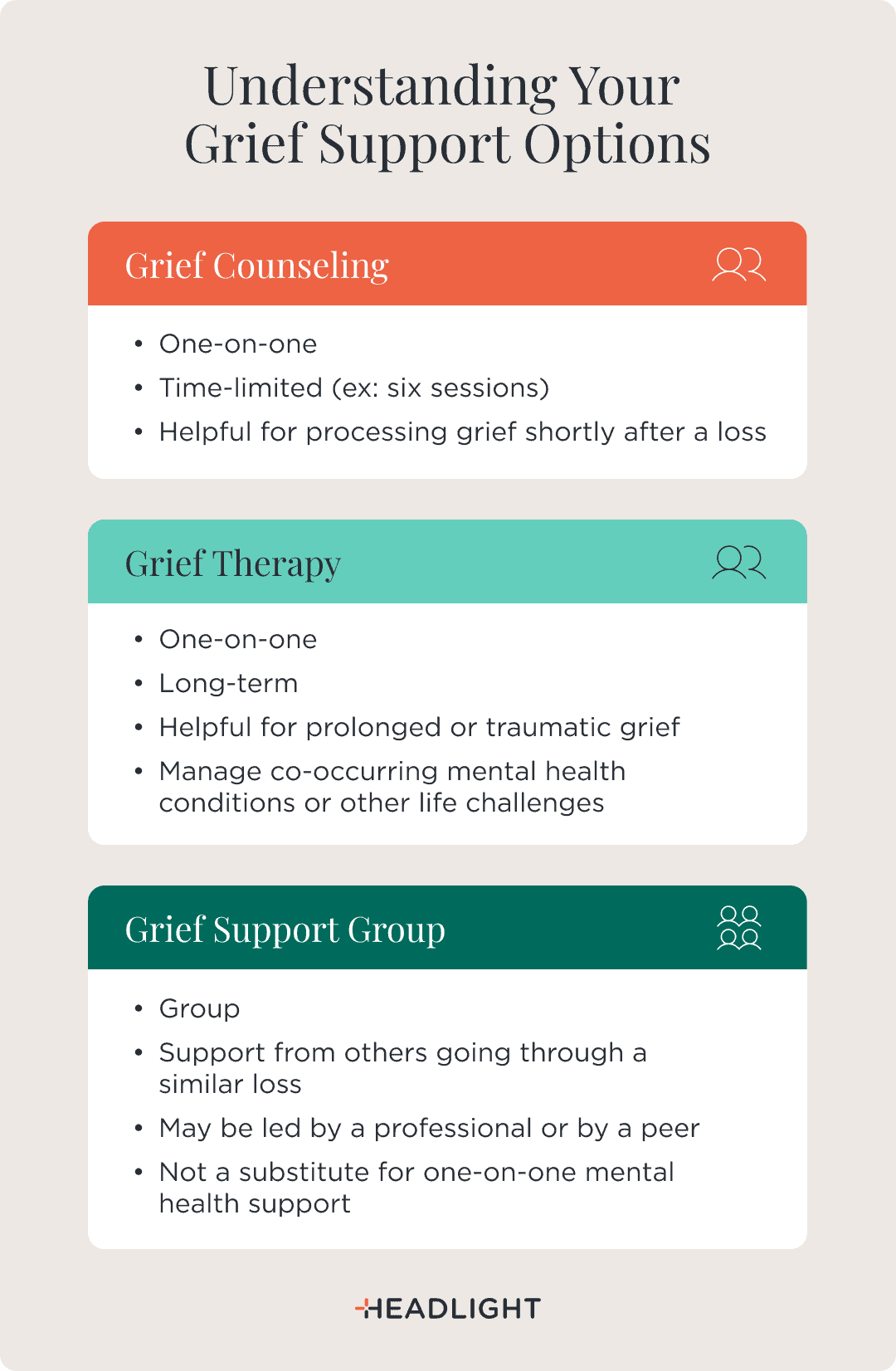
A grief counselor isn’t necessarily the same as a grief therapist or a support group, but all of these mental health resources may benefit you if you’ve experienced a loss.
“A grief counselor offers time limited, brief interventions,” explains Goodman. This might look like a single visit or several visits, often shortly after a loss. On the other hand: “A grief therapist can help address more complex grief that is not time limited,” he says.
Some people, including myself, start with grief counseling and then transition to longer term work with grief therapy. Grief therapy can be beneficial if you’re dealing with prolonged or traumatic grief, or managing co-occurring mental health conditions or other challenges in your life.
Ultimately, the label (counseling vs. therapy) doesn’t matter as much as your clinician’s training and your personal fit.
Many people also benefit from processing their grief in community with others who’ve been through a similar loss. Support groups are a wonderful supplement to ongoing counseling or therapy.
“Processing the complexity of grief and how it is intertwined with trauma can take time, courage, and patience, so be sure to practice self-compassion with your grief,” says Goodman.
Signs it may be time to see a grief counselor
How do you know it’s time to see a grief counselor or therapist? Well, the simple answer is that anyone who’s experienced a loss can benefit from grief counseling. You don’t have to wait until you’re falling apart to deserve support.
Not everyone is so proactive about seeing a grief counselor after a loss, though, and that’s understandable. So many things follow a loss: overwhelming emotion, increased responsibilities, and just keeping up with your day-to-day. Mental health support might fall to the bottom of your list. You might convince yourself that you’re not struggling “enough” to need support. On the flip side, you might be scared that counseling will open up the dam of your pain.
Again, there is no right or wrong time to reach out for support after a loss. Some people start immediately after the loss, and others seek help years later.
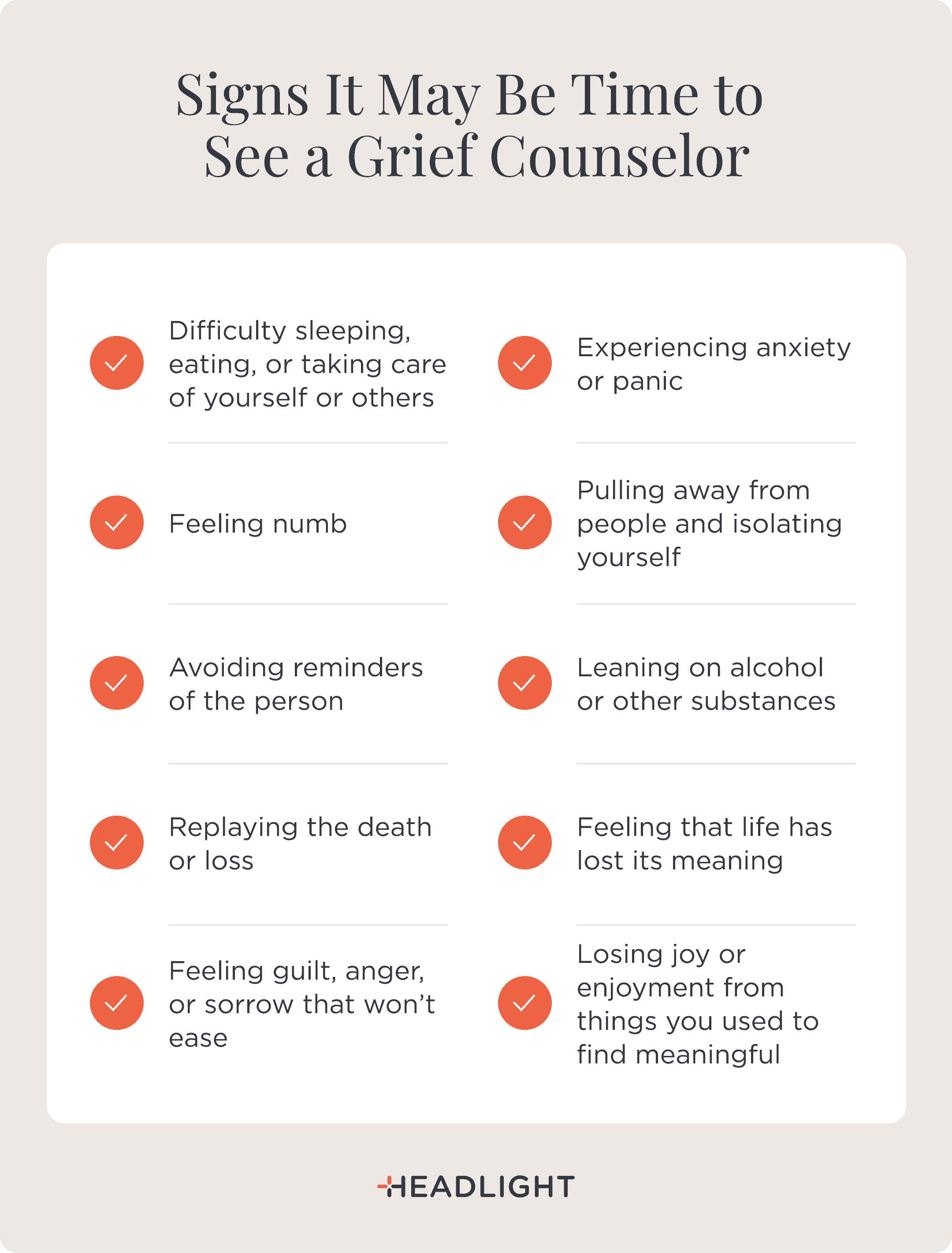
Some signs that it may be time to see a grief counselor include:
- Grief that is making it hard to work, sleep, eat, or take care of yourself or others
- Feeling numb
- Avoiding reminders of the person
- Replaying the death or loss
- Feeling guilt, anger, or sorrow that won’t ease
- Experiencing anxiety or panic
- Pulling away from people and isolating yourself
- Leaning on alcohol or other substances
- Feeling that life has lost its meaning
- Losing joy or enjoyment from things you used to find meaningful
And remember, if you ever experience suicidal ideation, or have thoughts of simply not wanting to be here anymore, you can call or text 988 (the Suicide & Crisis Lifeline) for 24/7 support.
How to find a grief counselor: a step-by-step approach
There’s no single “right” way to find a grief counselor, but the following steps may help you.
Step 1: Clarify what you need.
Your first step is to consider what you need and want out of a grief counselor. Some things to consider:
- Your type of loss, and whether it matters to you if the counselor specializes in that
- In-person vs online sessions
- A counselor who shares your faith or cultural background
- Language
- How often you can meet
Knowing your preferences and non-negotiables can guide the rest of your search.
Step 2: Ask for referrals.
If you’re looking for a grief counselor near you, a referral can help you narrow down what services are available to you.
The following professionals and groups may provide referrals to local grief counselors:
- Primary care clinician
- Hospice agency
- Hospital bereavement program
- Funeral home
- Faith leader
- University
- Employer
- Friends who have experienced a previous loss
Step 3: Search online and in directories.
In recent years, teletherapy has become available, making high-quality mental healthcare accessible as long as you have a reliable internet connection.
Headlight offers both in-person and online therapy, where a care coordinator matches you with a clinician, including those specialized in grief.
You can also search online directories for a grief counselor. Most insurance programs have a directory of approved providers. “Psychologytoday.com does a fairly good job identifying local grief resources, and is available wherever you live,” adds Goodman.
Step 4: Check credentials.
Once you’ve found a counselor or have a short list, take a moment to check their credentials. You might confirm they have a current state license, or ask specifically about grief and bereavement training or prior experience.
Step 5: Confirm cost and insurance before the first session.
You’ll want to ensure the counselor you plan to see is covered by your insurance, or otherwise affordable. Many insurance plans cover therapy with a licensed clinician.
If you choose to see a grief counselor through Headlight, know that your insurance coverage is always verified before the first session, so there are no surprises.
There are also free and low-cost options, through programs such as:
- Hospice bereavement programs
- Charities related to the type of loss
- University services or training clinics
- Employee assistance programs
- Community and faith-based support groups
Step 6: Book a first session or consultation.
Finally, it’s time to book your first session with your grief therapist. Try to look at this as a fit check, rather than a long-term commitment.
“Like any healthcare resource, it’s important that you feel comfortable and are experiencing rapport with your therapist,” says Goodman. “This feeling of being seen is more important than the therapist’s specialty on paper.”
Questions to ask a grief counselor before or during your first session
Before you schedule your first session with a grief counselor, it’s acceptable to send their office some questions. These can help you figure out if you’re a good fit.
Some questions you might ask include:
- Have you worked with people who lost someone the way I did? (Ex: sudden loss, suicide, long illness, child, parent, partner, etc.)
- How do you approach grief work, and what does a typical session look like?
- How long are sessions?
- How often do we meet?
- How will we know when I’m ready to stop?
- What do you charge, and are you in-network with my insurance plan?
- Do you offer in-person or virtual sessions?
- What happens if I feel we are not a good fit?
A good counselor will welcome these questions and answer them respectfully.
“When you call a therapist, remember that you are interviewing them too,” says Angela Schellenberg, LMHC, LPC, LPCC, a grief and trauma therapist. “Ask about their experience with your type of loss. Notice whether they seem rushed. Notice how you feel talking to them. Do you feel like yourself, or do you already feel like you are performing?”
If you sense any red flags from their answers, it may be time to move on to the next counselor on your list.
Your first session
Think of your first session as a gentle intro where you can feel out your counselor’s vibe and open up as much as you’re comfortable with. Here’s what you can expect at a typical first grief counseling session:
- Intake paperwork, including filling out surveys or measures relating to your grief and mental health.
- Open-ended questions such as “what brings you in?” or “tell me about the person you lost.”
- A review of your history, including the physical and mental effects of grief.
- Questions about your sleep, appetite, mood, support at home, and safety.
- Explanation of the therapist’s approach to grief work.
- Goal setting together. It’s also fine if you don’t know what you need yet.
It’s normal to cry during or after therapy, but it’s equally fine if you don’t cry. It’s also common to feel drained, or feel relief.
What to expect from grief counseling
Grief counseling is an individual therapy. Sessions take place in a private space, one-on-one with a licensed counselor. You’ll have the opportunity to talk about the person you lost, the circumstances of the loss or death, and how you’re functioning now. This all happens at your own pace, and you’re welcome to discuss anything else going on in your life — after all, everything is interconnected to your loss in some way.
“I lost both of my parents young, and I did what a lot of people do. I stayed busy,” says Schellenberg. “What I learned over time was that the grief was still there. So when someone comes into my office terrified that if they start talking they are going to completely fall apart, I want them to know they don’t have to fix anything for me. I can sit with it.”
Each therapist will have a slightly different approach, and they may also tailor their approach to what suits you best. Some approaches include:
- Talk-based support
- Cognitive behavioral techniques for guilt and rumination
- Acceptance and commitment strategies
- Meaning-making, continuing-bonds, and attachment trauma work
- Eye movement desensitization and reprocessing (EMDR) for traumatic loss
- Animal-assisted therapy
Between sessions, you may be asked to complete “homework.” This might include journaling, writing a letter to the person, practicing a coping skill, or something else.
How long does grief counseling take?
How long does grief counseling take? How long is a piece of string? There’s no universal answer here, because grief is different for everyone.
Some bereavement counseling programs can be time-limited, especially if they’re provided through organizations like universities or charities. It could be anywhere from one to 20 sessions, but there’s no set number and will depend on the individual program.
Grief therapy, on the other hand, is a more open-ended type of work. Therapy can support you as you continue along your grief journey, especially if you’re dealing with prolonged grief, or want to support your general mental health as time goes on and the ways grief intertwines with life’s challenges evolve.
“There is no expiration date on this work,” says Schellenberg. “I have sat with people decades after a loss whose grief was very much still alive. It was still something we could work with.”
It’s common to have weekly sessions early on, with sessions spacing out to biweekly or monthly as coping improves. It’s also normal to start grief counseling or therapy (or return to it) around anniversaries of your loss, during the holidays, or perhaps if a new loss or life event opens the wound of a previous loss.
How to tell if grief counseling is working (and when to switch)
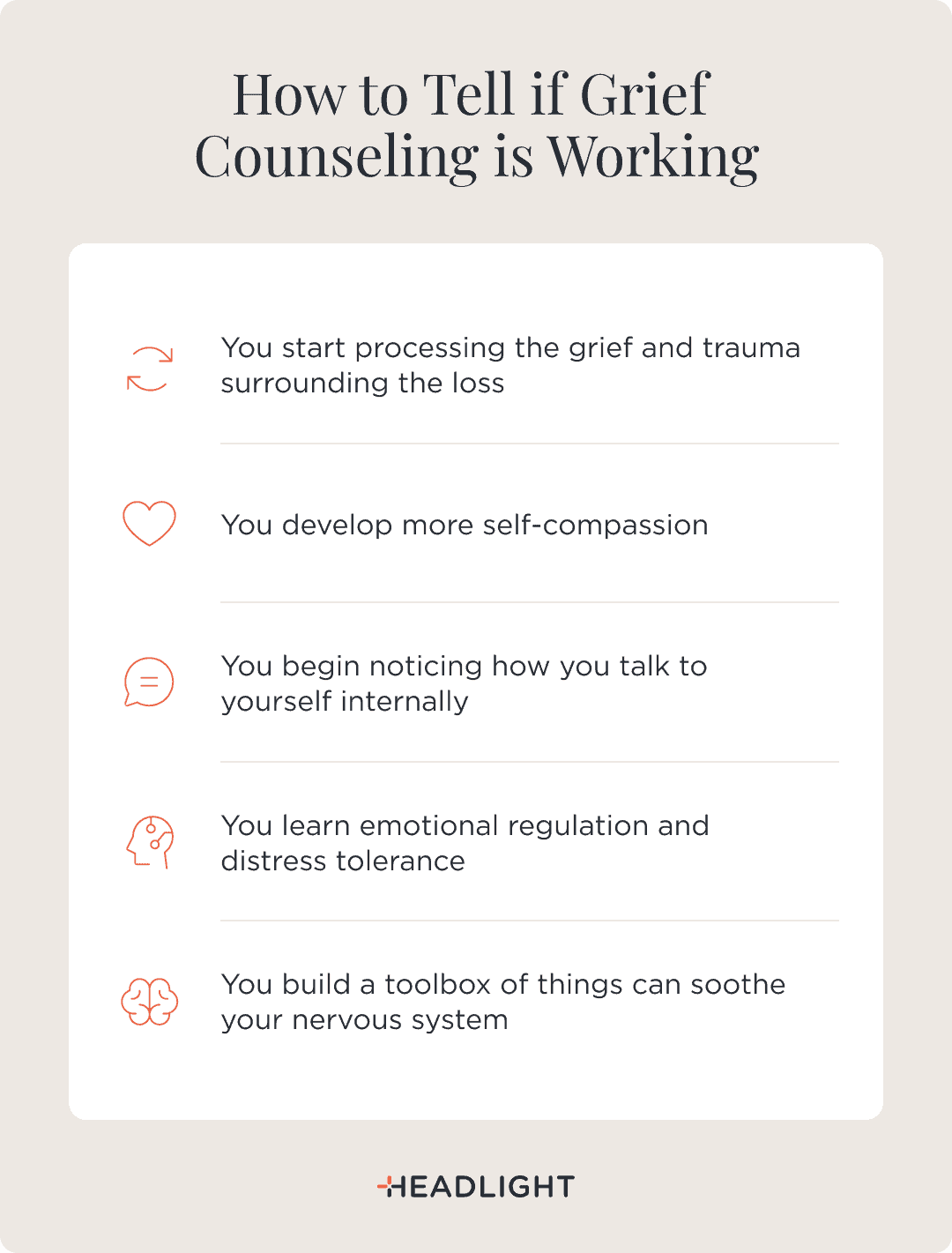
There’s no correct way that you “should” grieve — and a big part of grief counseling is acknowledging and embracing that. There are several other signs that grief counseling is “working:”
- You start processing the grief and trauma surrounding the loss
- You develop more self-compassion
- You begin noticing how you talk to yourself internally
- You learn emotional regulation and distress tolerance
- You build a toolbox of things can soothe your nervous system
“For me, progress isn’t measured by whether someone stops being sad,” says Schellenberg. “I look at capacity.” For instance:
- Can you carry the sadness and still function?
- Can you sleep?
- Can you work?
- Can you laugh without immediately feeling guilty?
- Can you look at a photograph of the person you lost?
- Can you say your person’s name?
- Can you recognize when your nervous system is becoming overwhelmed and know what might help?
“Part of the work is learning that you can have more than one feeling at the same time,” Schellenberg explains. “You can be deeply sad and still laugh. You can miss someone and have a wonderful day… Having one feeling doesn’t cancel out the other.”
Remember that it’s also okay to switch counselors if you don’t feel like you’re making progress. Try to give each counselor two to three sessions before you judge the fit, unless something feels clearly wrong. Some signs you might benefit from seeing a different counselor or therapist include:
- Feeling rushed
- Being told how you should feel or by when
- A counselor who avoids talking about the death or loss
- No sense of connection with the counselor after several sessions
Finding grief support at Headlight
If you’ve experienced a loss, reach out to Headlight. A care coordinator will match you to a therapist experienced in grief and loss, for either in-person or virtual sessions.
The care coordinator will also help check your insurance coverage before the first session. Headlight is in-network with most major insurance plans, and files claims for clients.
As a current Headlight client, it’s also easy to get support and switch therapists, if you feel that you’re not connecting with your current one.
Psychiatric care is available alongside therapy, in case grief has brought on depression, anxiety, or sleep problems that medication could help.
If you’re in crisis and need immediate mental health support, call or text 988 at any time to contact the Suicide and Crisis Lifeline.
Frequently asked questions (FAQs)
What type of counselor is best for grief?
The best type of counselor for grief is a licensed clinician (LCSW, LMFT, LPC, PsyD, etc.) who you feel that you work well with. You’ll also want to check that the clinician is in-network with your insurance, and see if they have any additional training or experience in your type of loss.
Can grief counseling really help?
Yes, grief counseling can help. It’s useful to process the complicated emotions of grief with a supportive professional. People experiencing prolonged or complicated grief can also benefit from ongoing grief therapy.
When should you start grief counseling?
There’s no perfect time to start grief counseling. Some people benefit from starting grief counseling shortly after their loss, and working through the initial stages of grief with a supportive counselor. Other people begin grief counseling months or years after their loss.