
How to Love an Avoidant Partner Without Losing Yourself
- Category: General
- October 12, 2026
Key takeaways
- An avoidant partner might appear fiercely independent, maintain surface-level connection, have difficulty trusting others, and struggle with communication, making relationships challenging.
- A relationship with an avoidant partner can be confusing, especially when they withdraw during times of connection or conflict.
- Although it’s not your responsibility to fix anyone or overlook relationship patterns that don’t meet your needs, you can learn how to communicate with your partner in a way that makes you both feel safer and more secure.
Conflict. Problems with communication. Things left unsaid. Resentment. These things can all bubble up to the surface to derail a relationship. But when you have a partner with an avoidant attachment style, you may struggle with how they keep you at arm’s distance emotionally while still being adamant that they want to be with you.
Consequently, you might feel confused by the closeness-distance cycle, alone in your attempts to resolve problems, or struggling with how your own needs aren’t being met.
If you can relate, this article is for you. Better understanding how to deal with an avoidant attachment partner can build compassion for their point-of-view and help bridge the divide between your communication styles.
Attachment styles describe relationship patterns, and they are not mental health diagnoses. Therapy can be a great resource to help support a more secure relationship pattern. On an individual level, seeing a professional can also help assess whether these challenges are the result of an attachment communication pattern — or if they’re something more.
How To Deal With an Avoidant Attachment Partner Without Abandoning Yourself
You two are in this together. It’s not up to you to chase, fix, or over-accommodate your partner. However, at this point, you might feel lost. That makes sense. “Being in a relationship with someone who has an avoidant attachment style can be very confusing,” says licensed marriage and family therapist Leanne Greenberg, LMFT. “Because they have developed firm emotional boundaries, you may find that they withdraw right at moments of connection, leaving those around them feeling hurt, rejected, or anxious,” she says.
You can learn to come together in a way that respects your partner’s desire for autonomy while honoring your own emotional needs. And so while you can’t control your partner, you can work on yourself by improving your own communication style, establishing boundaries, developing emotional regulation skills, and making choices that are best for you.
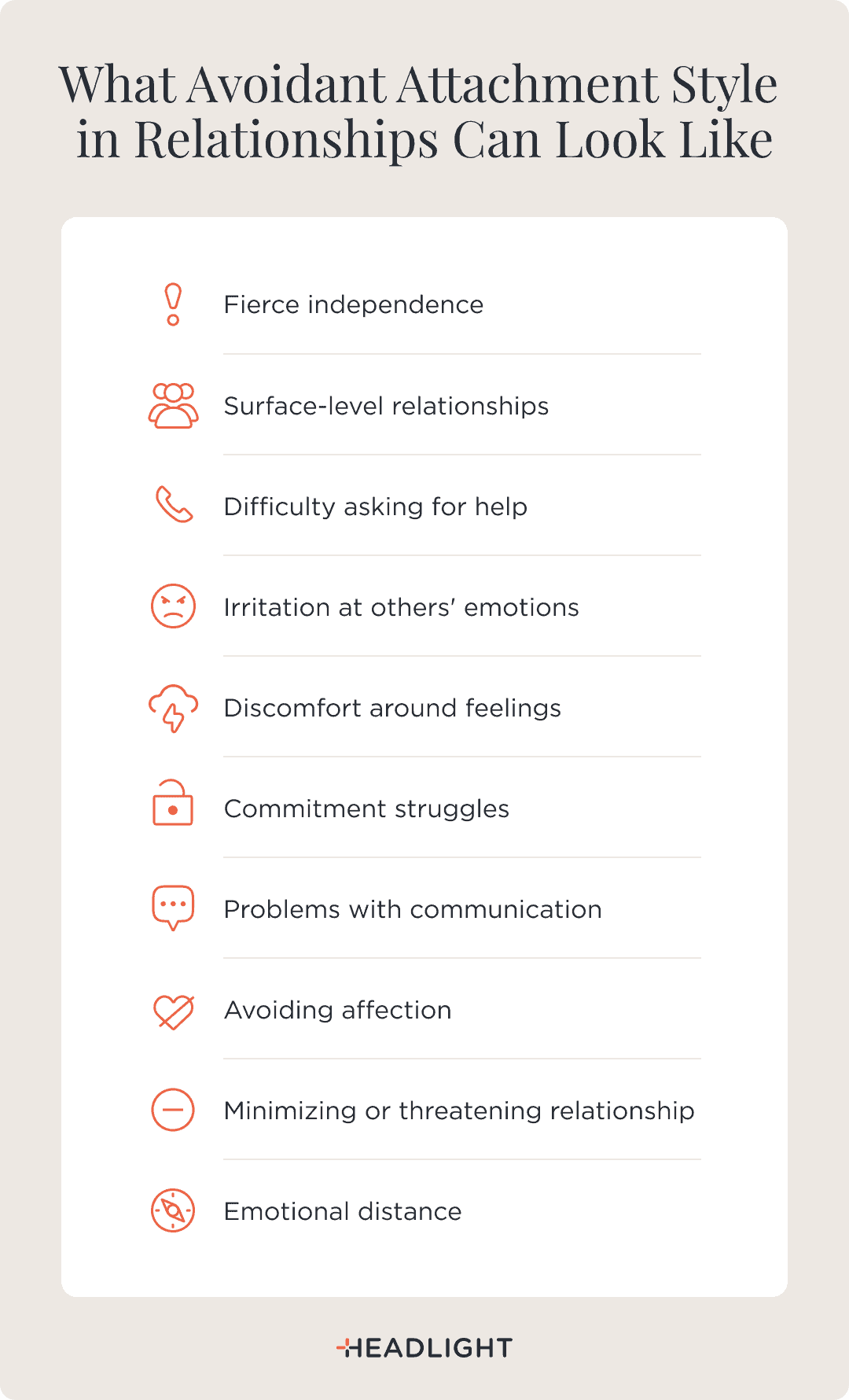
What Avoidant Attachment Style in Relationships Can Look Like
Attachment patterns are ways that someone seeks trust, intimacy, and closeness in a relationship, and secure attachment has been found to be positively associated with relationship satisfaction, per an article in Trends in Psychology. Avoidant attachment is an insecure attachment style with different presentations. For example, someone can have dismissive avoidant attachment or disorganized attachment.
An avoidant partner may have patterns that you recognize from your own relationship experience, says Greenberg: they may take time to open up, demonstrate their care in subtle ways, and have a greater need for alone time. These are the signs that your partner might have an avoidant-attachment style, she says:
- They have fierce independence
- Their social relationships tend to remain surface-level
- They have difficulty asking for help or trusting others
- They show irritation or confusion when others display emotions
- They show discomfort around their own feelings
- They may find it difficult to make commitments in relationships
- They may struggle with communication
- They may avoid demonstrating or voicing affection
- They may behave in ways that threaten or minimize the relationship
- They may seem emotionally distant
Understand the Pursue-Withdraw Cycle Before Trying To Fix It
A common misnomer about someone who has an avoidant pattern is that they don’t want a relationship or they try to avoid relationships entirely. “Although that can be true, that tends to be an extreme type of avoidance,” says Eli Kraiem, PsyD, a clinical psychologist who specializes in attachment-based therapy in New York City. “As a couples specialist, I frequently see people who show up in relationships and avoid confrontation,” he says. A person with an avoidant relationship pattern wants to be in a relationship but does not feel comfortable expressing themselves, getting too close to their partners, or being vulnerable.
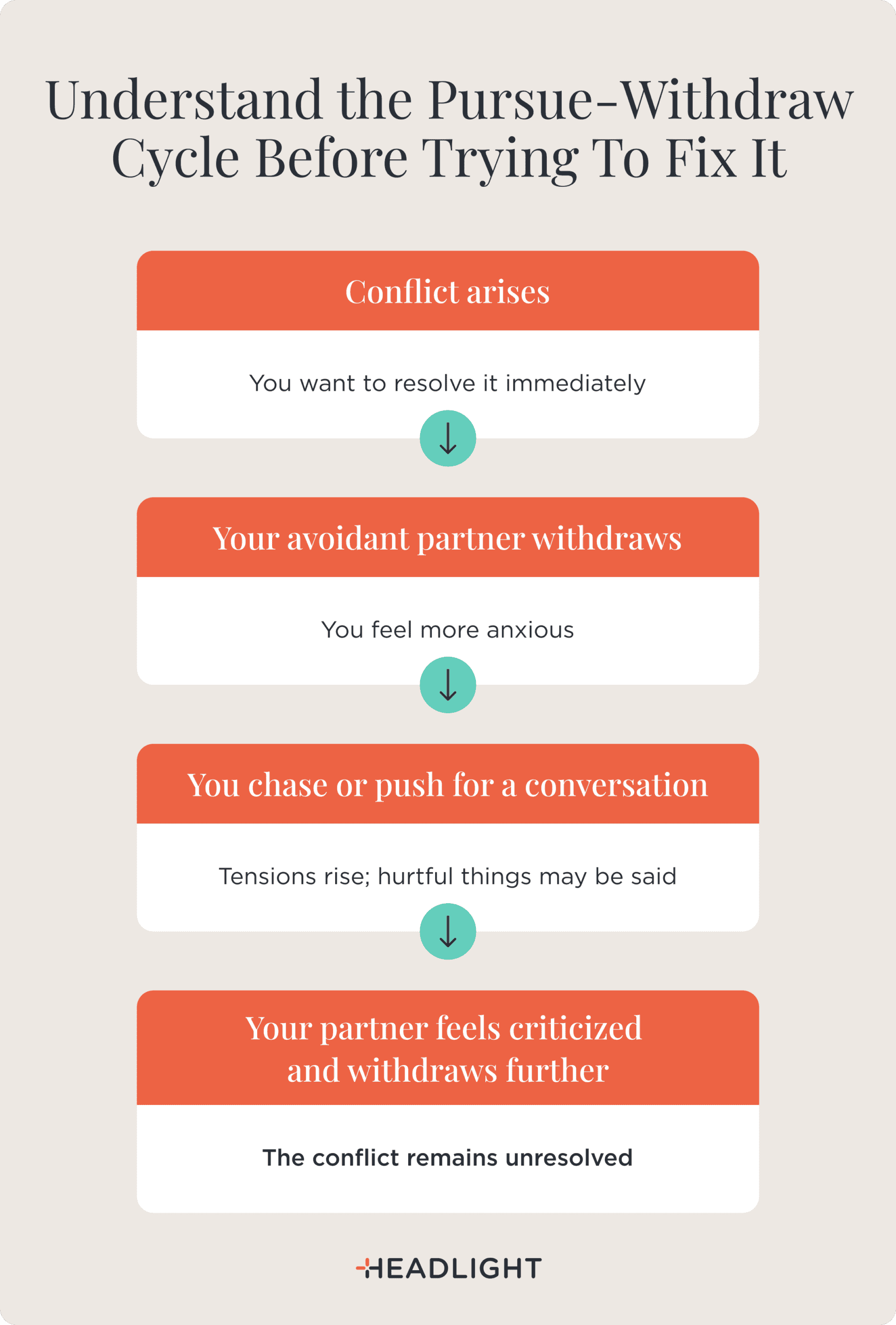
This can promote a pursuer-withdrawal dynamic, says Kraiem. Here’s how it can play out:
- You have a conflict
- As the partner, you might want it fixed immediately, especially if you have an anxious-avoidant style. You’d say something like: “Things aren’t working, let’s talk and fix it.”
- The avoidant partner withdraws to avoid conflict.
- As a result, you feel more anxious, so you try to “chase” (or force a conversation with) your avoidant partner.
- You both may raise your voice and say unkind or hurtful things.
- That pushes the avoidant partner away even further, as they feel criticized.
- The original disagreement does not get resolved.
What’s interesting is that you both are handling the issue with the same goal of protecting the relationship, says Kraiem.
Your goal: To directly confront and fix an issue so you can move on and feel secure in the relationship.
Your avoidant partner’s goal: Avoid engaging in conflict to preserve the relationship.
This dynamic can create a wedge in the relationship. “Over time, both people can feel misunderstood and depleted,” explains Julie Newman, LMHC-D, an anxiety and relationship therapist in New York City. “One partner may feel abandoned or chronically uncertain, while the other may feel overwhelmed, criticized, or like there is no such thing as enough space.”
That’s why there’s a delicate dance between respecting that space while also getting your needs met.
Respect Their Need for Space Without Making Yourself Disappear
Understanding what’s behind both of your reactions to conflict can help you both come together. Keep in mind that demanding that a problem be solved immediately will push an avoidant partner further away. “They need time to process and understand what they’re feeling and learn how to communicate their experience in a more concrete way,” says Kraiem.
Do not chase an avoidant partner. “If they are withdrawing, forcing confrontation will push them away even more because they will feel criticized. What they need is space,” Kraiem says.
They should be given that space, but that space isn’t forever. Having a partnership means they need to come back to the table to resolve a conflict or have the hard conversation.
There are consequences to not addressing this dynamic. When one person withdraws by avoiding the situation, not speaking, or creating distance during conflict and the other criticizes, demands, or threatens the other, the result is frustration that can eventually create dysfunctional relationship patterns, points out a research article in Frontiers in Psychology. For that reason, learning to communicate clearly without blame or pressure is key.
Communicate Your Needs Clearly Without Blame or Pressure
There can be a learning curve when learning how to deal with an avoidant partner. You can both learn to communicate in a way that makes each of you feel safer.
Greenberg says that one thing you can try is scheduling time for a relationship talk. Start with a pressure-free invite. An example script she recommends could be: “Hey, I’ve had some questions about our relationship that I’d love to hear your thoughts on. When would be a good time for us to chat?”
Once you set a time, you might want to come into the conversation prepared by writing down discussion points so that you can communicate clearly and calmly while still holding to what you need in the relationship. “Being in a relationship is a group project, so try to find a core value that you share (for example: harmony or respect) to keep you both invested in continuing the conversation, even when it gets hard,” says Greenberg.
Of course, it is possible that your avoidant partner may shut down. In that case, there are things you can do to maintain your connection and keep the conversation moving forward.
What To Do When Your Avoidant Partner Shuts Down
Your partner may shut down at the hint of conflict in a conversation. If that happens, you can express your needs, says Newman. “Clearly name what you’re noticing, how it’s affecting you, and what you need from them,” she says.
It’s possible that the conversation can become emotionally charged, which can make you both uncomfortable. You might want to step in to resolve it, while your partner will likely want to withdraw. If that happens, “it can be helpful to pause and give each other some space, but the pause should have a clear plan for when you’ll come back to the conversation so that ‘space’ doesn’t turn into avoidance,” says Newman.
That plan can sound like a partner saying “I need an hour to calm down, and then let’s talk,” describes Kraiem.
Ideally, your partner will be able to hear that you’re hurt, communicate their own needs, and come back to the conversation, adds Newman. “Those behaviors are important indicators of their capacity for emotional intimacy and repair.”
Stay Connected to Yourself While Dealing With an Avoidant Partner
Your needs matter in the relationship just as much as your partner’s. Tolerating every behavior isn’t a requirement for being compassionate. “Make sure that you don’t try to overcorrect and suppress your own needs. That’s not a healthy outcome either,” says Kraiem. “It’s helpful for you to continue to vocalize what you need in an effective, helpful way and show up in the way you need to feel satisfied in the relationship,” he continues.
Focus on building and maintaining a strong support system of your own. “Develop other sources of emotional regulation,” says Kraiem. “We should not make our partner responsible for regulating our anxiety,” he says. Friends, family, exercise, hobbies, journaling, and therapy are just a few things you can do to maintain sources of meaning outside of the relationship.
How To Heal Avoidant Attachment Style — and Whose Responsibility It Is
As a partner, you cannot heal someone else’s attachment pattern. This is not your responsibility.
Their healing may involve greater self-awareness around triggers and distancing behaviors, as well as learning about expressing vulnerability and how to clearly communicate versus shutting down or distancing.
Therapy can help if you are both open to it, and you can watch for progress. Some signs of improvement, says Newman, include being better at identifying and communicating their emotions and needs, creating boundaries — not walls — less withdrawal, and are more willing to come back to hard conversations. Also look for positive things like expressing more appreciation and gratitude, she says.
Look for Reciprocity, Not Perfection
Your partner deserves compassion and communication, but you need to make sure that you’re still present and heard, too. Consider what type of attachment style you have. “If you have an anxious attachment style, one of the most important things you can do is pay attention to whether your relationship is helping you feel more secure or keeping your attachment system constantly activated,” adds Newman. This is among one of the more challenging combinations of partnerships to support a secure attachment. “One person tends to seek more closeness while the other regulates through distance,” she says.
When It May Be More Than an Attachment-Style Communication Problem
Although you are a support person in your partner’s life, you are not responsible for resolving their challenges — they are. And there are times where it may be more than an attachment pattern that’s placing a communication wedge between you two. There are signs that there is more going on than attachment-style communication problems, Greenberg says. Those include:
- Withdrawal from usual activities your partner enjoys
- Changes to their basic functioning, such as sleep, appetite, weight, or hygiene habits
- Increased gambling, substance use, or other risky/compulsive behaviors
- Behaviors and emotions that seem odd or unpredictable
Any of the above can be especially concerning if they’re new or follow a loss or change in their life, Greenberg says. In that case, therapy may be a helpful next step.
How Therapy Can Help You Build a Healthier Relationship Dynamic
Individual therapy and/or couples therapy with qualified therapists, such as those at Headlight, can be an invaluable tool when you’re struggling with a partner’s attachment style (or your own). This is true for whether it is a relationship problem or when the issue might be more than an attachment-style communication problem, as described above. “Therapy can be useful in order to hear what’s normal and what’s not, so that you can provide your partner with support if they are struggling,” says Greenberg.
Therapy serves as a tool for strengthening relationships. For you personally, therapy can be a space of growth, allowing you to process your relationship challenges, learn how to communicate with your partner, or role play challenging conversations, says Greenberg. If you choose to attend couples therapy, therapy can provide a non-judgmental space for you to work with a professional to bring you two closer together and create a more secure relationship. If you’re ready, meet with a therapist or psychiatrist at Headlight.
Frequently Asked Questions (FAQs)
How do you deal with an avoidant partner without pushing them away?
Dealing with an avoidant partner can be challenging. Avoidant partners often avoid conflict, and so you might feel as if your partner is the one pushing you away. Oddly enough, giving them space to process can be one of the best ways to keep them close. Agree on a specific time to take space and agree to come back together to restart the discussion.
How much space should you give an avoidant partner?
There isn’t a specific rule about the amount of space you give an avoidant partner. However, you should recognize that space is important to them. Don’t push them for closeness immediately or chase them with a flurry of texts or calls after conflict. Decide on a set time to get together and discuss a relationship issue.
How do you know when dealing with an avoidant partner is costing you too much?
You still need to have your needs met in a relationship. If you feel as if you’re minimizing yourself or ignoring your own needs in the relationship and your partner is not putting forth effort to improve communication or their reaction to conflict, you may want to think about if your partner is right for you.