
Narcissist Gaslighting: Tactics, Signs and How to Respond
- Category: Relationships
- October 1, 2026
Key takeaways
- Narcissist gaslighting is a form of manipulation and abuse, in which another person leads you to doubt your own reality so they can feel correct or superior.
- Identifying narcissist gaslighting in real life can be tricky. It’s often a pattern that develops gradually, eroding your sense of reality, making it confusing and difficult to recognize.
- You don’t need to diagnose the other person with narcissistic personality disorder or narcissistic traits to deserve support for their gaslighting behaviors.
- Therapy can help you identify and respond to narcissistic gaslighting in a way that supports your mental health.
Perhaps your boyfriend ditched you at a party where you didn’t know anybody, but then said “you’re way too sensitive” when you pointed this out. Or maybe you remember your mom neglecting you as a child, but she insists she was an involved parent and you’re making it up.
It could be something as small as your sister saying she told you something when you swear she never did, or something as big as your partner cheating on you but then saying it was your fault.
All of these are examples of gaslighting, when the other person manipulates your reality to help them feel superior, in control, and blameless.
Recognizing and breaking free from narcissistic gaslighting can be challenging, but it’s possible.This article is your guide to narcissistic gaslighting, what it means, how to identify it, and how to respond.
What is narcissist gaslighting?
Gaslighting is when someone tries to make you believe that something is not true or did not happen, or that your reaction is unbalanced, over the top, or irrational.
“Narcissistic gaslighting is used specifically so the narcissist can look and feel superior, and make you believe their version of what happened, which always paints them in a golden light,” says Jennifer Walker, LPC, a licensed professional counselor with Headlight Health.
It’s important to know that gaslighting isn’t a single disagreement. It’s a repeated behavioral pattern.
Over time, narcissistic gaslighting can make you doubt yourself and your own memories and perception of reality. You may start to depend more and more on the other person’s version of events, and even believe what they tell you about yourself.
“One of the reasons narcissistic gaslighting is so impervious and problematic is that the narcissist, like the pathological liar, can often believe what they are saying,” says Walker. “[This] makes it especially hard to argue against or prove the true version of events.”
Gaslighting and narcissism are not the same thing
Gaslighting and narcissism go hand-in-hand, but they aren’t the same thing.
Gaslighting is a behavior, not a diagnosis. Narcissistic personality disorder (NPD), on the other hand, is a formal diagnosis. People with NPD have an inflated sense of superiority, a need for admiration, and a lack of empathy, according to the American Psychiatric Association.
Many people with NPD gaslight, but not everyone. The opposite is true, too. “Someone who is engaging in gaslighting does not necessarily have narcissistic personality disorder,” says Karen Stewart, PsyD, a clinical psychologist.
Narcissism is also a personality trait, often described as being self-centered, arrogant, or seeking admiration and attention. People can have narcissistic traits without having full-blown NPD.
Someone might engage in gaslighting behaviors because of narcissistic tendencies, rather than because they have a diagnosed personality disorder. Their motivations might come from a desire to feel superior, dominant, or in control by making the other person feel less-than, wrong, or crazy.
Someone might also gaslight because they’re:
- Defensive
- Emotionally immature
- Controlling
- Afraid of consequences
- Unwilling to admit they’re wrong
“Not every difficult or manipulative person is also a narcissist,” says Dr. Stewart.
Common narcissistic gaslighting tactics
Narcissist gaslighting can come in many shapes and forms. Knowing the various tactics that gaslighting narcissists use can help you recognize when and if this is happening to you.
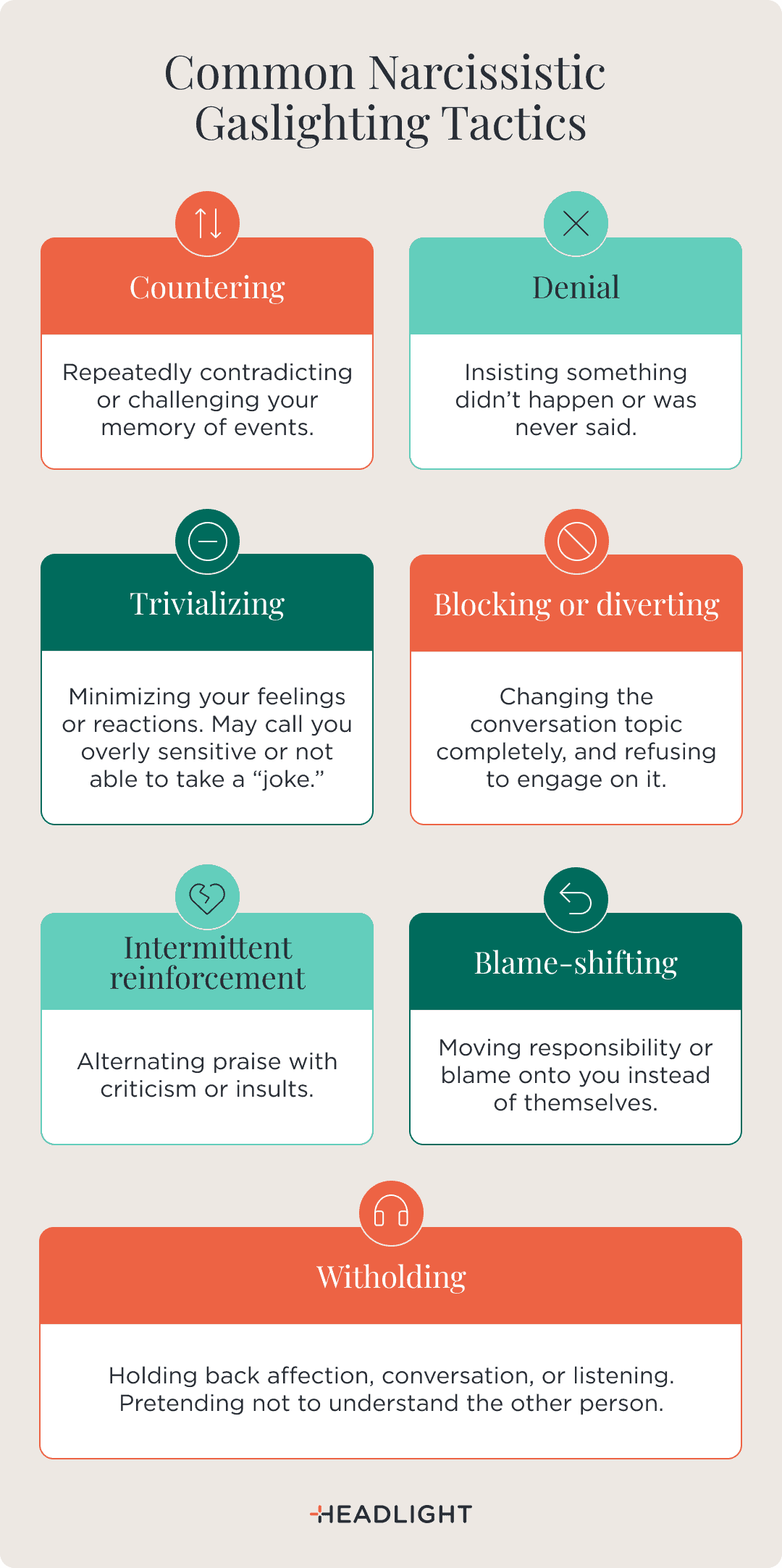
Common gaslighting tactics include:
- Countering: Repeatedly contradicting or challenging your memory of events.
- Denial: Insisting something didn’t happen or was never said.
- Trivializing: Minimizing your feelings or reactions. May call you overly sensitive or not able to take a “joke.”
- Withholding: Holding back affection, conversation, or listening. Pretending not to understand the other person.
- Blocking or diverting: Changing the conversation topic completely, and refusing to engage on it.
- Blame-shifting: Moving responsibility or blame onto you instead of themselves.
- Intermittent reinforcement: Alternating praise with criticism or insults.
Narcissist gaslighting examples
“One of the biggest misconceptions about gaslighting is that it always looks dramatic or obviously abusive,” says Dr. Stewart. In reality, gaslighting is often very subtle. Instead of one huge argument, it’s made up of many small moments of being told that what you saw didn’t happen, what you heard wasn’t said, or what you feel isn’t reasonable.
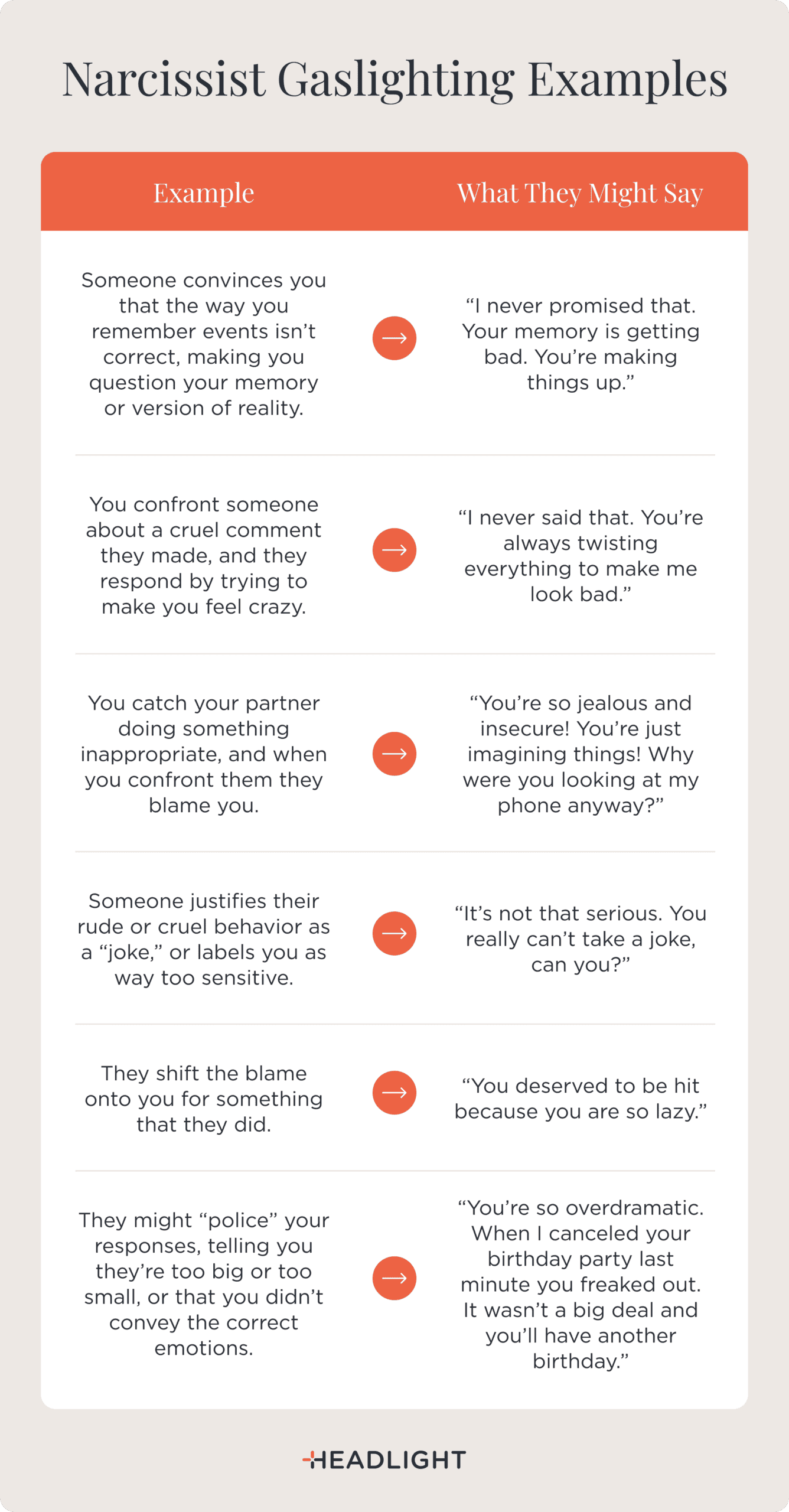
What do these gaslighting tactics actually look like in real life? Consider the following narcissist gaslighting examples:
| Narcissistic gaslighting example | What they might say |
| Someone convinces you that the way you remember events isn’t correct, making you question your memory or version of reality. | “I never promised that. Your memory is getting bad. You’re making things up.” |
| You confront someone about a cruel comment they made, and they respond by trying to make you feel crazy. | “I never said that. You’re always twisting everything to make me look bad.” |
| You catch your partner doing something inappropriate, and when you confront them they blame you. | “You’re so jealous and insecure! You’re just imagining things! Why were you looking at my phone anyway?” |
| Someone justifies their rude or cruel behavior as a “joke,” or labels you as way too sensitive. | “It’s not that serious. You really can’t take a joke, can you?” |
| They shift the blame onto you for something that they did. | “You deserved to be hit because you are so lazy.” |
| They might “police” your responses, telling you they’re too big or too small, or that you didn’t convey the correct emotions. | “You’re so overdramatic. When I canceled your birthday party last minute you freaked out. It wasn’t a big deal and you’ll have another birthday.” |
In each of the examples above, the overall pattern matters more than any single phrase.
“The commonality in these examples is the conversation shifts away from the action, topic, or gaslighter, toward how your perception is incorrect, your memory is wrong, you are the problem,” explains Dr. Stewart.
Signs narcissistic gaslighting may be affecting you
Perhaps you’ve heard the saying: “It’s hard to see the full picture when you’re in the frame.” This definitely applies when it comes to gaslighting. Even once you understand what gaslighting and narcissism can look like, it can still be difficult to recognize if it’s happening to you.
That’s why, in addition to recognizing the gaslighter’s behaviors, it’s also important to pay attention to changes in yourself.
Some signs that you might be experiencing narcissistic gaslighting include:
- Frequently second-guessing the way you remember events, your judgement, your emotional reactions, or your decisions.
- Wondering if you’re “too sensitive” or can’t take a joke.
- Always assuming that you’re responsible for conflicts or for the other person’s bad mood or behavior.
- Apologizing repeatedly for things the other person blames you for, but that you weren’t actually responsible for.
- Feeling increasingly isolated, confused, or dependent on the other person’s perspective.
- Believing and internalizing what the other person says about you, for example thinking you have a bad memory, or you’re bad with money, or you’re not likable.
- Defending or justifying the other person’s behavior when talking to friends or family.
- Losing confidence in yourself over time.
“The biggest sign you are in a relationship with a narcissistic gaslighter is that they make you feel crazy and discredit your experience to manipulate you to doubt yourself,” says Walker. “No one can tell you how you feel but yourself.”
Dr. Stewart adds that if you end most arguments or conversations feeling like you’re “crazy” or that things have spun back to you being the problem, there is a good chance you were being gaslit.
How narcissist gaslighting can affect mental health
Living with narcissist gaslighting—whether that’s from a partner, parent, friend, or someone else—can seriously impact your mental health.
Repeated gaslighting can:
- Erode your confidence and trust in your own judgement
- Create self-doubt
- Lower your self-esteem
- Make decision-making more difficult
- Isolate you from other people and things you loved to do
- Cause trust issues with yourself and others, both during and after the relationship
In some cases, gaslighting may contribute to a mental health condition, such as anxiety or depression. But you don’t necessarily need a mental health diagnosis to deserve support.
How to respond to narcissist gaslighting
There isn’t a single “right” way to respond to narcissist gaslighting, but there are a few strategies that can reliably help.
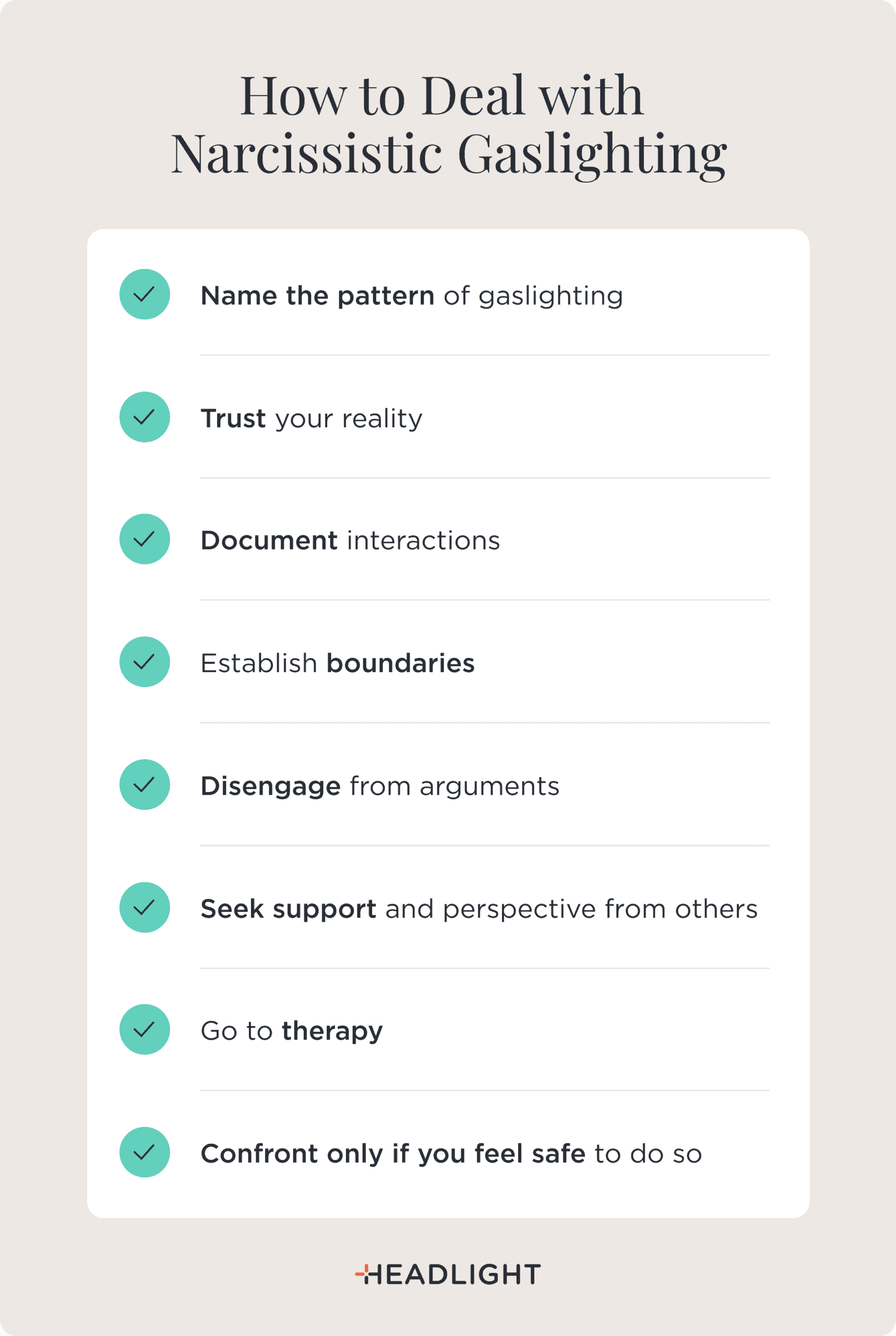
The first step is to identify and name the pattern of gaslighting, privately. Doing research on gaslighting (like reading this article!) or discussing with a therapist can help.
Recording interactions in a private journal or note, when safe to do so, is another useful strategy. This gives you something concrete to refer back to for reality-checks and pattern-finding.
Once you’ve accepted that the other person is gaslighting, the next step is setting and maintaining boundaries. Try to disengage from arguments where the other person is denying the truth, or being manipulative or aggressive.
“The most important thing you can do is disengage to protect your zen,” says Walker. “It’s important to remember that the narcissistic gaslighter likely believes what they are saying. There is no convincing them otherwise.”
You can also seek support from trusted family, friends, or support groups. They can give you a third-party reality-check, and offer perspective on the situation.
Ultimately, your safety is more important than proving the other person wrong. Only confront the person about their gaslighting if you feel safe to do so.
Protecting yourself when gaslighting is part of an abusive relationship
Gaslighting is a form of emotional abuse, and sometimes it can be part of a wider pattern in an abusive relationship. The abuser may use gaslighting (alongside other abusive tactics) to maintain power and intimidation, and ultimately control and isolate you.
If this is the case for you, then know that your safety comes first.
Don’t feel like you need to immediately confront the person about their gaslighting if you fear their reaction.
The same goes for recording instances of gaslighting. If the other person is monitoring your phone, accounts, or journals then this might not be safe.
Instead, try to seek support from trusted people, a mental health clinician like those who work at Headlight, or a domestic violence advocate.
You can contact the National Domestic Violence Hotline 24/7, for free and confidential support. Call 1(800)799-SAFE(7233) or text “START” to 88788.
When therapy or additional support may help
Individual therapy can help if gaslighting has affected your mood, self-trust, boundaries, relationships, and more.
Working with a clinician can help you identify when and if someone is gaslighting you, and the best ways to respond to preserve your mental health. You may also work to rebuild boundaries and trust, develop coping mechanisms, or create safety and self-care plans.
Keep in mind that therapy isn’t about diagnosing the other person with narcissism or NPD, but rather about supporting you to deal with the impacts of their behaviors.
If you’re interested in therapy, then Headlight offers quick access to mental health care for people in the Western states. Within 48 hours from completing the Get Support form, you will be contacted and scheduled to connect with a therapist or psychiatrist.
Mental health care with Headlight is also affordable, with insurance coverage verified before services start, so you won’t get any surprise bills.
If you’re experiencing a mental health emergency, including thoughts of self-harm, call or text the Suicide & Crisis Lifeline at 988.
Frequently asked questions (FAQs)
Do narcissists know they are gaslighting you?
Sometimes narcissists know they are gaslighting you, and sometimes they don’t, but there’s no clear-cut way to distinguish this.
Gaslighting can be deliberate, in which the person knows the truth and intentionally distorts it to maintain control or make you feel “crazy.” But it can also be an ingrained defensive pattern, according to Dr. Stewart. “A person may have learned to rewrite events so consistently to protect themselves from shame or accountability, that they genuinely begin to believe their own version.”
Whether the other person is intentionally gaslighting you or not doesn’t matter as much as their impact. “You do not have to prove that someone consciously manipulated you to recognize that their behavior is making you question your own reality or make you uncomfortable,” says Dr. Stewart.
Can someone gaslight you without being a narcissist?
Yes, someone can gaslight you without being a narcissist. Gaslighting is a behavior, not a diagnosis. Often, gaslighting (and the motivations behind it) reflects narcissistic tendencies, but this isn’t enough to diagnose NPD or any other mental health condition.
Should you confront someone who is gaslighting you?
You should only confront someone who is gaslighting you if you feel safe and supported to do so. Arguing with the person who is gaslighting is often circular. They may have deluded themselves into believing their version of events, and refuse to see reality. You may find it more beneficial for your mental health to disengage from arguments, rather than confronting gaslighting every time it happens.