
Intrusive Thoughts: What They Are and Why You’re Not “Crazy”
- Category: Anxiety
- September 1, 2026
Key takeaways
- Intrusive thoughts are unwanted or unexpected mental events, such as sudden thoughts, images, or scenarios.
- They’re often embarrassing, concerning, shocking, or disturbing.
- It’s normal to experience intrusive thoughts once in a while. They don’t reflect your inner character or desires.
- However, it’s important to seek help if your intrusive thoughts become persistent, upsetting, affect your daily life, or if you feel an urge to act on them. This can be a sign of a mental health condition such as anxiety or OCD.
- Headlight offers in-person and virtual mental health services to people in the Western states, and is here to help if you’re struggling with intrusive thoughts.
Are you wondering, “What are intrusive thoughts?” Intrusive thoughts feel like they pop up out of nowhere, and they often contain socially unacceptable or shocking content. These thoughts can feel scary, but they don’t reflect your values or desires.
Having intrusive thoughts doesn’t mean you’re “crazy,” and they don’t reveal some underlying character flaw. In fact, intrusive thoughts are a normal part of life, and most people experience them at some point or another.
For instance, I’ve had intrusive thoughts while cooking along the lines of, “What if I slapped my hand down on the stovetop?”. I don’t act on it, and having that thought doesn’t mean that I want to burn my hand. It’s just an intrusive thought.
You can apply that same logic to most intrusive thoughts—even ones that feel more disturbing than touching a hot stove.
But sometimes intrusive thoughts can spiral out of control. It’s worth seeking professional mental health help when intrusive thoughts become distressing, persistent, interfere with your life, or if you feel drawn to act on them.
Consider this article your primer on intrusive thoughts: what they are, when you should be concerned, and how to seek help.
What are intrusive thoughts? Meaning, signs, and normality
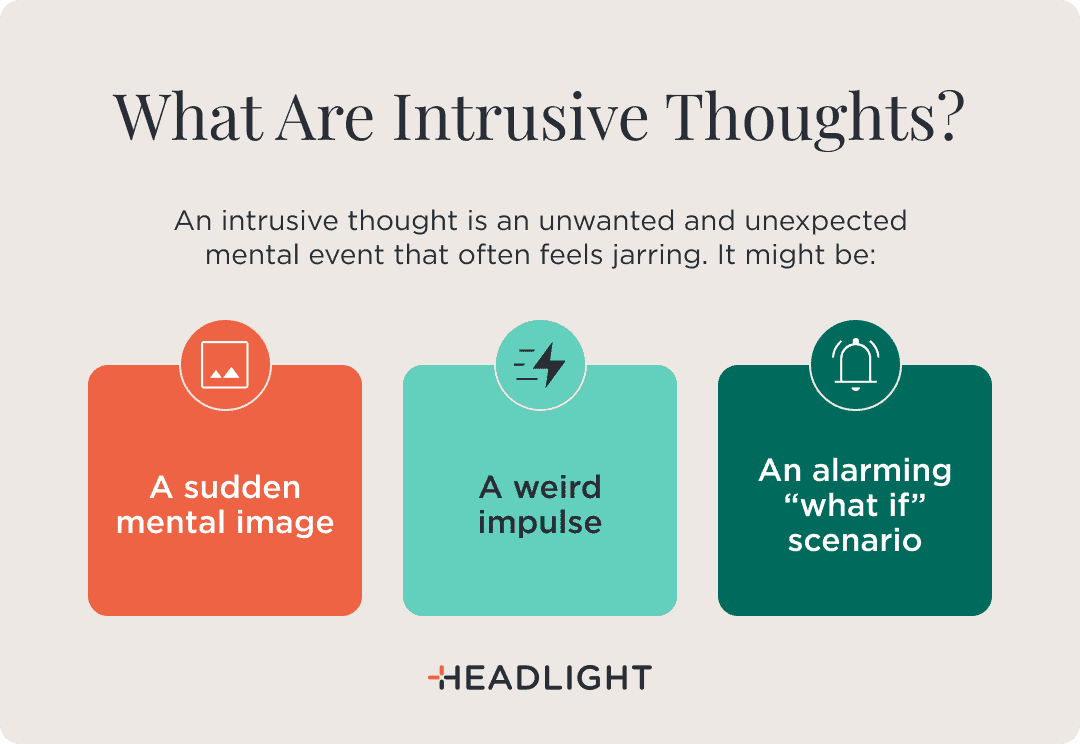
An intrusive thought is an unwanted and unexpected mental event that often feels jarring. It might be:
- A sudden mental image
- A weird impulse
- An alarming ‘what if’ scenario
“What makes a thought truly ‘intrusive’ isn’t just that it showed up,” says Amanda Pearman, LPCC, a mental health therapist with Headlight. “It’s that it feels completely ego-dystonic.”
That’s a fancy clinical way of saying that the thought clashes with your core values, morals, or what you stand for.
Pearman gives the examples of a parent having a mental flash of dropping their baby, or a driver thinking about swerving off the road.
These thoughts are understandably frightening and often at odds with our values, and that’s what makes them feel intrusive.
But are intrusive thoughts normal? “It’s 100% normal to have intrusive thoughts,” says Pearman. “Intrusive thoughts are human.”
Intrusive thoughts only become concerning when they’re persistent, upsetting, or difficult to disengage from.
Common types of intrusive thoughts—and why they do not define you
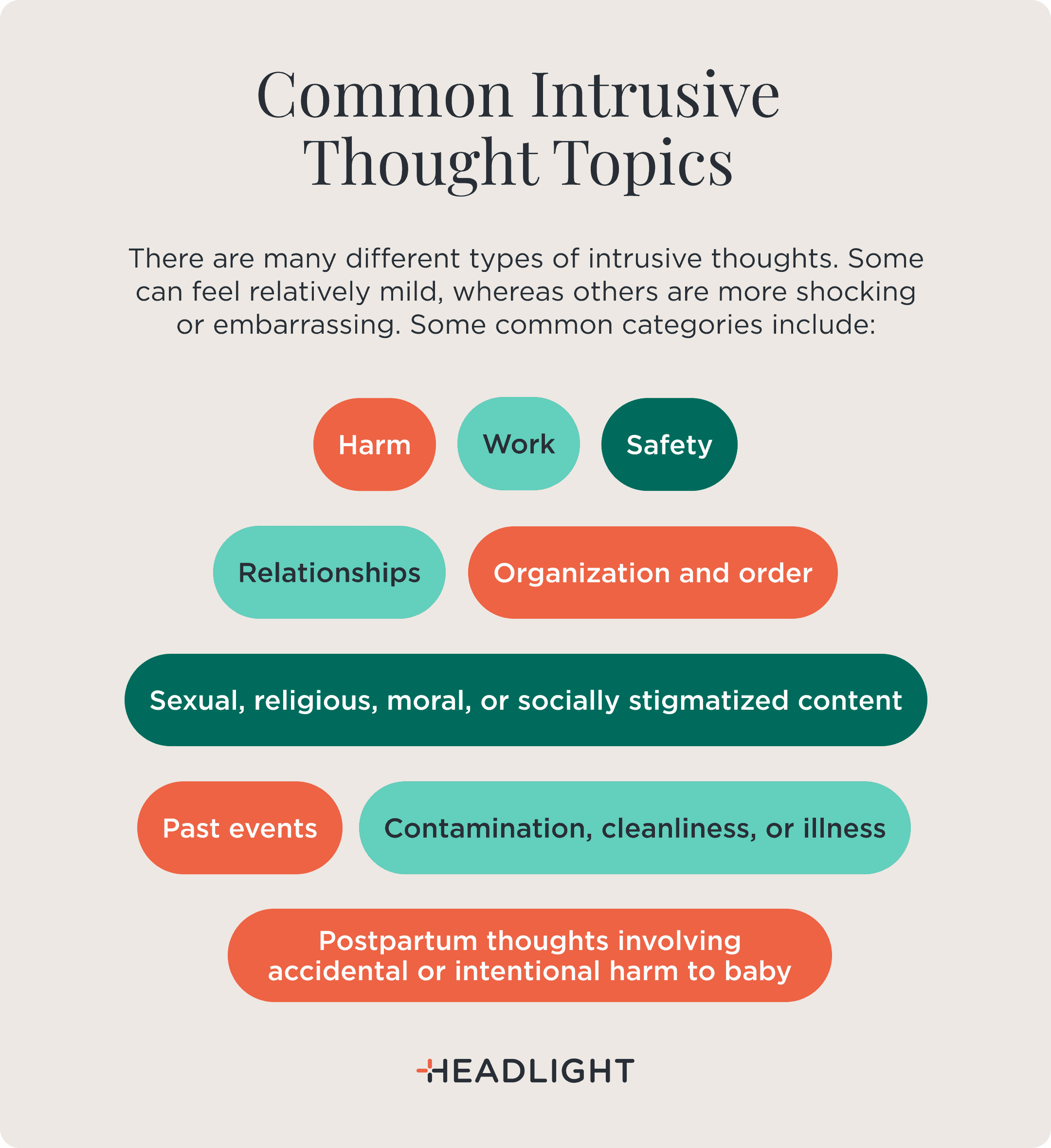
There are many different types of intrusive thoughts. Some can feel relatively mild, whereas others are more shocking or embarrassing. Some common categories include:
- Harm
- Work
- Safety
- Relationships
- Sexual, religious, moral, or socially stigmatized content
- Contamination, cleanliness, or illness
- Organization and order
- Past events
- Postpartum thoughts involving accidental or intentional harm to baby
These thoughts come in many shapes and forms. They may look like repetitive doubts: “Did I turn off the stove?” or “Did I send that email?”. Or, they could be disturbing images that whoosh into your mind, related to hurting yourself or someone else.
Visuals of harming your new baby are a particularly concerning intrusive thought for many new parents. However, this is a classic and highly treatable symptom of anxiety, and not a sign of psychosis or bad parenting, according to Pearman.
It’s important to know that experiencing an intrusive thought is not the same as an intention or action, and by no means does it make you a bad person.
Why intrusive thoughts happen
“[Intrusive thoughts] happen because our brain’s threat-detection filter, the amygdala, gets a little overzealous,” says Pearman.
Think of it like this: when you’re feeling stressed, burnt out, sleep deprived, or going through a big life transition, that threat-detection filter weakens. So, your brain starts throwing out wild, worst-case scenarios into your mind in a misguided attempt to prep you for potential danger.
Looking back at my hand-meets-stovetop example, that was my brain’s messy way of warning a tired me not to put my hand on the stove.
In some cases, hormonal or biological shifts (like you might experience during pregnancy, postpartum, or perimenopause) can trigger intrusive thoughts.
Mental health conditions—for instance anxiety or obsessive compulsive disorder (OCD)—can also make intrusive thoughts more persistent.
“[An intrusive thought] isn’t a secret desire, a hidden dark truth, or a premonition,” says Pearman. “It’s just a neurological state.”
Intrusive thoughts, obsessive thoughts, and the anxiety cycle
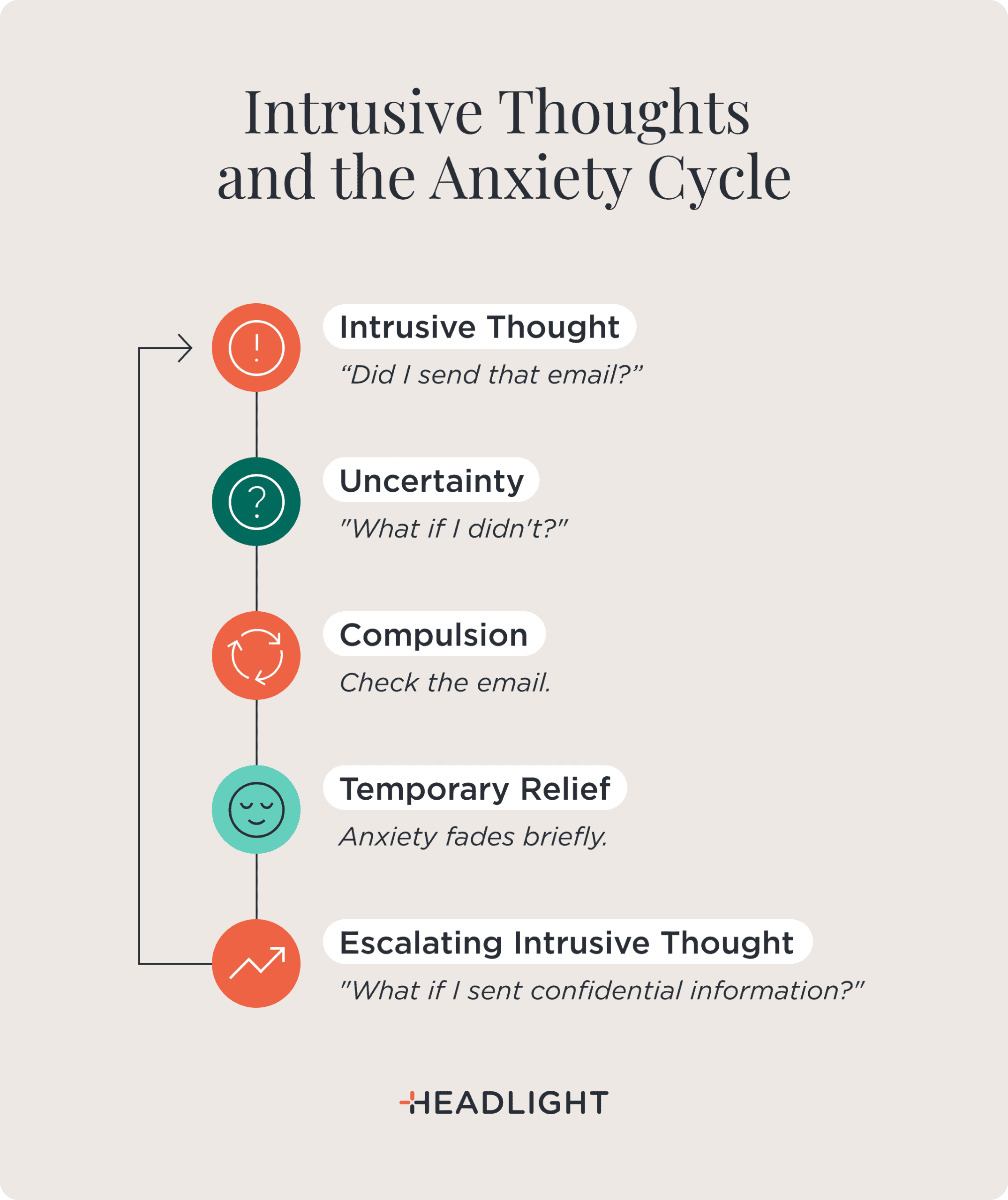
The occasional intrusive thought can become a problem if you start obsessing or ruminating over it, or engage in compulsions related to it. This cycle can disrupt your life, and may be linked to a diagnosable mental health condition such as generalized anxiety disorder or OCD.
“The best way I can describe a thought-compulsion cycle when you have OCD is similar to a spiral,” says Emily Devlin, LICSW, an advocate for the International OCD Foundation who has experienced intrusive thoughts related to her OCD for the past 20 years.
The spiral begins with an intrusive thought, for example: “I should double check to make sure I sent that email.”
“Individuals with OCD, when OCD is left untreated, will feel the overwhelming desire to listen to the intrusive thought and complete what is called a compulsion,” says Devlin. In this example, they’d check their email to ensure it was sent, and might get a rush of relief.
Unfortunately, the spiral continues. The intrusive thought often escalates. For instance: “what if I sent confidential information in the email?”
Someone without OCD may be able to brush off that thought and move on with their day, whereas someone stuck in the anxiety cycle of obsessive thoughts would go back and check the email again and again. The spiral can become unrelenting, affecting their physical and mental health, and personal life.
“As an individual with over 20 years of being diagnosed with OCD, I still get caught in these thought spirals often,” says Devlin. “The most important part is having a toolbox and strategies for getting out of that spiral and taking control.”
How to handle intrusive thoughts without making them stronger
There are some strategies to free yourself from the control of intrusive thoughts. How to stop intrusive thoughts:
- Humanize yourself: Pearman recommends starting by being kind to yourself and humanizing the experience. “Every human has thoughts and sometimes we have dark or unreasonable thoughts,” she says. “It doesn’t mean anything about the person you are or who you will become.”
- Disengage: It can be challenging, but do your best to let the thought pass without trying to mentally interpret, judge, or debate it.
- Avoid compulsions: Continue with whatever you were already doing when the intrusive thought occurred, and avoid engaging in compulsions (even if they give you temporary relief). Learn to sit in discomfort, and eventually it will ease.
- Grounding exercises: Techniques that physically ground you can draw you back into your body and away from ruminating over intrusive thoughts. Pearman recommends the five senses exercise (naming five things you can see, four things you can touch, three things you can hear, two things you can smell, and one thing you can taste).
Instead of trying to control the intrusive thought, focus on controlling your response to it. There are also evidence-based mental health therapies that can treat intrusive thoughts—more on those below.
Why trying to stop intrusive thoughts can backfire
Unfortunately, for many of us our natural instincts for dealing with intrusive thoughts can backfire. Strategies that might make you feel better in the short term can ultimately make the intrusive thought cycle worse.
Here are a few behaviors to avoid, and what to do instead.
| What not to do | Why you shouldn’t do it | What to do instead |
| Trying to avoid the thought completely. | This can lead to more rumination and distress. | Humanize yourself. Intrusive thoughts happen to everyone and it doesn’t make you a bad person. |
| Debating and analysing the thought. | This can give the thought weight and trick your brain into thinking it’s an active threat that’s worth investigating. | Disengage from the thought. Notice thoughts without judgement and let them pass. |
| Reassurance-seeking behaviors. | These can build up your anxiety over time (ex: seeking reassurance from friends or family, Googling your symptoms, quadruple checking your straightener’s unplugged). | Continue what you were already doing and avoid compulsions. Try a grounding exercise instead. |
Evaluation and conditions associated with intrusive thoughts
There’s no specific medical test for intrusive thoughts. However, intrusive thoughts—and how they’re impacting your life—can be a sign of other conditions, such as:
- Generalized anxiety disorder
- OCD
- Perinatal or postpartum OCD
- Post-traumatic stress disorder (PTSD)
- Eating disorders
- Depression
- And more
It’s important to seek professional help, such as from the clinicians at Headlight, rather than trying to self-diagnose, especially if your intrusive thoughts are impacting your day-to-day life.
“When someone describes intrusive thoughts to me, I ask targeted questions to understand what’s driving them under the surface,” says Pearman, who treats clients experiencing intrusive thoughts.
Some examples of questions you may be asked by a mental health clinician include:
| Questions | Why they’re asked |
| When this thought pops up, what do you tell yourself it means about who you are as a person? | Uncovers shame and ego-dystonic distress |
| How much of your day is taken up by either having these thoughts or trying to make them go away? | Gauges real-world functional impact |
| Are you doing specific mental checks, physical rituals, or seeking reassurance to feel “safe” again? | Differentiates OCD compulsions from general anxiety |
| Are there specific places, people, or items you’ve started avoiding because of these thoughts? | Assesses behavioral avoidance |
| Has there been a recent shift in your life (major stress, trauma, birth, or big hormonal changes)? | Screens for generalized anxiety, OCD, perinatal or postpartum OCD, or PTSD |
Treatment options and working with a mental health clinician
There are several evidence-based treatment options for intrusive thoughts, and the mental health conditions that they may be a symptom of. These include:
- Cognitive behavioral therapy (CBT)
- Exposure and response prevention (ERP)
- Acceptance and commitment therapy (ACT)
- Trauma-focused therapy
- Medication
Discussing intrusive thoughts with anyone, even a mental health clinician, can feel frightening. This is especially true if your intrusive thoughts are related to stigmatized or violent content.
Know that therapy with Headlight is a confidential place for you to discuss these unwanted thoughts, without judgement. You are free to share as much or little detail as you feel comfortable with.
Headlight clinicians are experienced at treating intrusive thoughts (of all types and severity) as well as related conditions including OCD, anxiety, and more. You can get started today, and be connected to insurance-covered talk therapy and medication management in as little as 48 hours.
When to seek professional or urgent help
You deserve help if intrusive thoughts are impacting your quality of life. This might look like:
- Thoughts occurring frequently, persistently, or obsessively
- Compulsions related to the thoughts
- Thoughts interfering with your work, sleep, relationships, hobbies, or responsibilities
- Difficulty caring for yourself or others due to thoughts
- Uncertainty if the thought is unwanted or reflects genuine intent
- Severe distress from thoughts
“After living with OCD for as long as I can remember and being formally diagnosed for 20 years, I cannot stress enough that with the right help and by accessing a therapist who is trained in ERP, you can live a happy, positive, and wonderful life,” says Devlin.
“Do not wait to find help,” she says. “Even if you are nervous or don’t feel like you can start or know where to begin, take small steps and small actions towards treatment.”
Reading this article is a good starting point. The International OCD Foundation is another useful resource for information on intrusive thoughts. And you can always connect with a Headlight therapist for in-person or virtual mental health support.
If you ever feel the urge to follow-through on a thought, particularly if it involves harming yourself or someone else, seek urgent support. Call emergency services at 911, or call or text the 988 suicide and crisis lifeline for 24/7 mental health support.
Frequently asked questions (FAQs)
Should I tell my partner or family about my intrusive thoughts?
You should tell your partner or family about intrusive thoughts if and when you feel comfortable. “Intrusive thoughts rely heavily on isolation and secrecy to stay powerful,” says Pearman. “The longer you keep them locked up inside, the easier it is to convince yourself that you are a dangerous outlier or a terrible human being.” Opening up to a loved one, and getting professional support, can be helpful.
Can journaling help with intrusive thoughts?
It’s possible that journaling could help with intrusive thoughts, but it could also make them worse via an increased focus on analyzing or judging the thoughts. It’s best to discuss journaling and other treatments and therapies with your mental health clinician, because this can vary individually.
Can children and teenagers experience intrusive thoughts?
Yes, children and teenagers can experience intrusive thoughts, similarly to adults. In a study of 49 children aged 8 to 10 years old, 71% had experienced at least one obsessive intrusive thought, most frequently related to harm and doubt.
Can caffeine affect intrusive thoughts?
Caffeine intake may reduce intrusive thoughts. Research in the Journal of Anxiety Disorders found that caffeine increases inhibition, which can reduce subsequent intrusive thoughts and compulsions. However, too much of something often has counterproductive impacts and can also cause caffeine toxicity or worse. Therefore, consuming caffeine should not be considered a long-term or even standalone treatment; instead, seek therapy and/or psychiatry for support and guidance.