
How to Find Therapists That Take Blue Cross Blue Shield Near You
- Category: General
- November 3, 2026
Key takeaways
- Most Blue Cross Blue Shield (BCBS) plans cover outpatient therapy as an essential health benefit, but specific coverage and cost depend on your specific policy.
- BCBS is an association of over 30 independent companies in different states with separate networks, meaning a clinician who accepts one BCBS plan may still be out-of-network for another.
- It’s always important to check your coverage by calling the behavioral health phone number on the back of your insurance card and asking the provider’s office if the specific clinician is credentialed with your exact plan name and member ID.
- Practices like Headlight have internal teams who can verify your BCBS benefits for you and match you with an in-network therapist.
Finding a therapist can feel overwhelming, but trying to find one who is in-network with your specific Blue Cross Blue Shield (BCBS) plan may feel especially daunting, given the nuances and sheer amount of insurance terminology involved. While yes, most BCBS plans cover therapy as an essential health benefit, “covered” does not necessarily mean free, and your exact out-of-pocket costs depend entirely on your specific plan’s deductible, copay, coinsurance, and more.2
Luckily, there are plenty of resources for navigating the world of mental healthcare through BCBS, including the national network’s Find a Doctor tool, and the help of practice intake managers and care coordinators. While organizations like Headlight can verify your BCBS benefits for you, clarify your expected costs, and match you with an in-network therapist, it’s always important — no matter where you get care — to know the steps to check your own plan details and cross-check cost and coverage information with both your insurer and your provider.
Does Blue Cross Blue Shield cover therapy?
Generally speaking, many health insurance plans, including those under Blue Cross Blue Shield, do cover therapy. However, the exact type of therapy that’s “covered” (note: “covered” does not mean “free”) depends on a variety of factors, including your specific plan and policy details. According to the Health Insurance Marketplace, all U.S. marketplace plans (health coverage purchased through an official government website or exchange) must cover behavioral health treatment (like psychotherapy and counseling), mental and behavioral health inpatient services, and substance use disorder treatment. And while the Mental Health Parity and Addiction Equity Act (MHPAEA) of 2008 prohibits insurers from charging more for therapy than other services, according to the Centers for Medicare & Medicaid Services, there’s no law that requires insurance companies — including BCBS — to make therapy free or “fully covered.”
According to an email interview with a Blue Cross Blue Shield Association (BCBSA) representative, Blue Cross and Blue Shield are not a single entity, so the answer to whether BCBS covers therapy is, “it depends.” “Blue Cross and Blue Shield is a federation of independent, locally operated companies,” they said. “The benefits, provider networks and cost-sharing can vary depending on the company and a member’s specific plan.”
In fact, Blue Cross Blue Shield is an association of more than 30 independent companies including Anthem, Regence, Blue Shield of California, and more, each with its own networks and plan designs. According to BCBSA, the only surefire way to know whether your specific plan covers therapy is to call the phone number on the back of your insurance card or visit your plan website to verify that the provider you’re considering is in-network for your specific plan. “They can also better understand details such as copays, deductibles, or coinsurance,” the representative said. “Covered services may still involve cost-sharing depending on the benefit design. Reviewing plan materials and confirming network participation before an appointment can help avoid unexpected costs.”
“Blue Cross Blue Shield is an association made up of 30+ independent companies, each with its own networks, plan designs, contracts, and coverage rules,” explains Headlight Intake Manager Miguel Godinez. “Even if a provider accepts BCBS, that does not necessarily mean they are in-network with every BCBS plan.”
According to Godinez, your specific plan, state, network, employer group, and payer can all affect whether the provider you’re considering is in-network and what services are covered. “It is also important to remember that ‘covered’ does not mean ‘free,’” Godinez adds. “Services may still be subject to a deductible, copay, coinsurance, or other out-of-pocket costs. Because of these differences, please provide your specific plan name, along with any other identifying information available on your insurance card, so we can verify the correct coverage and network.”
Why “takes Blue Cross Blue Shield” does not always mean in-network for you
As the BCBSA website explains, “the Association owns and manages the BCBS trademarks and names in more than 170 countries around the world” as well as “grants licenses to independent companies to use the trademarks and names in exclusive geographic areas.” With that extensive network and varied makeup, you might get a sense of why asking whether a provider “takes Blue Cross Blue Shield” is typically not specific enough to verify in-network coverage.
While a specific therapist might be in-network (i.e. contracted with your health plan to provide a discounted rate) with one BCBS plan, they may be out-of-network (i.e not contracted with your insurer, requiring you to pay the cost) with another. As the Blue Cross Massachusetts website explains, there are a variety of ways and places to get health insurance, whether you’re using an employer-sponsored plan that allows you to share the cost of insurance with your employer or an individual plan that you can buy through private insurers or through the Health Insurance Marketplace. Here are the main types of plans and definitions you should know about:
- HMO: A health maintenance organization (HMO) plan typically has lower premiums and requires you to see your primary care provider (PCP) first whenever you need care. Your PCP will be the one to refer you to specialists and care is only covered if you see providers within your plan’s network.
- PPO: A preferred provider organization (PPO) plan usually has higher premiums and out-of-pocket costs, but can offer more flexibility. You don’t need referrals to see specialists and you have the option to seek care out of your plan’s network.
- EPO: According to HealthCare.gov, an exclusive provider organization (EPO) plan only covers services from providers in the plan’s network (other than in emergency situations).
- POS: HealthCare.gov defines point of service (POS) plans as those that require PCP referrals to see specialists and offer lower costs for seeing providers in the plan’s network.
- Marketplace plans: According to the Kaiser Family Foundation (KFF), health insurance Marketplaces (also called Exchanges) are “organized markets where individuals and families can shop for and enroll in health insurance online, over the phone, or in person.”
- Employer plans: According to KFF, health insurance policies or plans offered by a sponsoring group, such as an employer, union, or trade association are called group health insurance. When an employer sponsors your health plan or policy, it’s referred to as an employer plan.
- Federal Employee Program: As the Blue Cross Blue Shield Federal Employee Program website explains, BCBS offers a Federal Employee Program (FEP) that provides health insurance to federal employees, and includes a national network of doctors and hospitals, free preventive care, and no referral requirements to see a specialist.
Given the nuances of each specific plan type and differences in coverage depending on factors like location, BCBS offers the national BlueCard program that allows members to get care from in-network providers when traveling outside of their coverage area. “BlueCard is a nationwide program that allows many BCBS members to access care and participating provider networks when they are traveling or living outside their home plan’s service area while receiving benefits through their home BCBS plan,” the BCBA rep says. “For individuals seeking mental health support, BlueCard may help expand access to participating providers outside their local area and provides tools to help members identify in-network providers and understand their coverage.”
With the number of BCBS plans out there, there is also variability in how mental health benefits are managed from plan to plan. In some cases, BCBS routes mental health benefits through a separate behavioral health administrator (for example, according to the BCBS website, some plans provide “resources like specially trained coaches, peer support specialists and community health workers” through outside organizations. This is why the details on your membership card matter so much when verifying coverage. “There are some plan-specific exceptions,” Godinez says. “For example, certain Anthem plans may use Carelon Behavioral Health to manage or administer behavioral health services, while some Medicare Advantage plans may route behavioral health through the member’s medical group or IPA.”
While these distinctions may sound niche, they matter because, as Godinez points out, the BCBS name alone does not necessarily paint the full picture of who is managing your behavioral health benefits. “If a plan uses a separate behavioral health administrator, that administrator may determine the behavioral health network, authorizations, medical-necessity requirements, claims process, and provider participation,” Godinez says. “In those cases, a provider being in-network with the member’s local BCBS plan does not necessarily mean they are in-network for the behavioral health benefit.”
How to read your Blue Cross Blue Shield card
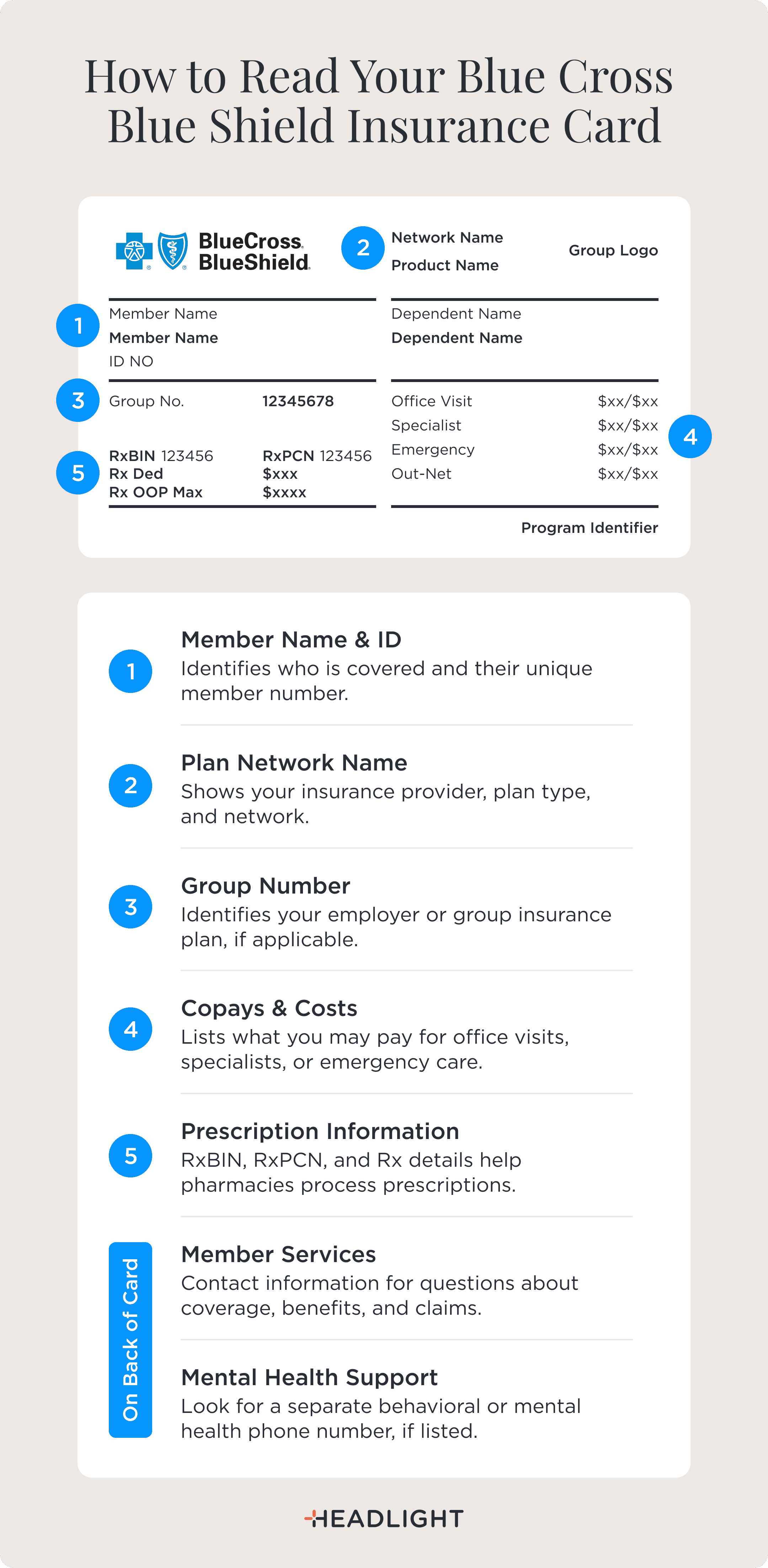
While the information displayed on your BCBS card may vary by plan type, all membership cards have similar details. The BCBS North Dakota website offers some easy tips for how to read your BCBS card so you can feel confident you have all the information you need to verify your benefits:
- The front of your card usually includes your plan logo, the subscriber’s name, a unique member identification (UMI) ID number and its three-letter prefix, the network name, plan type, and the group number.
- The front of your card may also include the types of services associated with that card, the RxBin, RxPCN, RX cost share (for pharmacy related services), plan code, office visit copays and ER visit copays, or other details.
- The back of your card usually includes contact information for members, as well as instructions and an address for filing claims and sending correspondence. Be sure to look for a separate behavioral or mental health phone number.
How to find therapists that take Blue Cross Blue Shield near you
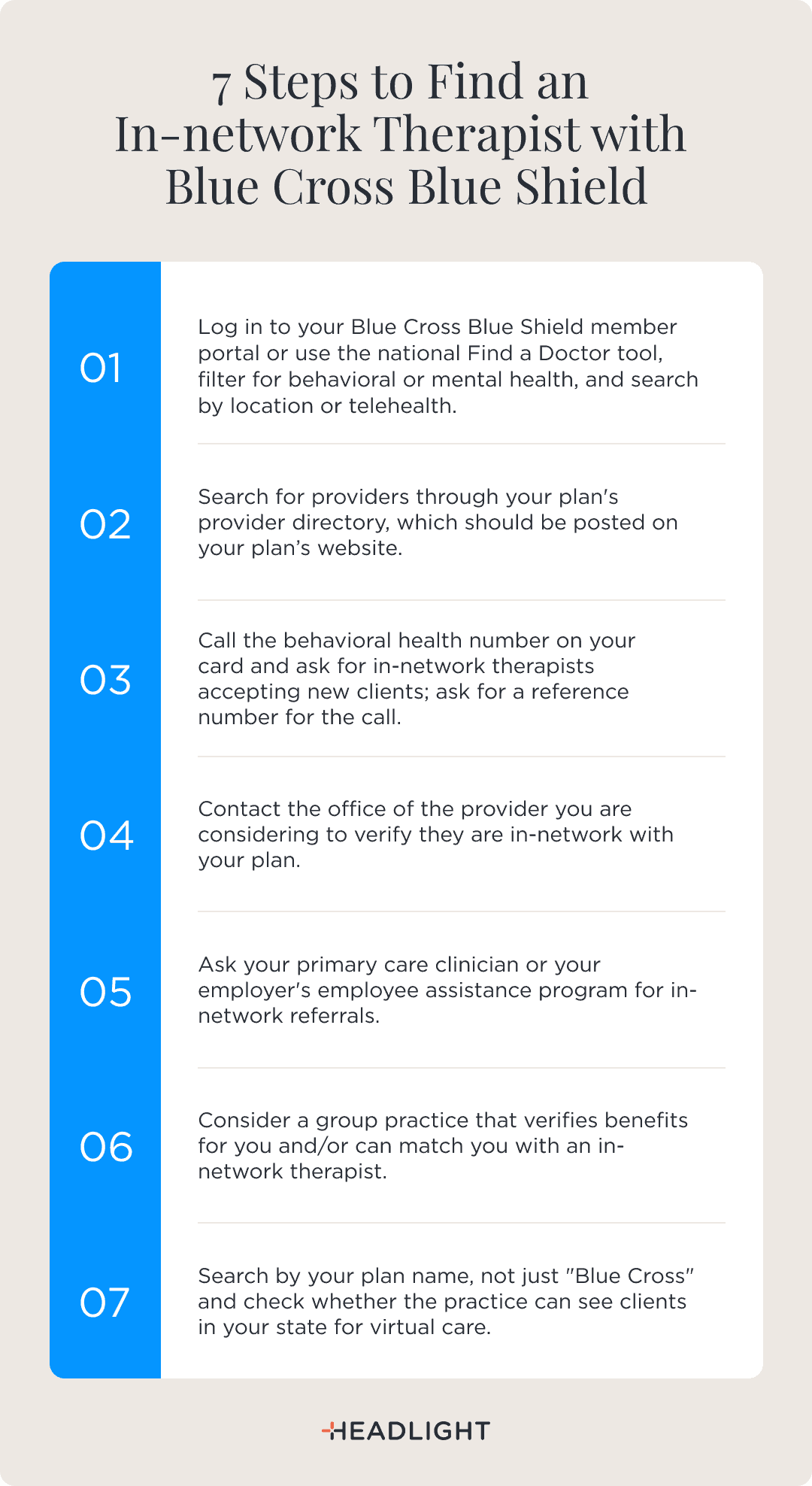
According to the BCBSA representative, taking a few simple steps can help you better understand your benefits, identify participating providers, and avoid surprises before their visits. Here are the actions you can take:
- Step 1: Log in to your Blue Cross Blue Shield member portal or use the national Find a Doctor tool, filter for behavioral or mental health, and search by location or telehealth.
- Step 2: Search for providers through your plan’s provider directory, which should be posted on your plan’s website.
- Step 3: Call the behavioral health number on your card and ask for in-network therapists accepting new clients; ask for a reference number for the call.
- Step 4: Contact the office of the provider you are considering to verify they are in-network with your plan.
- Step 5: Ask your primary care clinician or your employer’s employee assistance program for in-network referrals.
- Step 6: Consider a group practice that verifies benefits for you. For example, at Headlight, a Care Coordinator checks Blue Cross Blue Shield coverage and can match you with an in-network therapist.
- Step 7: When searching the BCBS website or even checking third-party sites like ZocDoc or Psychology Today, search by your plan name, not just “Blue Cross” and check whether the practice can see clients in your state for virtual care.
How to verify a therapist is in-network before your first session
Before booking your first appointment with a new provider, take these steps to verify that they’re actually in-network with your BCBS plan:
- Step 1: Call the practice with your exact plan name and member ID and ask, “Are you in-network with this specific plan?” rather than “Do you take Blue Cross Blue Shield?”
- Step 2: Ask whether the specific clinician (not just the practice) is credentialed with the plan, and whether they are accepting new clients.
- Step 3: Cross-check this information by calling your insurer and providing them with the name of the practice and the specific clinician; ask for a reference number in case of a billing dispute.
- Step 4: Ask your insurance representative whether telehealth sessions are billed the same way as in-person visits.
- Step 5: At the start of each plan year and any time your coverage changes, repeat the steps above since networks and plans can also change.
What therapy costs with Blue Cross Blue Shield
Understanding any kind of healthcare costs can be challenging, but trying to make sense of therapy costs can often feel specifically confusing with the terminology involved. Here are some quick definitions you should know:
- Deductible: The amount of money you’ll need to pay before your insurer starts contributing
- Copay: The fixed amount of money you owe for a covered visit (can be applied before or after you hit your deductible)
- Coinsurance: The percentage of the covered cost you’ll owe once you’ve hit your deductible
- Out-of-pocket maximum: The highest amount of money you’ll have to pay for covered services in a plan year. Once you spend this set amount on deductibles, copayments, and coinsurance for in-network care and services, your health plan will pay 100% of the costs of covered benefits.
According to a 2024 analysis published in Health Affairs Scholar, about one-third of private practice psychotherapists do not accept insurance, and insurance acceptance significantly varies across states. The average cash pay rate for a typical therapy session averaged $143.26, according to the study. While therapy costs can vary widely, a 2025 BCBS Service Benefit Plan sheet provides some potential scenarios for BCBS members, but each scenario is unique depending on the specific plan. If you have a PPO plan for example, you’ll likely pay a specific negotiated amount as payment in full for covered services including therapy. However, if you have a high-deductible plan, you may have to initially pay the full contracted rate (which is still typically lower than the provider’s self-pay fee).
According to Godinez, Headlight’s insurance cost calculator provides an estimated cost only. “For example, the estimated Blue Cross Blue Shield member copay is based on an average and may be as low as the amount shown,” he says. “Your actual copay or out-of-pocket cost may be different based on your specific insurance plan and benefits.”
It’s also important to keep in mind that insurance benefit verification is not a guarantee of your final cost. “The information provided by your insurance carrier is an estimate, and your actual responsibility may vary depending on your individual benefits and how your claim is processed,” Godinez says. “For the most accurate information about what you may owe, we recommend contacting your insurance carrier directly using the member services number on the back of your insurance card.”
It can also be helpful to remember that eligible therapy costs can often be paid with a Health Savings Account (HSA) or Flexible Spending Account (FSA) to lower out-of-pocket costs.
Does Blue Cross Blue Shield cover online therapy?
According to an email from BCBSA, Blue Cross Blue Shield typically does cover online therapy—and there is generally no difference in coverage for virtual vs. in-person care. “Telehealth has become an important tool for expanding access to mental healthcare, particularly in areas facing provider shortages,” the representative says. “Many BCBS companies offer tele-mental health options that help members connect with care when and how they need it, though specific coverage details vary by plan.”
While many Blue Cross Blue Shield plans cover telehealth therapy, coverage and cost-sharing vary by plan and state, so it’s important to verify before booking. In order for telehealth to be covered, the therapist must be licensed in the state where you’re located during the session.
Headlight offers both virtual and in-person therapy and that the same insurance check applies to both.
What kind of therapist can you see with Blue Cross Blue Shield?
According to our email interview with a BCBS representative, coverage varies by plan, but “BCBS companies recognize the importance of making mental healthcare accessible and affordable.” The representative added that “many BCBS plans provide coverage for behavioral health services, including therapy and counseling, subject to a member’s specific benefits and network requirements.”
According to the Blue Cross and Blue Shield of North Carolina website, most insurance plans cover a variety of therapy options including individual therapy, group therapy, couples counseling, family therapy, and other psychiatric services for issues including anxiety, depression, ADHD, grief, trauma, relationships, and more. But again, all these services may vary based on the exact plan you have.
“BCBS plans generally cover medically necessary behavioral health services, which may include individual, family, and group therapy, psychological services, and other behavioral health care, depending on the member’s specific plan and benefits,” Godinez says. “Coverage may also include psychiatric services, such as evaluations and medication management. Many BCBS plans will also cover online therapy (telehealth). Depending on the member’s plan and the type of service, therapy and other behavioral health services may be available through video visits and, in some cases, by phone.”
Questions to ask before you book
To help avoid unexpected costs, Godinez recommends asking a provider the following questions before booking your first appointment:
- “Can you verify that my insurance is active and that this specific therapist is in-network before my first appointment?” When asking this, be sure to provide the exact plan name listed on your insurance card rather than just the name of the insurance company.
- “Are you in-network for mental health or therapy services specifically?”
- “Do I need a referral or prior authorization before my first session?”
A few other questions you might want to ask include:
- “What will I owe per session under my plan, and do I have to meet a deductible first?”
- “Do you verify benefits before the first session, and will you bill the plan directly?”
- “Are virtual sessions covered the same way as in-person sessions?”
- “What happens if my coverage changes mid-treatment or a claim is denied?”
Getting matched with an in-network Blue Cross Blue Shield therapist at Headlight
Headlight is in-network with most major insurers, including Blue Cross Blue Shield plans, and files claims for clients. “At Headlight Health, we want to make the process of getting started as easy and transparent as possible,” Godinez says. “Our staff members have knowledge of which clinicians are in-network with different insurance plans and will help match you with a clinician who is both a good fit for your needs and participates with your insurance whenever possible.”
And once you’ve scheduled an appointment with a provider, Headlight’s billing team will verify your insurance benefits to confirm that your plan is active and that they are able to bill your insurance. “If we find that your plan is no longer active or includes a carve-out that we are unable to accept, we’ll reach out as soon as possible to discuss alternative options and provide helpful resources,” Godinez says.
Therapy is available in person at Headlight clinics and virtually, with psychiatry available alongside therapy when needed. Switching therapists is also simple if the first match is not the right fit. To find out more, visit Headlight’s support page.
Frequently asked questions (FAQs)
Does Blue Cross Blue Shield pay for therapy?
Many health insurance plans, including those under Blue Cross Blue Shield, do cover therapy. However, the exact type of therapy that’s “covered” (note: “covered” does not mean “free”) depends on a variety of factors, including your specific plan and policy details.
How do I know if a therapist accepts my insurance?
To help avoid unexpected costs, ask a therapist the following questions before booking your first appointment:
- “Can you verify that my insurance is active and that this specific therapist is in-network before my first appointment?” When asking this, be sure to provide the exact plan name listed on your insurance card rather than just the name of the insurance company.
- “Are you in-network for mental health or therapy services specifically?”
- “Do I need a referral or prior authorization before my first session?”
- “What will I owe per session under my plan, and do I have to meet a deductible first?”
- “Do you verify benefits before the first session, and will you bill the plan directly?”
- “Are virtual sessions covered the same way as in-person sessions?”
- “What happens if my coverage changes mid-treatment or a claim is denied?”
Do I need a referral to see a therapist with Blue Cross Blue Shield?
Whether you need a referral to see a therapist depends entirely on your specific plan details. A preferred provider organization (PPO) plan, for example, does not require referrals to see specialists and you have the option to seek care out of your plan’s network. But a point of service (POS) plan does require primary care provider (PCP) referrals to see specialists.
Deep dive recommendations
- https://www.bcbs.com/member-services/find-a-doctor
- https://www.cms.gov/marketplace/private-health-insurance/mental-health-parity-addiction-equity
- https://www.healthcare.gov/coverage/mental-health-substance-abuse-coverage/
Suggested Graphics
- Which Blue plan are you on? Annotated insurance card graphic showing the plan name, member ID prefix, network name, and behavioral health phone number. Drawing inspiration from the illustrations here: https://www.bcbsnd.com/providers/news-resources/member-id-card-guide
- 7 steps to find an in-network therapist process graphic:
- Step 1: Log in to your Blue Cross Blue Shield member portal or use the national Find a Doctor tool, filter for behavioral or mental health, and search by location or telehealth.
- Step 2: Search for providers through your plan’s provider directory, which should be posted on your plan’s website.
- Step 3: Call the behavioral health number on your card and ask for in-network therapists accepting new clients; ask for a reference number for the call.
- Step 4: Contact the office of the provider you are considering to verify they are in-network with your plan.
- Step 5: Ask your primary care clinician or your employer’s employee assistance program for in-network referrals.
- Step 6: Consider a group practice that verifies benefits for you. For example, at Headlight, a Care Coordinator checks Blue Cross Blue Shield coverage and can match you with an in-network therapist. “At Headlight Health, we want to make the process of getting started as easy and transparent as possible,” Godinez says. “Our staff members have knowledge of which clinicians are in-network with different insurance plans and will help match you with a clinician who is both a good fit for your needs and participates with your insurance whenever possible.”
- Step 7: When searching the BCBS website or even checking third-party sites like ZocDoc or Psychology Today, search by your plan name, not just “Blue Cross” and check whether the practice can see clients in your state for virtual care.