
Avoidant Attachment Style: Signs, Causes & How to Heal
- Category: General
- August 12, 2026
Key takeaways
- Avoidant attachment style is a type of attachment pattern that influences the type of relationships you form. People who have an avoidant attachment style tend to fear intimacy and closeness and distance themselves from others.
- Many factors may contribute to the development of avoidant attachment, including genetics, less supportive caregiving when growing up, and current challenges in adult relationships.
- Therapy is one option for identifying, assessing, and healing avoidant attachment patterns. You can learn how to shift your thinking and actions to develop closer, more fulfilling relationships with others, but this takes time, patience, work, and a willingness to change.
Do you ever wonder why you “don’t do closeness” or vulnerability makes you feel funny inside? Or why just as you start to grow close to a romantic partner, you feel yourself pulling away? All of this may have to do with your attachment style, specifically an avoidant attachment style. With focused work in therapy, you can help heal this pattern and start to build a life of close relationships that make you feel safe and seen.
Emotional safety matters. Closeness with others matters. Sometimes, though, despite knowing that we want this, we still back away — or run — when it’s presented to us. If that sounds like you, you may have an avoidant attachment style. To be clear: There is nothing wrong with you, and this is a pattern that’s shaped by a host of factors in your past and present, but it can impact your romantic relationships, friendships, and even work connections.
If you recognize an avoidant attachment style in yourself, the good news is that you can learn to be more vulnerable and value ‘soft’ emotions like sadness, fear, and vulnerability, explains Headlight clinician Mark Goodman, LCSW. Keep reading to learn more about avoidant attachment style, the reasons why it may develop, and the self-work that can help you form closer relationships.
Avoidant attachment style: what it means
What is avoidant attachment style? It’s a type of attachment pattern that influences the type of relationships you form. As research in the International Journal of Environmental Research and Public Health points out, people who have an avoidant attachment style tend to fear intimacy and closeness and distance themselves from others. This differs from secure attachment, which is when you form relationships based on trust and support.
You might recognize it in yourself if feeling strong and capable seems easy. On the other hand, feeling vulnerable or unsure feels very uncomfortable, says Goodman. Same with wanting gentleness from someone else, which can also feel foreign. “This can feel like people around you are ‘too sensitive’ or ‘so emotional’,” he says. You may wonder why friends, family, and your partner keep asking about what you’re feeling. “Asking for help or affection can be the hardest ask of them all,” he says.
Avoidant attachment style traits to look for
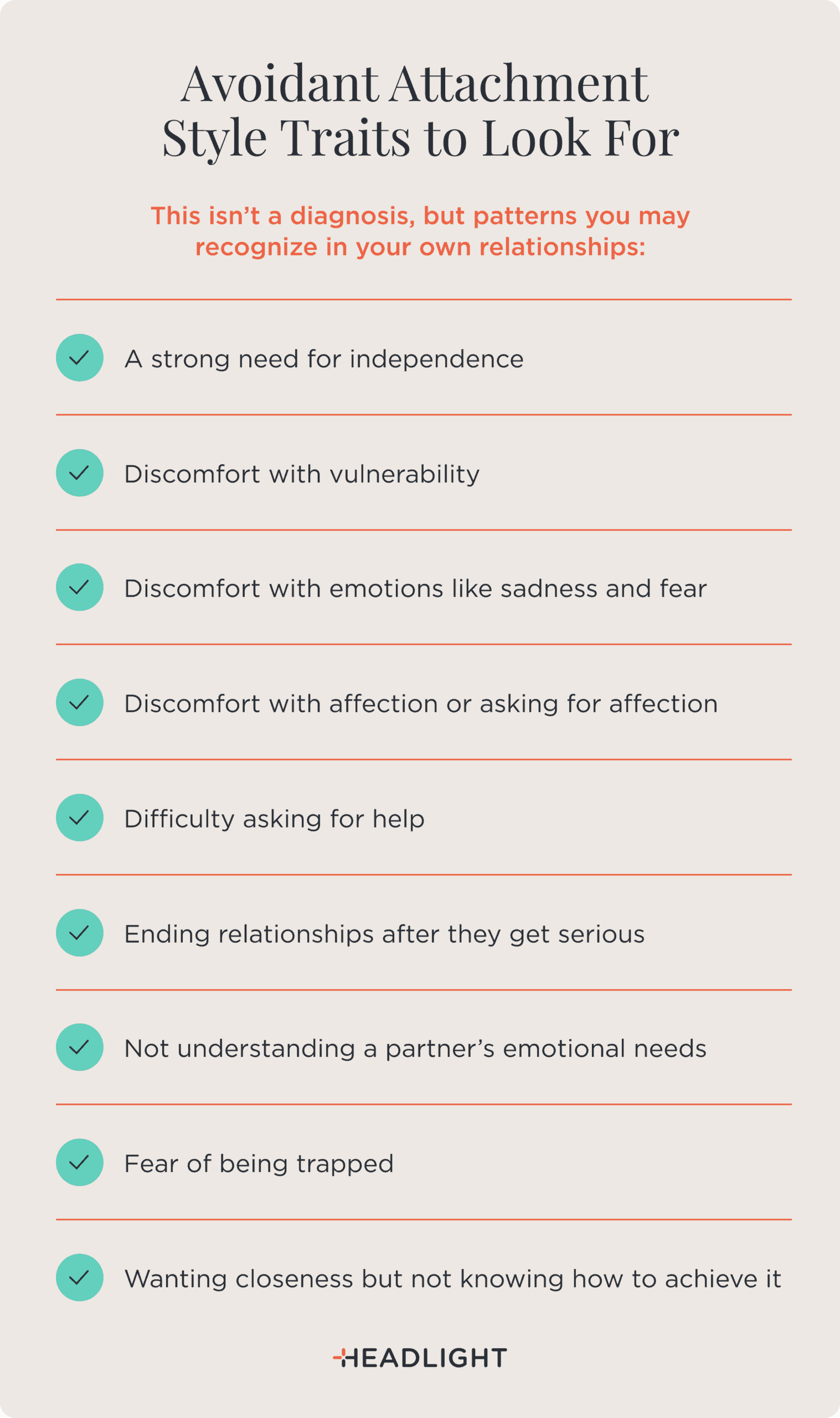
If you’re not sure where your attachment style falls, the following are a sampling of avoidant attachment traits. This isn’t a diagnosis, but patterns you may recognize in your own relationships:
- A strong need for independence
- Discomfort with vulnerability
- Discomfort with emotions like sadness and fear
- Discomfort with affection or asking for affection
- Difficulty asking for help
- Ending relationships after they get serious
- Not understanding a partner’s emotional needs
- Fear of being trapped
- Wanting closeness but not knowing how to achieve it
What causes avoidant attachment?
Many factors may contribute to the development of avoidant attachment. “One of the things we have been learning in longitudinal research is that it is unlikely there is a single reason why avoidant attachment develops,” says R. Chris Fraley, Ph.D., a professor at the University of Illinois’s Department of Psychology who researches attachment processes in close relationships.
Based on twin-studies of children, Fraley says, there are genetic differences that come into play. These genetic differences may make someone more or less likely to develop avoidant attachment. About 40% of avoidant adult attachment may be linked to genetic causes, according to research in the World Journal of Psychiatry.
As you’re well aware, there are a lot of things that have shaped you into the person you are today. Interpersonal experiences make a big impact in the development of avoidant attachment, says Fraley, including:
- Less supportive caregiving
- Father absence
- Changes in friendship quality
- Maternal depression
- Experiences in adult relationships, including breakups
With less supportive caregiving, we may have been taught that our emotions are “silly, nothing, a distraction, or problematic,” adds Goodman. On the other hand, achievement and independence were praised.
It’s critical to understand that your genetics, your upbringing and bond with caregivers, and your relationships today all combine to affect your attachment to others today. It is not one thing, and some of these factors, such as if your mom had depression, deserve respect and compassion rather than blame. You can acknowledge some of these things that have affected you while also moving forward.
How avoidant attachment affects relationships
First, let’s consider the effect avoidant attachment has on you. It’s associated with less resilience, social adjustment, low self-esteem, anxiety, and depression, notes research in The Journal of Affective Disorders. From there, it’s easier to see how avoidant attachment can affect relationships between you and loved ones.
Research in the European Journal of Investigation in Health, Psychology and Education shows that people with avoidant attachment will keep their emotional distance, isolate themselves, and actively suppress their need for connection (or even thoughts about connecting with others). As a result, you might appear emotionally numb, cold, or distant from your partner and very reluctant to receive care or help they offer. For your partner, that may dredge up feelings of loneliness, confusion, or emotional exhaustion as they try to keep the relationship afloat.
It’s no surprise then that research in The Spanish Journal of Psychology shows that people with avoidant attachment are less likely to be able to regulate their emotions or resolve conflicts effectively. Despite these challenges in relationships, you can still love deeply even with avoidant attachment.
Avoidant attachment vs. other attachment styles and diagnoses
Under the umbrella of “attachment” there are two main categories: secure and insecure attachment.
Insecure attachment can then further be divided. Avoidant attachment is one type of insecure attachment, along with others. “Some people are what we could label ‘fearfully avoidant’ whereas others are more ‘dismissing’,” says Fraley. Fearful avoidance, he says, involves a desire to distance oneself from closeness because it makes them feel vulnerable (or at risk in this position). Dismissive attachment downplays the value of close emotional bonds, Fraley explains. Anxious attachment is rooted in fear of being left, rejected, or unlovable.
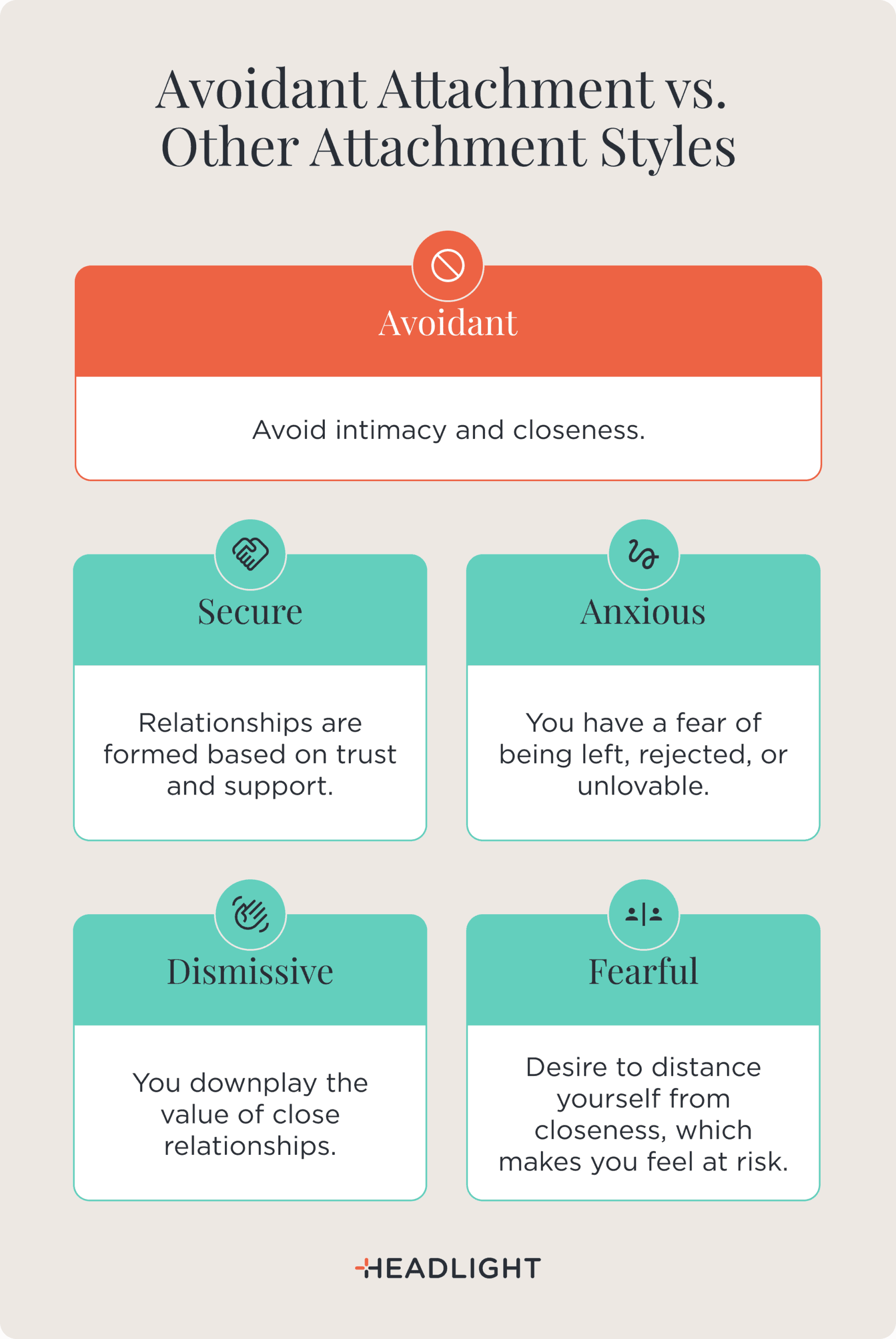
Possible Infographic: Attachment style spectrum graphic showing secure, anxious, dismissive, and fearful-avoidant patterns.
Secure: Relationships are formed based on trust and support.
Avoidant: Avoid intimacy and closeness.
Anxious: You have a fear of being left, rejected, or unlovable.
Dismissive: You downplay the value of close relationships.
Fearful: Desire to distance yourself from closeness, which makes you feel at risk.
Many people search for the term ‘avoidant attachment disorder,’ but this is not an accurate descriptor. Adult attachment styles are relationship patterns, not mental health diagnoses. Another seemingly similar term is “avoidant personality disorder.” This is a diagnosable personality disorder that’s characterized by social anxiety, heightened sensitivity to rejection, pervasive feelings of inadequacy, and a longing for meaningful connections, per StatPearls.
If avoidant attachment is causing you distress, individual therapy can still help you improve problematic relationship habits. A licensed mental health professional can help sort attachment patterns from mental health diagnoses like anxiety, depression, PTSD, personality disorders, or relationship stress.
How to know if avoidant attachment issues are affecting your life
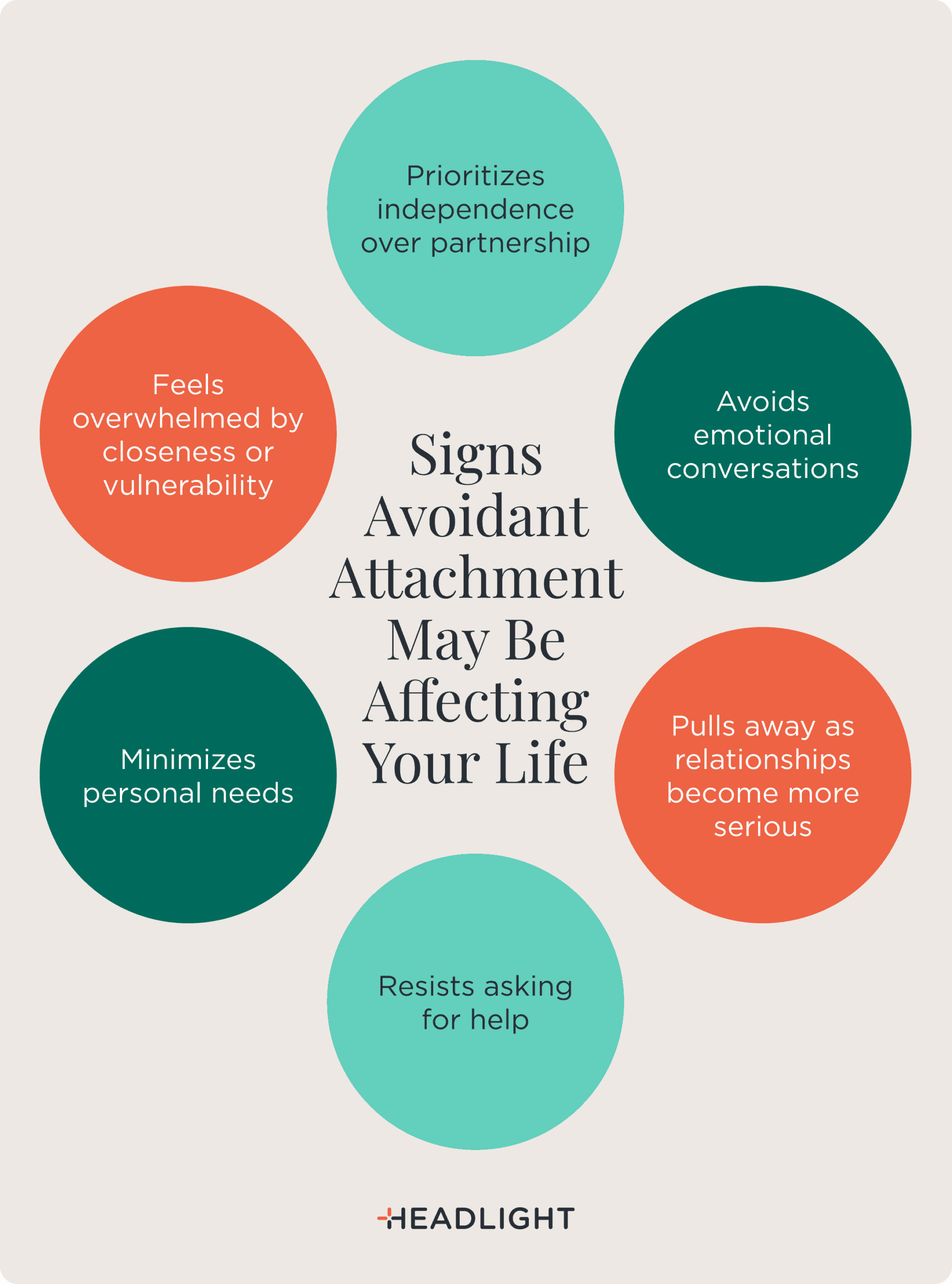
There is real value in reflection. Here are some things you can ask yourself, focusing on a range of relationships, including romantic, friendship, family, and your workplace:
- Do I value independence over partnership?
- Do I feel overwhelmed by closeness or vulnerability?
- Do I avoid emotional conversations?
- Do I minimize my own needs?
- Am I resistant to asking for help?
- Do I pull away from relationships when they begin to advance?
A mental health clinician can help assess you. During your initial conversation, you’ll talk to them about your relationship history and current challenges, childhood, trauma history, mood and anxiety symptoms, and support needs.
Insecure attachment is associated with lower well-being, in part because this style decreases resilience and mindfulness, says research in Current Psychology. Journaling is one activity that can help you improve mindfulness and explore your feelings in a safe way. Some prompts you can use include “What do I fear will happen if I depend on someone?” or “How do I react when I feel emotionally vulnerable, and why?”
How to heal avoidant attachment style
One place that Goodman has clients start is with experimenting with vulnerability, which, he says, can be scary at first. “It’s just the kind of exposure therapy that shifts emotional set points and well-worn assumptions we have if we’ve used avoidance to cope.” Specifically, this is called cognitive restructuring, a strategy used across different therapy styles, including cognitive behavioral therapy (CBT).
Cognitive restructuring is defined as a collection of techniques that teach you how to identify, evaluate, and correct inaccurate beliefs and explore why this pattern developed, according to a review in Psychotherapy. As an example, Goodman would work with a client to test new ways of feeling and being and notice the results that are possible. “We look for subtle differences in how you feel and how you can trust people with your feelings in much the same way as you can trust them with your house keys,” he says.
Goodman also uses internal family systems work, or IFS. With this practice, he describes, a client would hold space to have an unburdening (or release) of the past part of them that existed for self-protection and coping in early unsupportive environments.
In addition to the strategies above, you can also move closer to feelings of emotional safety by naming your emotions (using an emotion/feeling wheel can assist), practicing asking for help in small ways, staying present during conflict or emotional conversations, and choosing emotionally secure relationships.
Your therapist can help you with all of the points above by developing your emotional vocabulary, practicing communication scripts, and developing boundaries that make you feel safe — you don’t have to do this work alone.
Rewiring relationship patterns that have been in place for decades takes time, so be patient with yourself as you’re moving toward healing.
What partners and loved ones can do
If you’re a loved one or partner, it’s not your job to ‘fix’ someone else or be the source of their healing. If your partner is actively in therapy working on this, then you can be a source of steadiness and acceptance for them. “It’s a real breakthrough to take a chance with someone you trust and to have that person hold you, embrace you, show you that they love you more in your vulnerability, not less,” says Goodman. This experience can be life-changing for someone, he adds.
In many instances, couples therapy can be a safe space to express your needs while also developing tools to help your relationship, whether that’s respecting your partner’s space, making clear plans to reconnect on an issue, or staying calm if they emotionally shut down. You might learn specific scripts to use, such as: “I can give you space, but I’d like us to come back to this issue tonight.”
You can’t force vulnerability and it’s not healthy to ignore your own needs in service of someone else. Therapy can help you provide support, not tolerate emotional neglect or manipulation, and take care of yourself in the process.
When to seek professional help
Keep in mind that we don’t always show our vulnerable side or clearly express our feelings. That can be uncomfortable for everyone sometimes. “We all have moments of protection, armoring up, or masking when we aren’t sure where things will go with someone. It’s important to offer self-compassion when we notice this happening and normalize this as part of the human experience,” says Goodman.
Knowing this, you can seek professional help whenever it feels right to you. That might be when you experience:
- Repeated relationship distress, especially anxiety or depression related to relationships
- Fear of intimacy
- Unresolved trauma
- Conflict that you’re unable to work through
“It’s worth honoring what avoidance has offered us in the past while simultaneously considering whether or not this approach always serves us now, or if some reconsidering is warranted,” says Goodman. A desire to work toward healthier relationship patterns or self-improvement is a good enough reason as any to consider therapy.
If you have thoughts of self-harm, hurting someone else, feeling unsafe at home, escalating emotional or physical conflict, or are misusing substances to cope with relationship stress, seek care immediately and call or text 988. If you’re having a life-threatening emergency, call 911.
When it comes to treatment, no medication will directly treat an attachment style. However, if you also have anxiety and/or depression, PTSD, or sleep disruption related to your mental health, medication may be used as one therapy. From there, you may be better poised to work with a therapist to address relationship patterns that are holding you back.
With avoidant attachment, it may feel strange to discuss your feelings, and you may be reluctant to consider therapy. With several options available to you, you don’t have to come up with a plan on your own. Headlight offers therapy, psychiatry and medication management, and interventional psychiatry treatments, with in-person and virtual sessions available so you can choose what’s most comfortable for you.
Frequently asked questions (FAQs)
Is needing alone time the same as avoidant attachment?
It is not. Many people enjoy alone time and people need different amounts of it. Although avoidant attachment places a huge value on independence, this is done at the expense of close relationships.
Can avoidant attachment show up at work?
Yes. There is evidence that those who have avoidant attachment are more likely to develop workplace friendships, which can affect their level of support at work, per a study in the European Journal of Work and Organizational Psychology.
What should I do if therapy feels uncomfortable?
Therapy might feel uncomfortable, and that’s okay. If you feel okay doing so, you can share these thoughts with your therapist, who is trained to acknowledge those feelings and work with you in a way that prioritizes your feelings of comfort and safety.