
Disorganized Attachment: What It Looks Like and How to Heal
- Category: General
- September 14, 2026
Key takeaways
- Disorganized attachment is an insecure attachment pattern and is associated with a lack of fulfilling relationships.
- Attachment patterns, including disorganized attachment, develop from early relationships with primary caregivers. Disorganized attachment can stem from feeling frightened by or frightened for your primary caregiver.
- Those early life experiences can create someone who grows up conflicted, confused, and apprehensive about relationships.
- Disorganized attachment can share overlapping personality features with personality disorders and bipolar disorder, but these are not the same, and an attachment pattern is not a psychiatric diagnosis.
- While it can be tough to maintain healthy relationships, this skill can be learned over time. Therapy, including addressing early trauma, can help you move into more of a secure attachment pattern.
If you step back and think about it, it’s confusing: You want closeness but you’re afraid, distrustful, and repeatedly pulling away. What you’re experiencing may be a feature of disorganized attachment, an insecure attachment style.
If you’re confused about why you run away from and seek comfort from someone (all at once, sometimes), or this is a common pattern with someone you’re in a friendship or relationship with, this article can help you better understand the push-pull that’s present.
These attachment patterns develop during childhood — they were how you learned to stay safe — but they’re not fixed personality traits. With work, you can begin to build healthier relationships over time with some awareness, supportive people in your life, and professional help.
What is disorganized attachment?
Disorganized attachment is one type of attachment pattern (we’ll get more into the specifics of those, below). “This attachment pattern is characterized by the lack of engagement with fulfilling relationships, presenting a disturbance in identity development,” says licensed mental health therapist Alejandra Viramontes, LCSW. As a child, one might have contradictory behaviors, low emotional expression, and extreme inhibited or dissociated behavior, she says. Dissociation, generally, is a disconnect between one’s thoughts, memories, feelings, actions, or sense of self, according to the American Psychiatric Association. Separately, someone can be diagnosed with a dissociative identity disorder.
What causes a disorganized attachment style?
There are four different patterns of attachment: secure, preoccupied (also called anxious), dismissing (also called avoidant), and disorganized, says Arthur Becker-Weidman, Ph.D., founder of the Attachment-Focused Treatment Institute in Clarence Center, New York. The large majority of the population has one of the first three, which are all organized patterns, he says.
“Children develop the pattern of attachment of their primary caregiver,” says Becker-Weidman. For a disorganized attachment style, that typically arises after being raised in a home where your primary caregiver was frightened or frightening, he explains. “Quite often people who have experienced complex traumas or chronic early mistreatment in their caregiving relationship are more likely to develop a disorganized pattern,” he says.
Frightening or frightened caregiver behaviors can include being psychologically unavailable to a child, threats of harm, unusually extended absences,or seeing the caregiver be harmed by partner violence, explains one review in Attachment & Human Development. That results in a child who tries to move away from their caregiver, while also seeking support and safety from them. It’s that paradoxical push-pull that creates someone who grows to be conflicted, confused, and or apprehensive.
A child can still develop a secure attachment pattern if another caregiver (such as the other parent) has a secure pattern themselves, Becker-Weidman adds.
What does disorganized attachment in adults look like?
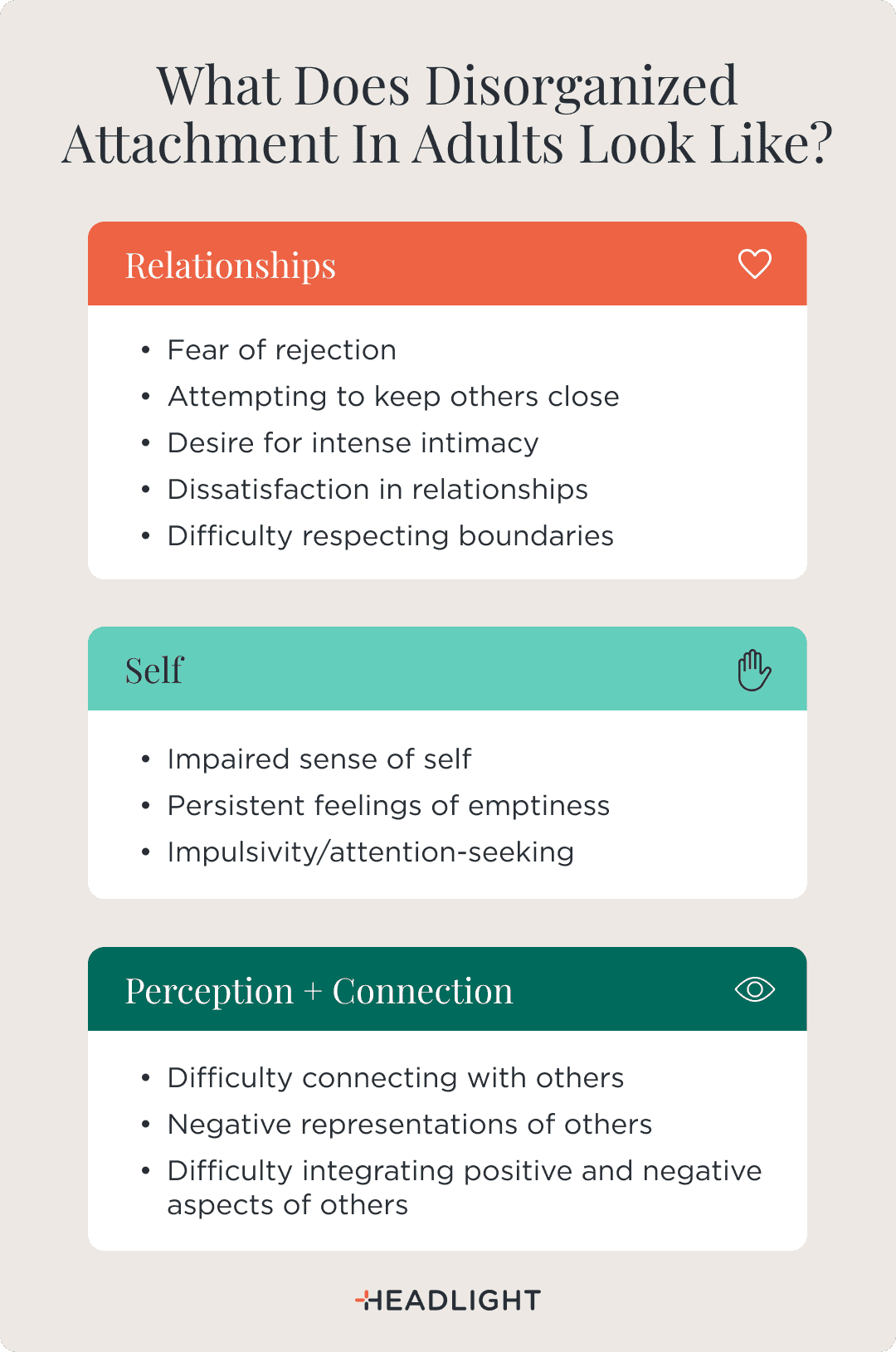
Here are behavioral patterns you might recognize if you or loved one has a disorganized attachment style, says Viramontes:
- Fear of rejection
- Attempting to keep others close
- Desire for intense intimacy
- Dissatisfaction in relationships
- Difficulty connecting with others
- Impaired sense of self
- Negative representations of others
- Difficulty integrating positive and negative aspects of others
- Difficulty respecting boundaries
- Persistent feelings of emptiness
- Impulsivity and attention seeking behaviors, sometimes
[Infographic opp? Either listing those above or illo’ing some of them that can be represented by a small graphic.]
As you can see, some of the above are opposites. And so, what can be complex is the push-pull that disorganized attachment often presents as. “Often, when [they are] receiving the desired connection they will push away from said connection,” says Viramontes. “They may hold contradictory beliefs that people cannot be trusted and are a source of fear while also believing that they can be a source of comfort.”
How disorganized attachment can affect relationships
A secure pattern values emotion and can understand the theory of mind, says Becker-Weidman. This is the awareness that your perception and understanding of something can be different from another person. Disorganized attachment struggles with seeing the other person’s point of view and emotions due to an unstable emotional foundation. You can see how this impacts one’s relationships, since securely being with another person involves caring about and acknowledging another person’s perspective.
It can be tough for someone with disorganized attachment to maintain healthy relationships. It’s difficult to maintain a close relationship with someone when you have trouble understanding the inner workings of someone else, explains Viramontes. “They have a difficult time connecting meaningfully with others,” she says. In addition, mood swings, difficulty engaging with unpleasant emotions, and difficulty with emotional regulation make quality relationships challenging.
Another point: A disorganized attachment style is usually present alongside secure, preoccupied, or dismissing patterns when it comes to relating to other people. To put this together, you could have a disorganized pattern with features of secure and dismissing, says Becker-Weidman. With that, you can see “elements of healthy or positive connections with others coupled with pushing away and devaluing the other person’s emotions,” he explains.
Is disorganized attachment the same as fearful avoidant?
There are some overlapping features, which is why the patterns are often used interchangeably and the terminology can vary across researchers and clinicians. You might also see this written as fearful-avoidant (disorganized) attachment, for instance.
Fearful-avoidant attachment is a type of insecure attachment pattern whereby someone has a negative view of others and themselves, desire intimacy, fear rejection and abandonment while being mistrustful of others and avoiding closeness, explains research in the Archives of Sexual Behavior. Those who have a fearful avoidant style are also likely to be lonely and struggle to form healthy romantic relationships.
What is disorganized avoidant attachment?
As mentioned earlier, attachment patterns can be seen more as a continuum, per the Journal of Personality and Social Psychology—rather than putting someone into one bucket or the other. That’s why you can see a combination of two or three insecure attachment styles.
With that, there can be different expressions of disorganization, including patterns that have more dismissive (avoidant) or more preoccupied (anxious) characteristics.
One example of how a dismissive pattern might come into play on a normal day is if a partner is upset about something that happened during the day. You might recognize that they are sad but then devalue it and move on, saying something like, “well, let’s figure out what we’re going to have for dinner,” explains Becker-Weidman.
Rather than self-diagnosing using one label, focus on recurring patterns of behavior to better understand your reactions and relationships with others.
Common triggers for disorganized attachment in adults
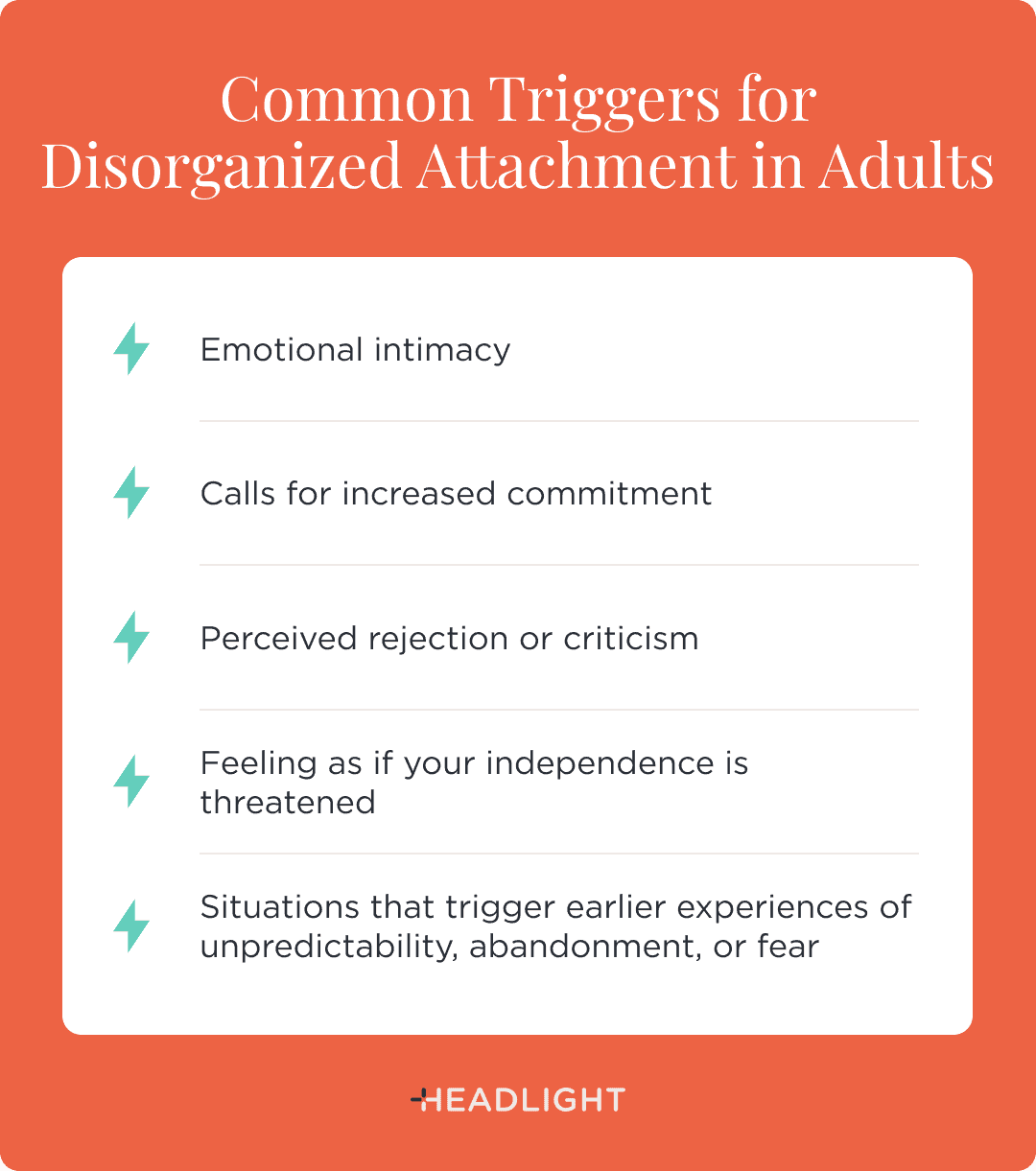
Depending on your overlapping attachment patterns, these are some triggers that might impact your reactions and behaviors toward someone, whether that’s a friend, intimate partner, family member, or colleague:
- Emotional intimacy
- Calls for increased commitment
- Perceived rejection or criticism
- Feeling as if your independence is threatened
- Situations that trigger earlier experiences of unpredictability, abandonment, or fear
How to heal disorganized attachment
“This attachment style has deep roots in trauma,” says Viramontes. “Someone wanting to work to heal disorganized attachment would need to engage with processing the trauma that occurred in childhood.” Some skills that someone with this attachment pattern could work on in therapy include learning emotional awareness and regulation, which would help with a better understanding of emotions, as well as self-compassion to improve sense of self-worth.
It’s also important to point out that disorganized attachment does not mean that you have bipolar disorder or borderline personality disorder. These are commonly conflated because some behavioral patterns can be similar between the two (such as acting “hot and cold” and being someone who has bipolar disorder), but are very different. “Attachment pattern is the way you generally organize your world. You can’t use a pattern of attachment to make a psychiatric diagnosis,” says Becker-Weidman. What’s more, psychiatric diagnoses have very specific, validated treatments, which may include medication or therapy.
Disorganized attachment patterns may be an indication that you are more prone to developing a personality disorder, notes an analysis in Personality Disorders. Or, it could also be that people with borderline personality disorder, for instance, have a more disorganized attachment style that comes out in shared features like extreme need for closeness, intense fear of rejection, and contradictory mental states and behaviors, the researchers suggest.
How therapy can support more secure attachment
Attachment-focused psychotherapy is recommended for helping you build more secure, trusting attachments, says Becker-Weidman. This should address the early trauma that entrenched the attachment patterns in the first place, he says. This is something that can be worked on in trauma-focused therapy, as well.
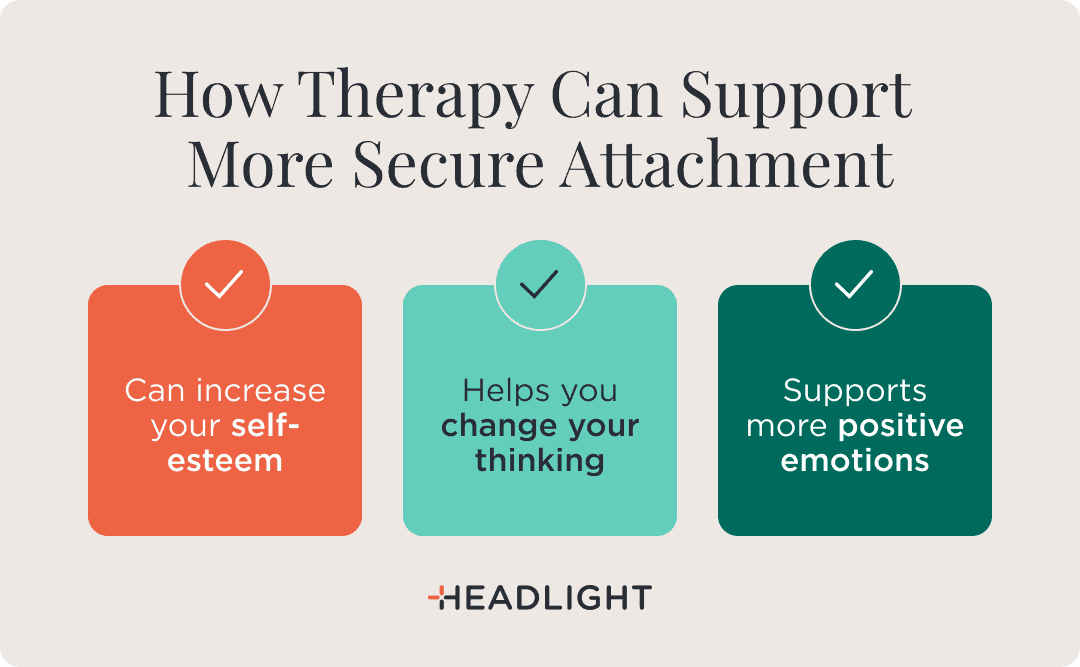
- Can increase your self-esteem: Increasing self-awareness and understanding more about where your cognitive distortions (thought patterns that don’t reflect reality) are coming from and how they’re related to attachment style, can help improve how you view yourself, says Viramontes.
- Helps you change your thinking: Reframing thought patterns pertaining to perceived rejection and abandonment that come up around relationships will help you respond in a way that reinforces quality relationships—rather than pushing people away, says Viramontes.
- Supports more positive emotions: A treatment approach called behavioral activation can be used to encourage you to participate in rewarding activities to improve your mood, says Viramontes.
Several different types of therapy may be appropriate for you along the way, including emotion-focused therapy, cognitive behavioral therapy (CBT) or dialectical behavior therapy (DBT), says Viramontes. For help with your relationship, couples therapy is work you can do together to help you better understand and support each other.
Building secure relationships while you heal
Building a more secure attachment comes from recognizing your own attachment style and understanding how it developed. The next step is learning skills like healthy communication to express your emotional needs. The work can be lifelong with no distinct “finish line” when you’re healed. Although the goal isn’t complete healing, it is building increasingly secure relationships, says Becker-Weidman. “You’re working toward a more secure pattern, and in this pattern people value emotions, relationships, and have a reasonably well-developed ability to reflect on someone else’s feeling and perception without labeling it good or bad,” he explains.
Connecting with a secure person in your life to build a trusting relationship (such as a teacher or coach) can also lead to healing, Becker-Weidman adds. This, of course, is not guaranteed and it may be someone who comes into your life by accident, but being open to this may also be helpful.
Frequently asked questions (FAQs)
Can disorganized attachment be healed?
Disorganized attachment is something that you can work on in therapy, but building secure attachments can be a lifelong pursuit. The goal isn’t to heal, but it’s to move toward a more secure attachment pattern to improve your relationships with others.
What does disorganized attachment look like in a relationship?
It can look like many different things, but often it’s described as a “push-pull.” You have a tendency to push away from or flee someone that you’re getting close to, while at the same time trying to seek comfort and safety in them.
Does disorganized attachment always come from trauma?
Not always. However, the origins of disorganized attachment are believed to come from a childhood where your primary caregiver was frightened or frightening. You didn’t feel safe but you still had to turn to them for comfort and care.
Deep dive recommendations