How To Find Relationship Counseling Near You
- Category: General
- July 15, 2026
Written by Michelle Konstantinovsky
Clinically Reviewed by Michael Falcone, Psy.D, LMFT
Key takeaways
- Before starting your search for a relationship counselor, it’s important to agree on core relationship concerns, practical logistics, and a mutual readiness to participate.
- Identify whether your goals align best with couples counseling, marriage therapy, discernment counseling, or another form of relationship counseling.
- Skilled clinicians generally maintain a balanced, safe environment without taking sides. Red flags include a clinician promising quick fixes, imposing personal values, or consistently aligning with one partner over the other.
Real-life relationships rarely resemble the Hollywood-style rom-coms we’ve all been raised on. If you and your partner are experiencing repetitive arguments, emotional distance, or major communication issues, seeking professional support may be your best bet. Finding the right relationship counselor may seem daunting—but it doesn’t have to be. Start by sitting down together, aligning on your shared logistical and emotional goals, and finding a neutral professional who treats the relationship itself as the client.
Despite what you may have witnessed repeatedly in rom-coms and made-for-TV holiday movies, relationships aren’t always easy. Acknowledging that you and your partner may need some professional support and guidance is a big deal—taking the next step to actually find that support and guidance can feel even bigger.
Starting your search for a relationship counselor can feel incredibly intimidating—especially if you and your partner aren’t even sure if you’re on the same page yet. But, unlike our favorite on-screen fictional characters, real people often need and deserve real help to keep their relationships fulfilling and functional. Whether you’re dealing with repetitive arguments, emotional disconnect, or just want to strengthen your foundation, finding the right relationship clinician requires some research, education, and commitment.
Read on for a no-nonsense guide to help you and your partner identify your shared goals and confidently choose the right relationship counselor for your unique needs.
How to find relationship counseling near you: start with shared goals
Before you even begin your search for a relationship clinician near you, you might be wondering whether you even really need relationship counseling. After all, couldn’t your issues be sorted out in individual therapy? Well, it depends. And before you make the decision to research and pursue a specific type of counseling, it’s helpful to know what makes relationship counseling unique and potentially more beneficial for certain situations.
“Determining whether individual or couples counseling is the best fit often begins by identifying the primary concern,” says Headlight clinician, Joshua Price, LPC. “If the difficulties are primarily related to one person’s mental health, such as anxiety, depression, trauma, grief, or self-esteem concerns, individual counseling may be the most appropriate starting point.” That said, if the biggest challenges you and your partner face seem to involve communication difficulties, recurring conflict, trust concerns, emotional disconnection, or relationship satisfaction, then couples counseling is probably your best bet.
But it also doesn’t have to be a black and white issue—many people find individual counseling to be a great complement to relationship counseling. “In many cases, both individual and couples counseling can be helpful,” Price says. “The best way to assess which is correct for each person is to determine whether the struggle is about the relationship itself and communication with their partner, or whether it stems from the individual and/or affects areas outside the relationship.”
And it’s totally okay if you really can’t figure out where your problems stem from. You can go ahead and book an initial consultation with a counselor even without knowing which direction you’d like to go. “Discussing with your potential therapist during the intake appointment can help you decide on the best approach,” Price says. “Additionally, assessing whether your partner is open to couples counseling is important, as when couples are not aligned on the idea of couples counseling or on what they want from it, it is less effective.”
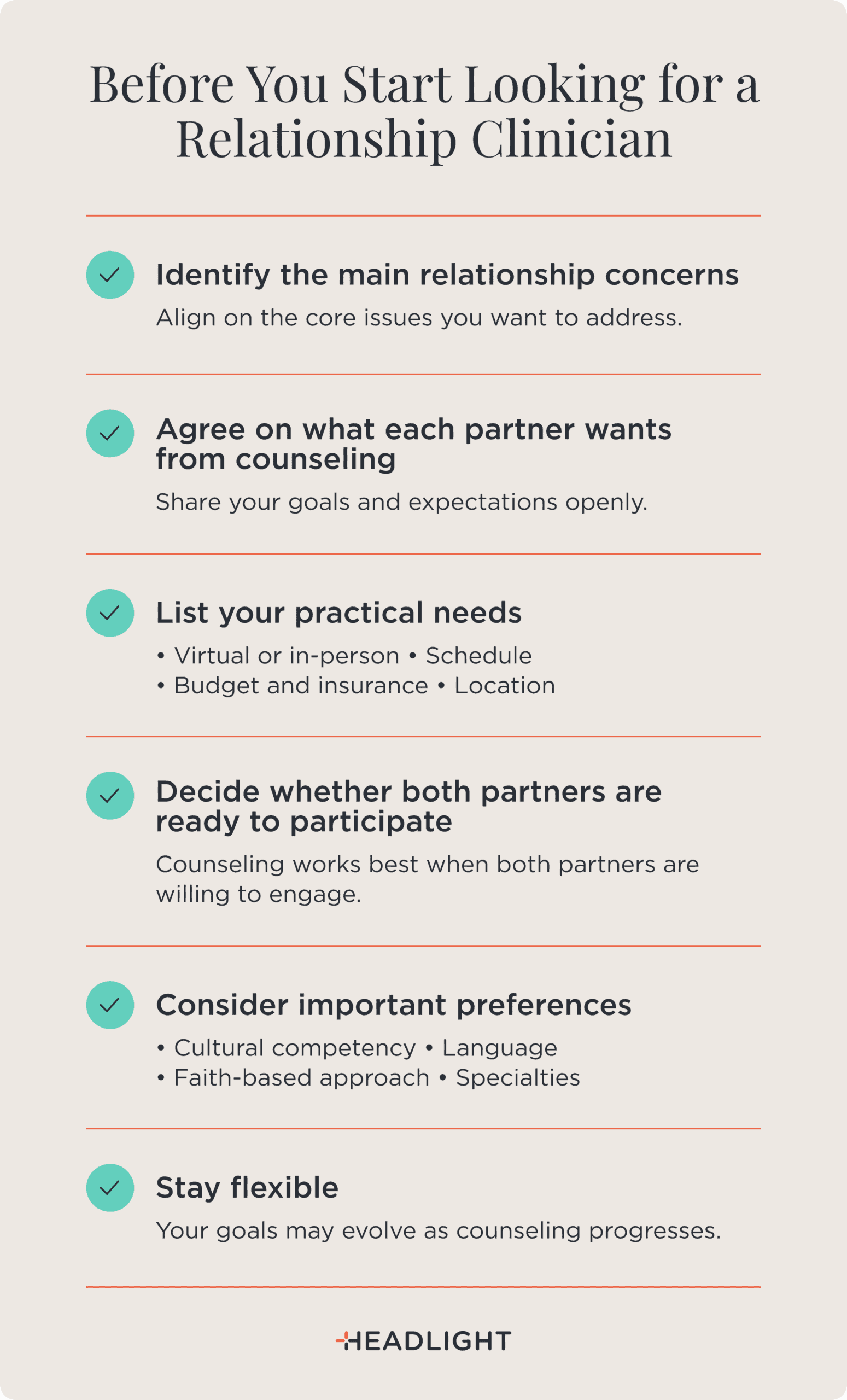
Finding the right relationship clinician is a process, and the whole thing runs much more smoothly when both partners are on the same page regarding concerns, goals, and logistical preferences. While there may be existing friction or disagreement in the relationship, finding a clinician typically requires both partners to sit down and map out a few needs and expectations:
- Identify the main relationship concerns. While there may be two sides to every story, both partners will need to align on the core issues in the relationship and what’s causing tension or distrust.
- Agree on what each partner wants from counseling. You may want different things, and that’s okay. But it’s important to be honest with each other about what your counseling goals are.
- List your practical needs. Consistency and commitment are essential when pursuing relationship counseling, so logistics matter. Make sure you’re both aligned on the convenience of the clinician’s location (or whether you’d both prefer virtual care), scheduling, cost, insurance, etc.
- Decide whether both partners are ready to participate. Relationship counseling requires both partners to agree to the process; if one person is hesitant or adamantly against the endeavor, it may be time to reevaluate how to proceed.
- Consider important preferences. It may be important to seek out certain characteristics or specialties in a relationship clinician, including cultural and identity competency, language abilities, faith influence, and more.
- Stay flexible. Things may change as you move through relationship counseling. It’s important to keep your goals flexible as you both evolve in the process and reveal deeper, ingrained patterns in yourselves and in your relationship.
Know which type of relationship support fits your situation
While we often refer to “relationship counseling” as a singular modality, there are actually a variety of options when it comes to getting the right kind of relationship support. Despite these terms often being used interchangeably, there are important nuances to be aware of as you start considering your options.
“The most appropriate type of support often depends on the couple’s goals,” Price says. “Understanding the distinctions between these services can help couples select a provider whose expertise aligns with their specific needs and desired outcomes. Discussing with your therapist and your partner what your goals and intentions for couples counseling is crucial, as when partners are not aligned, couples counseling becomes less effective.”
According to marriage and family therapist Alyssa Mass, MFT, there can be a variety of nuances associated with specific licenses and titles that vary by location, but asking direct questions about a clinician’s background can be helpful when figuring out what kind of support fits your situation. “Ask somebody what their license is in and if you’re not sure what that license means, ask them to explain it,” she says. “Ask them to explain what their background is, what they’re training is, what was required for them to get their license, etc. They should be very comfortable and able to provide that background for a prospective client.”
Here’s a breakdown of the most common types of relationship support:
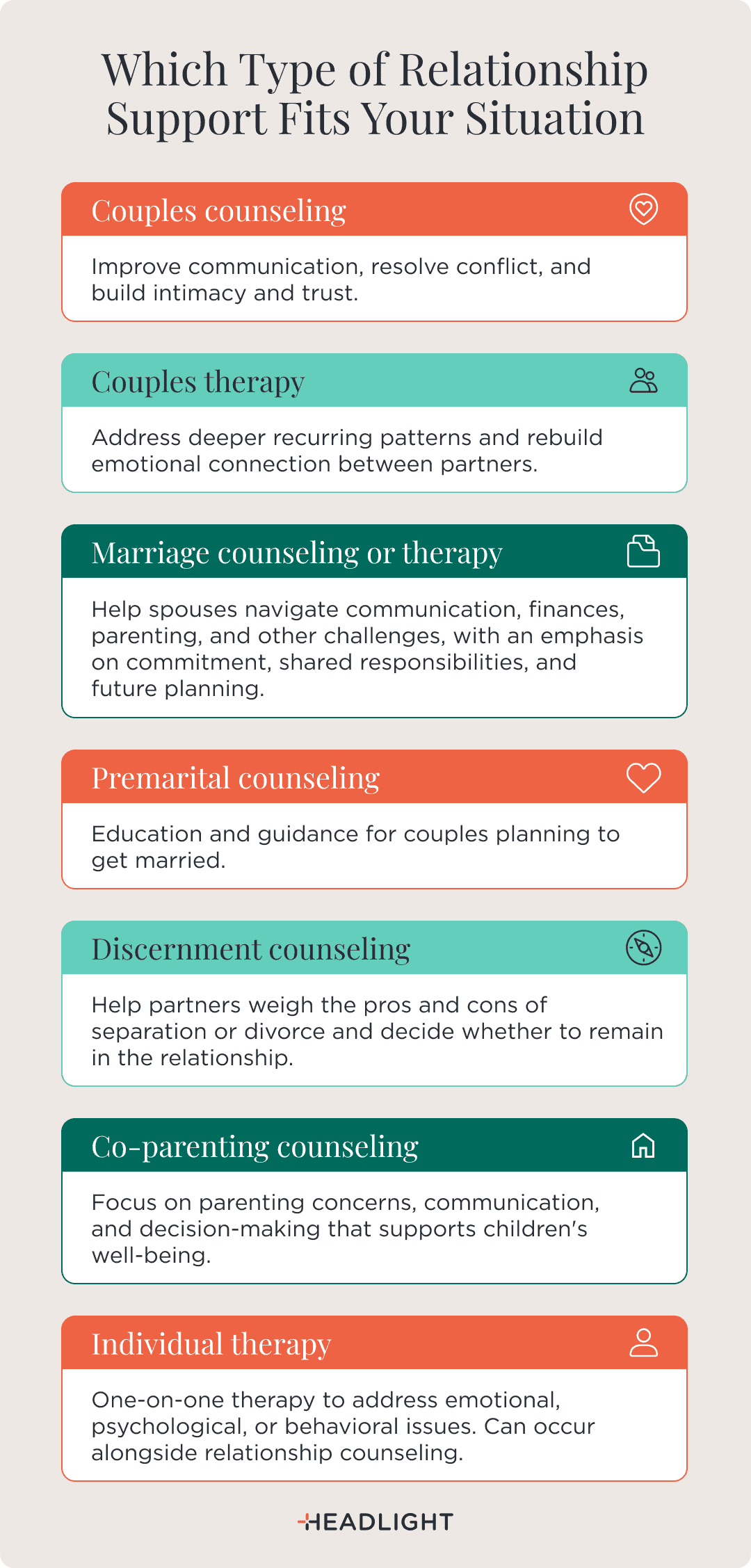
- Couples counseling: This type of counseling is rooted in improving communication, resolving conflict, and building intimacy and trust. “Couples counseling generally focuses on strengthening communication, improving conflict resolution, and increasing emotional connection within the relationship,” Price says.
- Couples therapy: This type of support is generally for deeper recurring patterns and for building or rebuilding emotional connection. According to the American Psychological Association (APA), couples therapy involves both partners being treated at the same time by the same therapist or therapists. This type of therapy typically addresses problems within and between partners that are affecting the relationship.
- Marriage counseling or therapy: This type of counseling is often led by a licensed marriage and family therapist (LMFT) specifically trained to help spouses work on issues related to communication, finances, parenting, and other problems, according to Cleveland Clinic. While marriage counseling may address many of the same concerns that arise in couples counseling, it also emphasizes “commitment to the marriage, shared responsibilities, and future planning,” according to Price.
- Premarital counseling: This form of counseling consists of education and guidance to couples planning to get married, according to the APA. This type of counseling is often led by a therapist, member of the clergy who is trained in counseling, or another appropriately qualified person.
- Discernment counseling: This form of counseling is designed to help partners weigh the pros and cons of separation or divorce. “Discernment counseling helps couples assess whether they want to remain in a relationship at all and move forward cordially,” Price says.
- Co-parenting counseling: “Co-parenting counseling focuses specifically on parenting concerns, helping caregivers communicate effectively and make decisions that support their children’s well-being, regardless of the status of the romantic relationship,” Price says.
- Individual therapy: Sometimes called “psychotherapy” or “counseling,” individual therapy involves one-on-one work between a client and a mental health professional to address emotional, psychological, or behavioral issues. This type of therapy can often occur in conjunction with any type of relationship counseling.
Signs it may be time for couples counseling
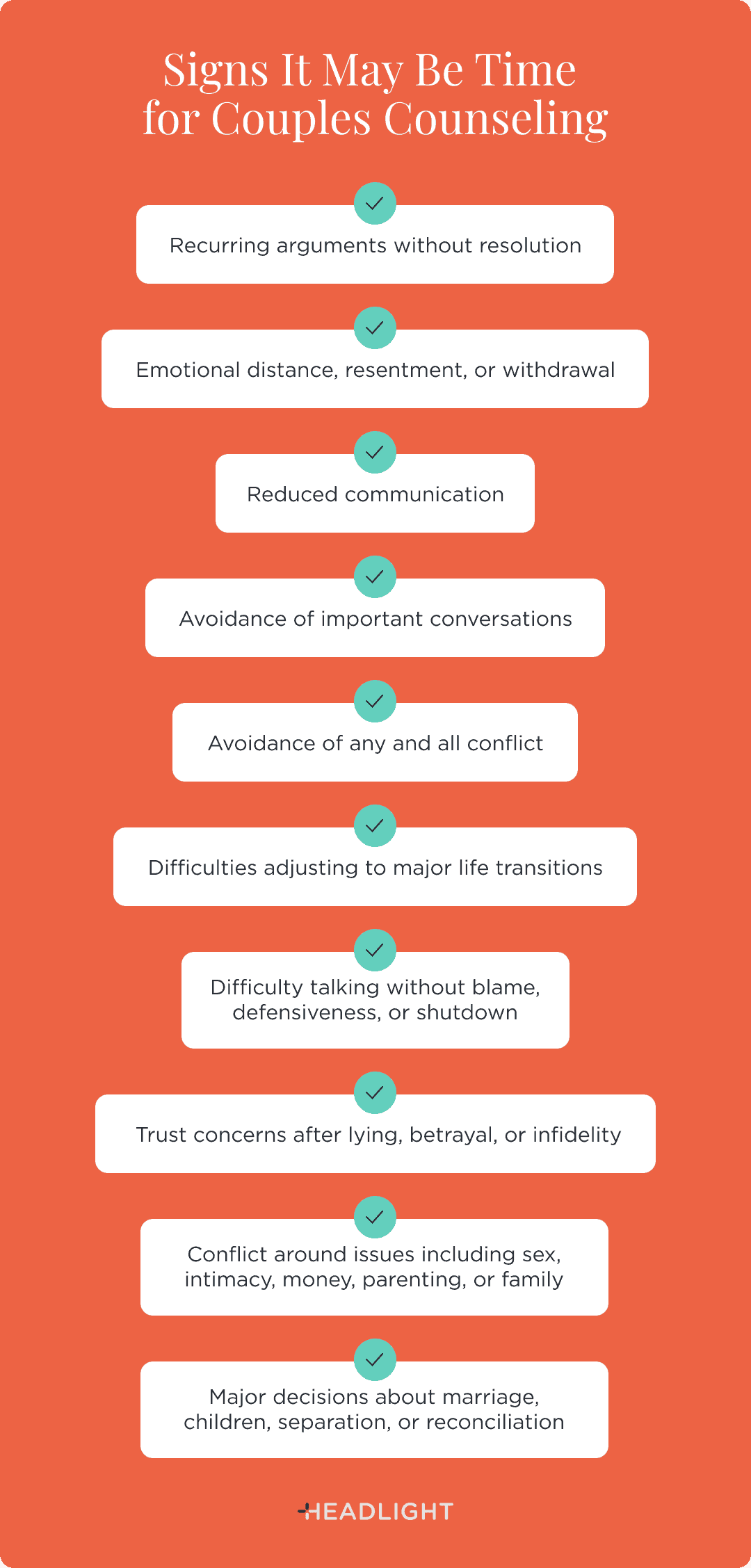
While every relationship is unique and comes with its own distinct set of circumstances, challenges, and goals, there are some common signs that a partnership may benefit from couples counseling. “Many couples assume counseling is only necessary when a relationship is in crisis,” Price says. “However, some of the most common indicators for counseling can appear much earlier.” Here are some of the most common concerns that may benefit from professional support, according to Price and Mass:
- Recurring arguments without resolution
- Emotional distance, resentment, or withdrawal
- Reduced communication
- Avoidance of important conversations
- Avoidance of any and all conflict
- Difficulties adjusting to major life transitions
- Difficulty talking without blame, defensiveness, or shutdown
- Trust concerns after lying, betrayal, or infidelity
- Conflict around issues including sex, intimacy, money, parenting, or family
- Major decisions about marriage, children, separation, or reconciliation
While these signs may seem like obvious red flags, Price says they’re all too easy to brush under the rug. “Unfortunately, these signs are often minimized because they develop gradually and may not feel urgent,” he says. “Many couples wait until patterns have become deeply ingrained before seeking help. Counseling is often most effective when concerns are addressed as early as possible to reduce frustration, resentment, and disconnection, which can intensify.”
How to find a relationship therapist with the right credentials
Potentially one of the most daunting parts of finding a relationship therapist is trying to make sense of the variety of clinicians and mental health professionals out there. “One of the most important factors to consider is whether the clinician has training and experience working with couples,” Price says. “Relationship counseling requires a unique skill set that is different from individual therapy, as the therapist works with the relationship itself rather than focusing solely on one individual.”
Headlight is one excellent starting point on your couples therapy journey, where you can learn communication skills, conflict resolution, and other essential tools. But it’s not the only option out there.
A few things to consider when searching for a couples clinician:
- Learn about the various types of mental health professionals (check out the National Alliance on Mental Illness or NAMI for a full list of the various types of mental health professions, including psychologists, counselors, clinical social workers, and more)
- Prioritize clinicians who have experience with couples, marriage, family, or relationship concerns
- Check local state licensing boards when possible to ensure the person you’re considering is, in fact, currently licensed
- Review the person’s specialties, training, and populations served
- Ask whether they work with both partners together at the same time
- Confirm whether they offer virtual, in-person, or hybrid sessions
Therapy approaches to ask about
While there are a variety of therapy approaches out there, many relationship clinicians ground their work in the following approaches:
- Emotionally focused therapy (EFT) is based in attachment theory and focuses on fostering emotional connection by identifying the emotional issues driving relationship problems, according to Current Opinion in Psychology.
- Gottman-Method and Gottman-informed care is based on structured behavioral adjustment to address conflict, improve communication, and cultivate friendship between partners, according to International Journal Of Environmental Research And Public Health.
- CBT-based approaches are rooted in cognitive behavioral therapy (CBT) and identify and restructure unhelpful thought patterns and behavior cycles, according to Current Opinion in Psychology.
- Psychodynamic approaches examine how early relationship patterns and attachment histories may shape current partnerships, according to Cleveland Clinic.
- Family systems approaches view the couple as a single unit rather than two separate partners and examines familial roles, boundaries, and dynamics, according to The Wiley Blackwell Encyclopedia of Family Studies.
- Integrative care blends theories and techniques to fit a couple’s unique needs.
According to Mass, many clinicians practice integrative care, pulling in ideas and approaches from a variety of sources. “A counselor should be able to meet their client where they are and they might need to have strategies from different schools of thought in order to do that,” she says.
Practical filters that help narrow your local search
Once you’ve researched the type of clinician and counseling style that best fits your needs, you’ll likely want to narrow your local search with some practical filters. Here are some logistical details to consider:
- Does the clinician accept insurance or are they out of network?
- What are the session fees and payment policies? Would they consider a sliding scale?
- What time of day will sessions take place, and what is the clinician’s recurring appointment availability?
- Are virtual sessions available for convenience and access?
- What is the office location, and what details do you need to know around the commute (parking, public transit, etc.)?
- What is the clinician’s availability for both partners’ schedules?
How to find a good marriage counselor or couples therapist
It can’t be overstated that every relationship is one-of-a-kind and the partners may want or need different qualities in a clinician. But generally speaking, Price says there are a few features to look for when trying to find the right person. “Couples benefit from seeking a counselor who can maintain neutrality, create a safe environment for both partners, and provide a structured approach to addressing concerns,” he says. “Additionally, finding a counselor whose communication style, therapeutic approach, and areas of expertise align with the couple’s needs can help foster engagement and improve treatment outcomes.”
Here are a few things to keep in mind during your search:
- Look for neutrality and balanced support for both partners
- Choose someone who explains their process clearly
- Notice whether both partners feel respected
- Ask how they handle high-conflict sessions
- Ask how progress is measured
- Expect structure, communication tools, and between-session practice
Price adds that it’s important to find a clinician who has experience working with couples and has a clear treatment approach—whether that’s Gottman Method, Integrative Behavioral Couple Therapy (IBCT—a method that focuses on behavior change and emotional acceptance, according to Current Opinion in Psychology), or something else.
“Effective relationship counselors typically possess a combination of clinical expertise and strong interpersonal skills,” Price says. “Couples may benefit from working with a counselor who demonstrates empathy, maintains neutrality, communicates clearly, and is skilled at helping partners identify patterns within their relationship.”
“I think sometimes a lot of people are intimidated or they’re scared or they think they’re not supposed to ask—by all means ask away,” Mass says. “Anyone who is experienced in the field and confident in their work and their approach should be able to explain how they work with clients. And you can ask for examples or you can also give an example of what’s going on in your life and ask how they would approach it. That doesn’t mean they’re going to give you therapy on the phone or during a consultation, but they should be able to give you a brief explanation.”
It’s also important for a couple to consider the type of environment they each need to fully feel comfortable, heard, respected, and appropriately challenged. “A strong relationship counselor helps couples move beyond assigning blame and instead develop greater insight into the interactional patterns that contribute to relationship distress, allowing the couple to feel they are tackling a problem together rather than ‘fixing’ one of the partners,” Price says.
Red flags when choosing a relationship counselor
With so much to consider when it comes to choosing a relationship counselor, it’s important to be aware of some red flags that should raise your alarm bells right off the bat, including:
- Promises of quick fixes or guaranteed outcomes
- Consistently taking one partner’s side
- Poor boundaries or unclear policies
- A lack of structure
- Imposing personal values on clients
- Minimizing important concerns
- Failing to address significant safety issues such as abuse or coercive control
- Dismissing identity, culture, values, or relationship structure
- Pressuring a specific decision about staying or separating
- Avoiding questions about training, cost, or process
“One of the most significant red flags is a counselor who consistently aligns with one partner against the other,” Price says. “Effective couples counseling requires balance and the ability to understand both individuals’ perspectives.”
Price also notes that couples counseling is contraindicated when there is active domestic abuse or substance use; in these instances, individual counseling is considered a more effective initial strategy. “Couples should feel that the counseling process is collaborative, purposeful, and focused on helping both individuals better understand themselves and each other,” he says.
What to expect in the first few sessions
Each clinician may approach their first few sessions in varying ways, but in most cases, you can expect the following:
- A discussion about relationship history and current concerns
- Space for each partner to express their perspective
- Identification of communication patterns and conflict cycles
- Clarification of shared and individual goals
- Practical exercises for communication and repair
- Ongoing evaluation of therapist fit and progress
“The initial sessions are often focused on assessment and relationship exploration,” Price says. “The counselor will typically gather information about the couple’s history, strengths, current concerns, and goals for counseling.”
Rather than immediately attempting to solve problems, Price adds that clinicians work to understand the patterns that contribute to the difficulties the couple is experiencing. “As counseling progresses, couples may begin learning new communication strategies, identifying unhelpful interaction cycles, and developing skills that promote healthier relationship functioning,” he says. “The first few sessions often lay the foundation for the work throughout the counseling process.”
When relationship counseling may not be enough or appropriate
“While relationship counseling can be highly effective, there are situations in which additional services may be necessary,” Price says, noting the following examples:
- Active substance abuse
- Untreated severe mental health conditions
- Domestic violence
- Coercive control
- Ongoing safety concerns
- Significant individual trauma
Each of these instances may require individual counseling in addition to or prior to couples counseling. “In these situations, individual therapy, psychiatric services, substance use treatment, crisis intervention, or specialized domestic violence resources may be appropriate,” Price says. “Working with your therapist to address these concerns and receive additional support and referrals for services allows individuals and couples to receive appropriate support.”
Frequently asked questions (FAQs)
How do I find a relationship therapist both partners like?
While there’s a lot to consider when it comes to finding a clinician both partners like, there are a few things that can help you get to a mutual decision:
- Before searching, agree on your logistical needs (budget, scheduling, in-person versus virtual) and what you both hope to get out of therapy.
- Look for licensed clinicians who specialize in couples therapy and who use structured, evidence-based methods.
- Take advantage of brief consultation calls to find someone who makes both partners feel equally heard, respected, and understood, without taking sides or assigning blame.
Can relationship counseling help if only one partner wants to go?
Relationship counseling requires both partners to agree to the process. If one person is hesitant or adamantly against it, couples counseling becomes significantly less effective. However, individual therapy is always an option, whether both partners are aligned or not. Working one on one with a therapist allows you to address your own needs, mental health, and personal goals while you reevaluate how to proceed in the relationship.
What is the difference between couples counseling and couples therapy?
While many people use these terms interchangeably, counseling typically focuses on the relationship dynamic in the present, and is focused on strengthening communication, resolving conflict, and increasing emotional connection. Couples therapy is designed to address more deep-seated, recurring patterns, focusing on the issues of each partner and the problems within their relationship.
Deep dive recommendations
For further information, consider visiting the following resources:
- https://www.apa.org/topics/marriage-relationships
- https://www.nhs.uk/every-mind-matters/lifes-challenges/maintaining-healthy-relationships-and-mental-wellbeing/
- https://www.aamft.org/
- https://www.bacp.co.uk/about-therapy/what-therapy-can-help-with/relationships/
- https://www.gottman.com/about/research/