
Gaslighting Examples: 10 Phrases to Recognize
- Category: General
- September 3, 2026
Key takeaways
- Gaslighting is different from lying or disagreeing — it’s a repeated pattern that makes someone doubt their own memory, feelings, or perception of reality.
- Gaslighting examples often include absolute language like “always” and “never,” and include phrases like “that never happened” or “you’re too sensitive.”
- Gaslighting can show up in contexts other than romantic relationships — including friendships, family, the workplace, and even healthcare settings.
- If you ever have concern for your own safety due to gaslighting, first prioritize your physical well-being and then consider talking to a therapist or trusted person.
Gaslighting isn’t the same as lying or arguing — it’s a repeated pattern where someone denies your reality until you start doubting your own memory and judgment. While gaslighting can occur in romantic relationships, it can also show up in the workplace, in families, friendships, and even in healthcare settings. If you find yourself consistently confused after conversations, constantly apologizing, or losing trust in your own perception of reality, it’s time to talk to a professional or someone you trust.
If you’ve ever experienced someone repeatedly denying your truth, invalidating your feelings, and even leading you to question your own sanity, you may be intimately familiar with gaslighting. While the term “gaslight” has surged in popularity over the last few years, it’s derived from a 1938 play, in which a husband lies, manipulates, and isolates his heiress wife to steal her money, according to The Lancet Psychiatry. And these gaslighting examples remain pertinent to the modern definition. According to the International Journal of Psychological Research, gaslighting is “a form of psychological violence characterized by manipulative and controlling behaviors intended to alter one’s own partner’s thoughts, perceptions, actions, and affects.”
Gaslighting isn’t a one-off argument or disagreement — it’s built on repeated patterns and involves specific context, power, and impact. Read on to learn some of the most common gaslighting examples, practical responses, how to find professional support and safety resources, and more.
Gaslighting examples: What the phrases have in common
While there are countless gaslighting examples, the phrases that people tend to use when gaslighting share a number of things in common, including denial, minimization, blame-shifting, diversion, and an intention to isolate the other person. A person attempting to gaslight someone may make repeated attempts to rewrite past events or undermine the person’s perspective, instilling growing confusion or self-doubt in the person experiencing the behavior. This self-doubt gives a gaslighter power or control by making their version of reality seem unquestionable.
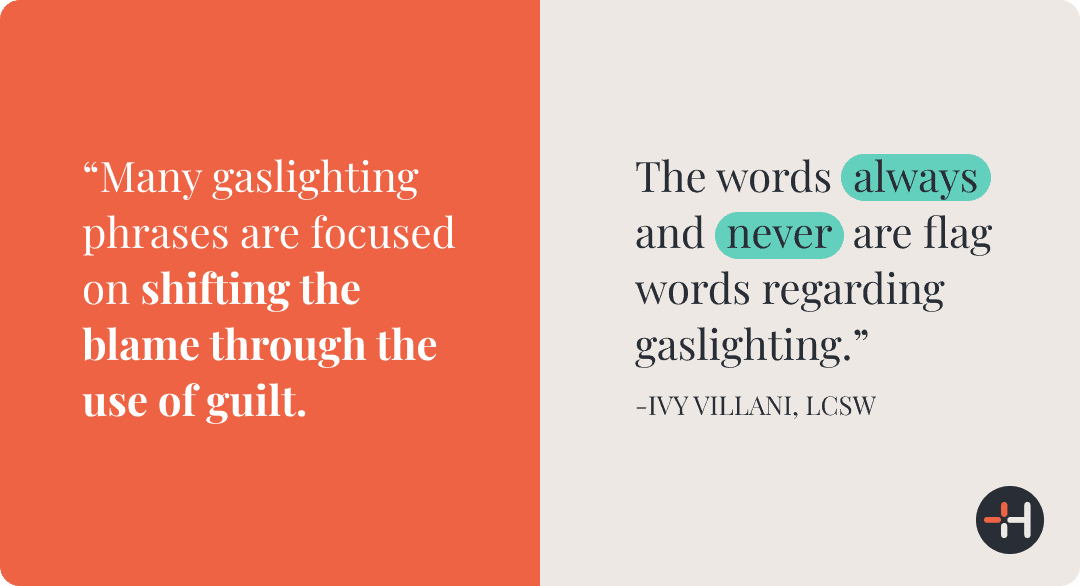
“The hard part about gaslighting is that it happens so fast and fluidly, it throws a person off balance and they end up blaming themselves for some wrongdoing of the other person,” says Headlight clinician Ivy Villani, LCSW. “Many gaslighting phrases are focused on shifting the blame through the use of guilt. If you believe that you are making someone feel like they are useless or can never do anything right, you will start to internalize those statements toward yourself rather than the other person. The words always and never are flag words regarding gaslighting.”
According to licensed psychotherapist and author of The Relationship Fix: Dr. Jenn’s 6-Step Guide to Improving Communication, Connection & Intimacy, Jenn Mann, LMFT, PsyD., gaslighting phrases are consistently about one party silencing another and making them question their own recollection or even sanity. “All of them are ultimately about shape-shifting reality into something where one person is denied their truth, and as a result feels alone, unheard, and crazy,” she says.
What is gaslighting? Meaning, patterns, and control
Gaslighting is a form of mental manipulation and emotional abuse, according to Cleveland Clinic. At its core, the practice involves using specific patterns of behavior to provoke another person to question their rationality and their decision-making abilities. The deliberate impact matters — even when the person doing it denies harmful intent. Gaslighting gradually erodes the victim’s confidence in their own memory, feelings, and decisions, and ultimately destabilizes their reality. Gaslighting is not just a severe form of arguing; it’s true abuse — and the person on the receiving end is more likely to lose trust in themselves and the world around them the longer they experience the manipulation.
As Villani sees it, gaslighting is a combination of guilt tripping and manipulation. “This is used as a way of controlling an interaction so that it ends up in the favor of the person who did something wrong,” she says. “When a person is being gaslit, there is a similar pattern to grief actually.”
To illustrate her point, Villani describes a scenario where person A raises a concern with person B, a gaslighter. “Person B will respond with either a question or they’ll outright deny that what was said is real,” Villani explains. Person A may then start second-guessing themselves, at which point person B may react with anger, accusing A of distrust. Feeling guilty, person A then apologizes — and person B, who was actually in the wrong, receives that apology and flips the script so A believes they were the one at fault.
Here’s an example of that dialogue in action, according to Villani:
Person A: Hey babe, you said you were going to get me from work today and you didn’t show up. What happened?
Person B: I didn’t say I was going to get you today.
Person A: I’m pretty sure I asked you the other day and you said you would get me on Wednesday — that’s today.
Person B: Sure Miss Perfect over there never forgets anything and I always forget, right? I can’t do anything right, can I?
Person A: No, you’re right, I must’ve thought I asked you and I didn’t. Sorry for upsetting you.
Person B: Thank you for apologizing. You really do need to work on how often you accuse me of things if you want this relationship to work.
Mann says that this type of ongoing deception and control can create a fog of uncertainty and fill the victim with self-doubt. “It can erode self-confidence,” she says. “People who gaslight are trying to manipulate the recipient in order to leave them feeling insecure and unsure of themselves, to make them deny their own reality. Intentional gaslighting is a form of emotional abuse.”
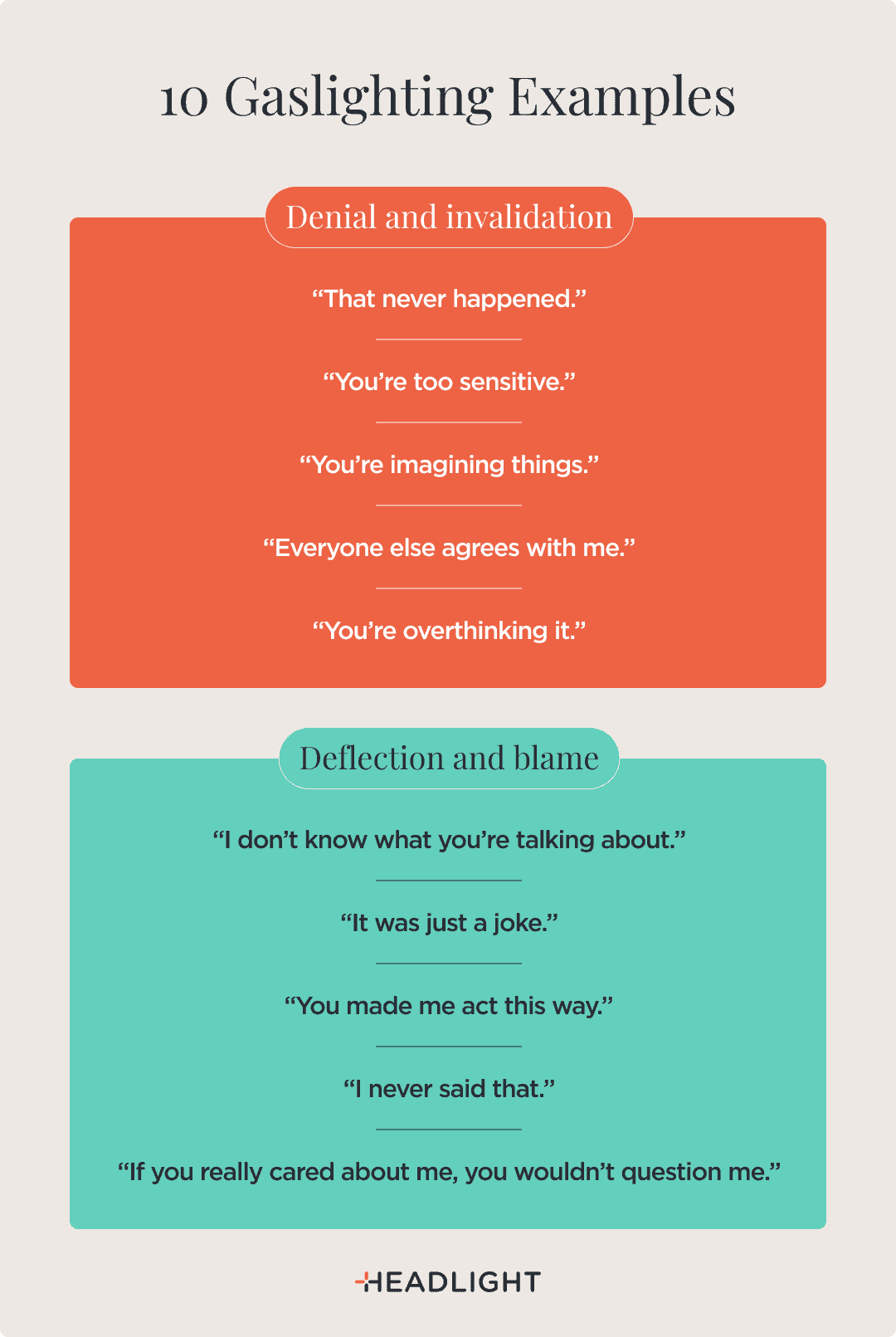
Gaslighting denial and invalidation examples:
Here are just a few common examples of how gaslighting can involve denial and invalidation:
- “That never happened.” This phrase often represents repeated denial of events or conversations.
- “You’re too sensitive.” By dismissing the person’s reasonable feelings or concerns, the gaslighter is invalidating their experience.
- “You’re imagining things.” This phrase directly challenges the victim’s perception and judgment.
- “Everyone else agrees with me.” By claiming the victim’s outside support system is in alignment with the gaslighter, the victim is likely to feel isolated.
- “You’re overthinking it.” Minimizing the victim’s feelings helps weaken their trust in their own instincts.
Gaslighting deflection and blame examples:
The gaslighting examples below depict how deflection and blame can fill the victim with self-doubt:
- “I don’t know what you’re talking about.” Withholding or refusal to address the issue.
- “It was just a joke.” Hurtful behavior reframed as harmless humor
- “You made me act this way.” Responsibility shifted onto the other person
- “I never said that.” Previous statements or promises repeatedly contradicted
- “If you really cared about me, you wouldn’t question me.” Affection or loyalty used to discourage boundaries
Gaslighting vs. lying, disagreement, and poor communication
While there may be some overlap between lying, disagreements, poor communication, and gaslighting, these are distinct categories of relationship conflict. Lying may certainly be a part of gaslighting, but by itself, lying does not always involve challenging another person’s reality. Disagreements allow both people to remember events differently without the denial and manipulation involved in gaslighting. And while poor communication may lack the healthy listening, accountability, and repair that solid relationships are built on, it doesn’t equate to gaslighting, which more likely involves repeated denial and distortion to provoke self-doubt.
“Social media has decided to use this word when describing any sort of manipulation done by others because it is an easy umbrella term. The reason why knowing what gaslighting is compared to other forms of manipulation is that this type of manipulation not only changes the course of the interaction but can end up changing how someone trusts and believes themselves after being told they are a liar or making things up time and time again.”
Villani points out that the deliberate nature of gaslighting also distinguishes it from other types of manipulation. “There is an intent with gaslighting to make the other person question themselves so that they can be controlled in the future,” she says. “Other types of manipulation can happen accidentally due to upbringing and social influences. When accidental manipulation or other types of manipulation occur, there can be apologies or work done to correct the negative language. With gaslighting, there is not an apology for the ‘wrong thinking’ of the person being gaslit.”
Mann agrees that the phrase ‘gaslighting’ has become overused, which is why it’s often confused with other patterns of behavior. “It’s very important to clarify that there’s a difference between gaslighting and lying, having different opinions, and seeing things differently,” she says. “Gaslighting has a malicious intent to deceive the other person. This is a very important differential.”
Signs you may be experiencing gaslighting
“Some of the most common signs of gaslighting are when a person is retelling an argument and after they describe the argument, they say, ‘I should have known better’ or ‘I keep messing up,’” Villani says. “A person that is being gaslit will have a difficult time seeing that their reaction to a situation or feeling after a fight are justified and not made up or exaggerated.”
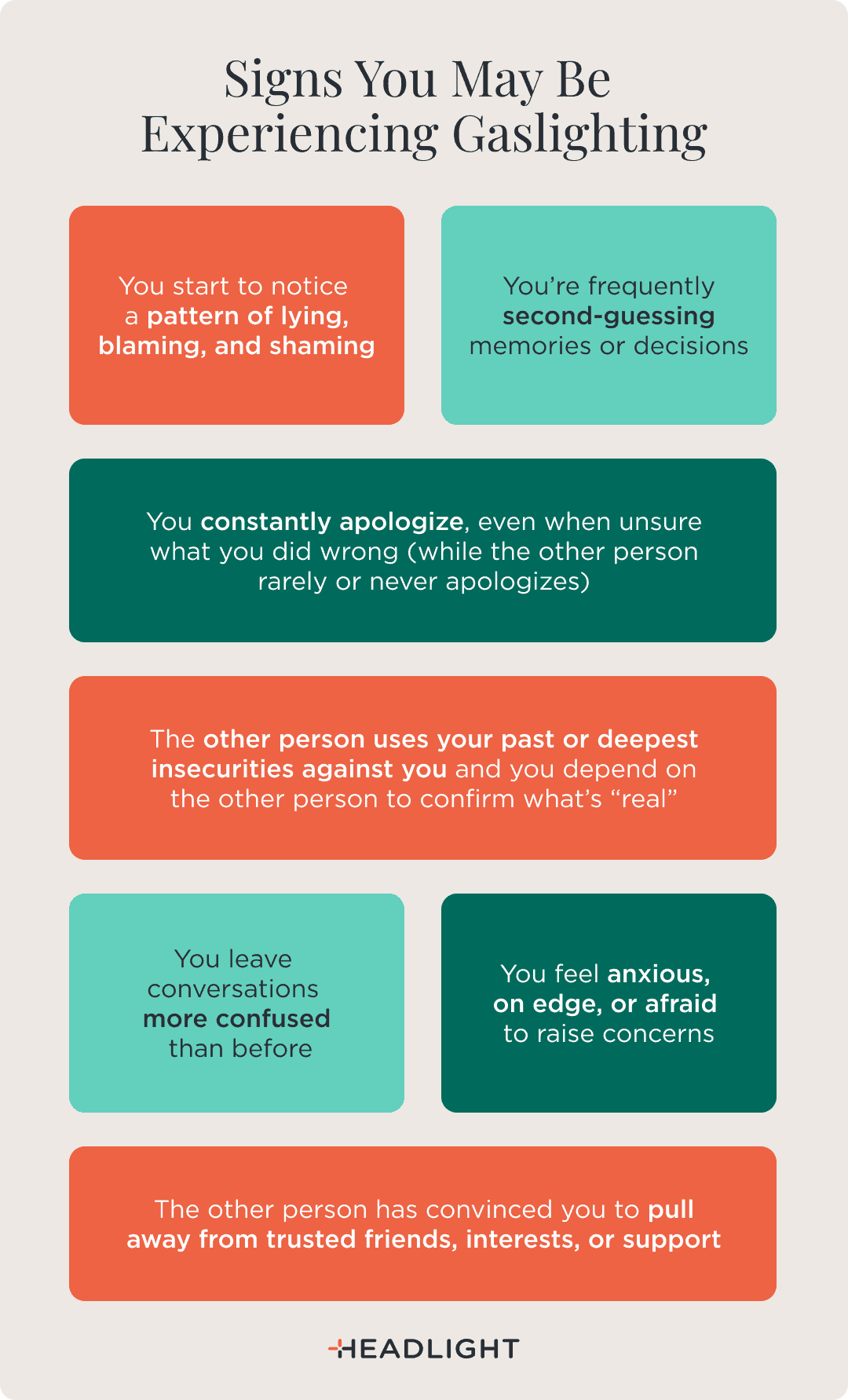
According to Cleveland Clinic, there are a variety of signs that indicate you may be experiencing gaslighting, including:
- You start to notice a pattern of lying, blaming, and shaming
- You’re frequently second-guessing memories or decisions
- You constantly apologize, even when unsure what you did wrong (while the other person rarely or never apologizes)
- You leave conversations more confused than before
- You feel anxious, on edge, or afraid to raise concerns
- The other person uses your past or deepest insecurities against you and you depend on the other person to confirm what’s “real”
- The other person has convinced you to pull away from trusted friends, interests, or support
“A few of the most common signs of gaslighting are: denying objective facts, telling blatant lies, undermining a person’s emotions in order to invalidate their reality or accusing them of making things up,” Mann says. “It’s also very common for the person who is gaslighting to accuse the victim of things like being too sensitive, hysterical, overly emotional or paranoid.”
Where gaslighting can happen
While we often think of gaslighting as something that occurs in the context of romantic relationships, it can also come up in familial relationships, friendships, workplaces, and even healthcare settings. In fact, the American Journal of Medicine provided a definition for “medical gaslighting” in 2024, describing it as “an act that invalidates a patient’s genuine clinical concern without proper medical evaluation, because of physician ignorance, implicit bias, or medical paternalism.” In romantic relationships, one partner may gaslight the other through jealousy, blame, and isolation, while family members may minimize or deny the victim’s painful memories. In the context of friendship, concerns may be dismissed, and group opinions may be weaponized to ostracize one person, while in the workplace, a victim’s contributions may be erased, feedback may be distorted, or blame may be reassigned.
“Unfortunately, gaslighting occurs primarily in the two areas people spend the most time: at work and in a relationship,” Villani says. “At work, gaslighting can happen when a subordinate asks a supervisor for help or support and they leave feeling like they are a burden and asking too much. In a relationship, it is a similar feeling of being a burden and asking too much with the addition of feeling like an imposter of a person rather than just within the job.”
How to respond to gaslighting safely
Villani says the appropriate and safe response to gaslighting varies depending on the person who is doing the gaslighting. “If an individual is in a physically abusive relationship, they should always put their own safety first,” she says. “Domestic violence can happen at a moment’s notice and without limitation. If they are safe from the person doing the gaslighting, after the initial round of denial happens, stepping back into the stage of advocacy and support of yourself can stop the progression. If you are worried about being able to confront the issue, bring a friend. There is support in numbers. Find bravery in your people. It’s okay to ask for help.”
Mann underscores the importance of trusting your instincts. “If something feels wrong, it probably is wrong,” she says. “If someone is gaslighting you, you wanna stay calm and not get into a debate with the person,” Mann says. “It’s better to just say, ‘I see things differently. We clearly have different perceptions.’ If it’s a person who’s interested in knowing how you feel about things, they’re going to care about your perception. And if it’s someone who’s just gaslighting, they are just going to continue to try to run you over with our version of events.”
Rather than engage in an endless cycle of verbal accusations, it’s important to set clear limits on disrespectful or circular conversations and to create distance when possible. It may also be important to save text or work messages or document incidents when it’s safe to do so. “You should never listen to anyone who calls you crazy,” Mann says. “Someone who cares about you would not speak to you that way, and if they were genuinely concerned, they would encourage you to seek therapy.”
How gaslighting can affect mental health
Constant ridicule, accusations, and denial of feelings can absolutely contribute to long-term mental health effects, according to experts. “Over time, gaslighting can make a person doubt themselves to such an extreme that they no longer have a sense of self within or outside of the relationship,” Villani says. “They can become dependent on the person doing the gaslighting to help them know what they feel and think about themselves because they no longer feel they can be trusted.”
According to Villani, gaslighting can lead to a person feeling:
- Depressed
- Isolated
- Insecure
- Doubtful
- Helpless
- Hopeless
- And more
“It weakens a person so that the next time there is an ‘attack,’ they are less likely to fight back,” Villani says.
Evaluation, treatment options, and professional support
While gaslighting itself is not a mental health diagnosis with a single test, seeking a mental health evaluation may help a victim explore issues related to anxiety, depression, trauma symptoms, sleep, functioning, and safety. Individual therapy can be beneficial for rebuilding self-trust, boundaries, and coping skills, while trauma-informed treatment may help when experiences have caused lasting distress.
“Talking with a therapist or other professional can help find assurance in your own mental well-being,” Villani says. “Being able to hear from someone that you are not crazy or delusional and that you are actually reacting in a way that is understandable can help you see the light through the trees. If gaslighting has caused lasting effects, talking with a professional can help address the concerns about sense of self, self-esteem, and confidence that can be impacted by repeated gaslighting.”
While some people may be tempted to seek out relationship counseling in scenarios where gaslighting is occurring in a romantic partnership, it’s important to know that couples therapy is not safe or appropriate when coercive control or intentional abuse is present. When you do seek individual help, be sure to bring examples, notes, symptoms, and personal goals to a mental health clinician.
When to seek urgent help or create a safety plan
Gaslighting can lead to serious safety concerns, including threats, stalking, physical violence, sexual coercion, or property damage. In all these cases, it’s essential to seek urgent help or to create a safety plan in preparation for an emergency escape.
“It is necessary to seek urgent help when your internal thoughts become filled with self-harm or end-of-life thoughts,” Villani says. “When you start to think that anyone would be better off without you in the world, this is an emergency situation. If you start to worry about your physical safety, get out, get help, don’t wait. Remember, the intent of gaslighting is to lower your own defenses against another attack; if the attack is already dangerous, the next step could be worse.”
While gaslighting can effectively erode a person’s sense of self and confidence, Villani urges victims to remain focused on their future well-being and to stay rooted in who they truly are.“Remember, you were a whole person before you met the person that is gaslighting you and you will be a whole person after you met them,” she says. “Don’t give up because the next step seems like a lot of work; you are worth it, regardless of what anyone else says.”
Frequently asked questions (FAQs)
Should you confront someone who is gaslighting you?
No. To avoid a potentially dangerous situation or engaging in the harmful cycle of gaslighting, it is important to set boundaries and create as much distance as possible, rather than confront the gaslighter. Experts generally recommend using short phrases like “I remember things differently” and stepping away from the gaslighter until things have calmed down rather than engaging in confrontation or justification.
Can gaslighting happen through texts or social media?
Yes. Gaslighting can occur through any form of communication, including texts, social media, phone calls, voicemails, written notes, and more. A gaslighter can manipulate a victim through denial, blame-shifting, and twisting reality, and all of this can be conveyed through text, as well as verbal communication.
Why can it be difficult to leave a gaslighting relationship?
Leaving a gaslighting relationship can be incredibly difficult because of the self-doubt, confusion, and blame involved. The person experiencing the gaslighting may believe the gaslighter is their only source of truth, even though they are the ones perpetrating the destructive act. Additionally, gaslighters tend to isolate their victims, making it harder for the person experiencing gaslighting to receive support or an objective reality check. In some situations, there may also be financial dependence or manipulation occurring, making it impossible to leave a potentially damaging situation. This is why it’s important to be aware of the signs related to gaslighting and to seek out a trusted person or an individual therapist as soon as possible.