How to Find a Therapist Who Specializes in ADHD
- Category: ADHD
- July 14, 2026
Written by Cathy Cassata
Clinically Reviewed by Chaitanya Pabbati, MD
Key takeaways
- Finding a therapist for ADHD can be overwhelming, but with a little guidance, it’s possible to find the right fit for your needs.
- Asking questions regarding a clinician’s experience with ADHD, approach, and availability are good ways to evaluate them.
- Headlight can connect you with a clinician who specializes in ADHD diagnosis and management. You deserve answers and support throughout your mental health journey, and Headlight is here to help.
Are you struggling with daily routines and focus, and considering an ADHD evaluation? Or maybe you’re newly diagnosed with ADHD. Regardless of the stage of your journey, it can feel challenging to find a therapist for ADHD who can provide care that feels practical, validating, and personalized. This guide can help you connect with the right clinician.
Finding the right therapist for ADHD can feel overwhelming. But rest assured, it’s possible to connect with a clinician who can provide care specific to your symptoms, goals, and life stage. While most licensed therapists have training in ADHD and neurodivergency, therapists who are ADHD Certified Clinical Services Providers (ADHD-CCSP) or obtained training from recognized organizations like ADD Coach Academy (ADDCA) have post-graduate education that makes them most helpful.
Qualified therapists can provide ADHD counseling that includes therapy, skills coaching, medication management, or a combined plan. Here’s what to consider as you search for an ADHD therapist.
What to look for in a therapist for ADHD
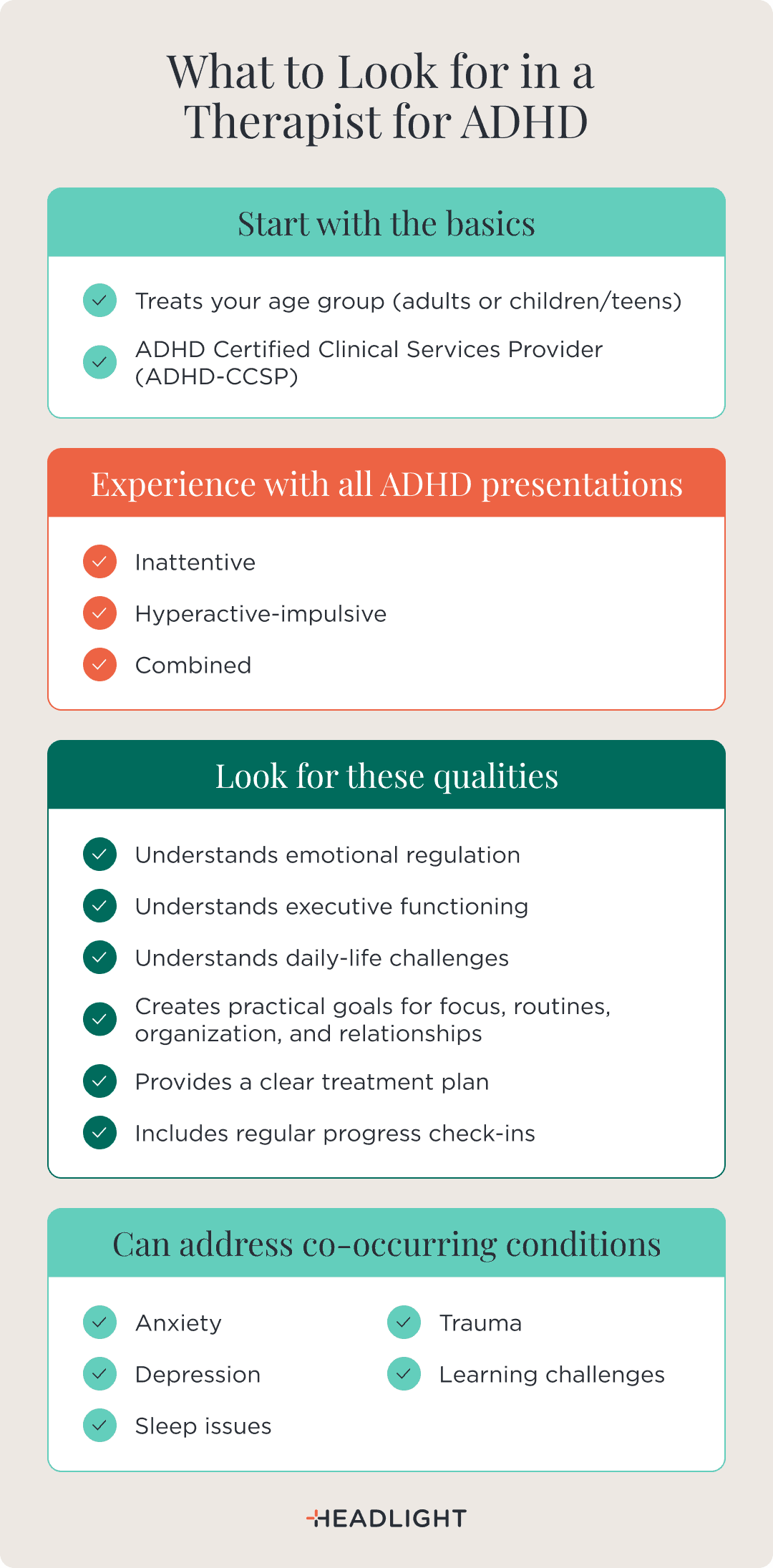
As you search for ADHD therapists, first look for those who treat the corresponding age group, whether that’s adults or children and teens (if you’re searching for your kid). Then home in on therapists who are ADHD Certified Clinical Services Providers (ADHD-CCSP). Finding a therapist who is familiar with inattentive, hyperactive-impulsive, and combined ADHD presentations can help ensure they correctly diagnose your type of ADHD.
“If a clinician is only looking for the classic, hyperactive-impulsive stereotype, they are going to completely miss the people whose chaos is quiet and turned inward,” says Amanda Pearman, LPC, LPCC, an ADHD therapist at Headlight.
She notes that many women and girls with primarily inattentive ADHD often go undiagnosed for years because their struggles look like silent drowning in daily tasks rather than disrupting a classroom.
“A therapist needs to deeply understand all three presentations to prevent diagnostic oversight and unintentional clinical gaslighting,” says Pearman.
Other skills and qualities to look for in an ADHD therapist include:
- An understanding of emotional regulation, executive functioning, and daily-life challenges
- Ability to create practical goals for focus, routines, organization, and relationships
- Focused on providing a clear treatment plan with regular progress check-ins
- Comfortable addressing anxiety, depression, sleep issues, trauma, or learning challenges, if you live with any comorbidities
“In clinical reality, comorbidity is the rule, not the exception,” says Pearman.
Untreated ADHD almost always generates secondary anxiety and depression from years of chronic stress and trying to meet impossible expectations, she explains. Furthermore, complex trauma and ADHD have symptom overlap. “[Hypervigilance] can look like hyperactivity, and trauma-induced dissociation can look like inattention,” Pearman says.
For these reasons, she adds, a therapist needs to be skilled enough to treat the intersections, because treating anxiety without addressing the underlying executive dysfunction will rarely bring lasting relief.
Know what ADHD therapy can help with
Pearman says the most impactful benefit of seeing an ADHD-informed therapist is that they can help with deconstructing a lifetime of shame. “Oftentimes, folks come into a therapeutic space holding an internalized narrative about who they are,” she says. “The words that are heard the most are ‘lazy,’ ‘careless,’ and/or ‘broken.’”
A childhood friend of mine who was diagnosed with ADHD in her mid-40s recently shared that she felt “broken” until her diagnosis. After seeing a mental health provider who didn’t specialize in ADHD, she eventually found an ADHD therapist who helped her untangle her core identity from her neurodivergent symptoms.
Qualified therapists like my friend’s are also aware of the chronic masking and overcompensating that can lead to severe nervous system burnout. “They will help clients identify their energetic limits, step away from unsustainable masking, and build rest into their lives without guilt,” Pearman explains.
A therapist can also help with sustainable lifestyle changes that lead to being more organized and efficient, as well as teach ways to slow down and be less impulsive, which can result in communicating more effectively.
Other areas a therapist for ADHD can help with include:
- Time management and planning
- Emotional regulation and frustration tolerance
- Impulsivity
- Family, school, work, or relationship stress
- Insight into your thought processes
Match the ADHD counselor to your needs
When looking for counseling for ADHD, find one who can address your specific situation and needs. Consider the following:
- Adult ADHD therapist for work stress, routines, relationships, and late diagnosis
- Family or parent support when home routines and behavior plans need consistency
- Psychiatric provider if medication evaluation or medication management is part of care
- Therapist with experience in co-occurring concerns when ADHD is not the only issue
- Child-focused therapist for behavior support, school challenges, and parent involvement
- Teen therapist for motivation, self-esteem, emotions, and independence
If you’re looking for a therapist for your child, Pearman says an adult-focused clinician might rely too heavily on verbal insight and cognitive strategies that a child’s brain isn’t developmentally ready to process yet. “Apart from children having their own developmental milestones and ways of expressing distress, it is also very important for the therapist to know how to work with the systems that the child is a part of…like IEPs and 504 plans,” Pearman says.
ADHD therapy approaches to ask about
Most seasoned, ADHD-informed therapists naturally practice from an integrative or eclectic framework. “Because ADHD impacts so many different areas of life, a rigid, one-size-fits-all approach just doesn’t work,” says Pearman.
She suggests finding a therapist who has a diverse toolbox. “If a provider only does strict behavioral coaching, emotional wounds and shame go untouched. But if they only do traditional talk therapy or mindfulness, the client might leave the session feeling validated but still unable to organize their life,” she says.
Finding someone who can pivot smoothly between deep emotional processing and concrete, actionable skill-building is ideal. Ask a therapist if they offer the following approaches depending on your needs.
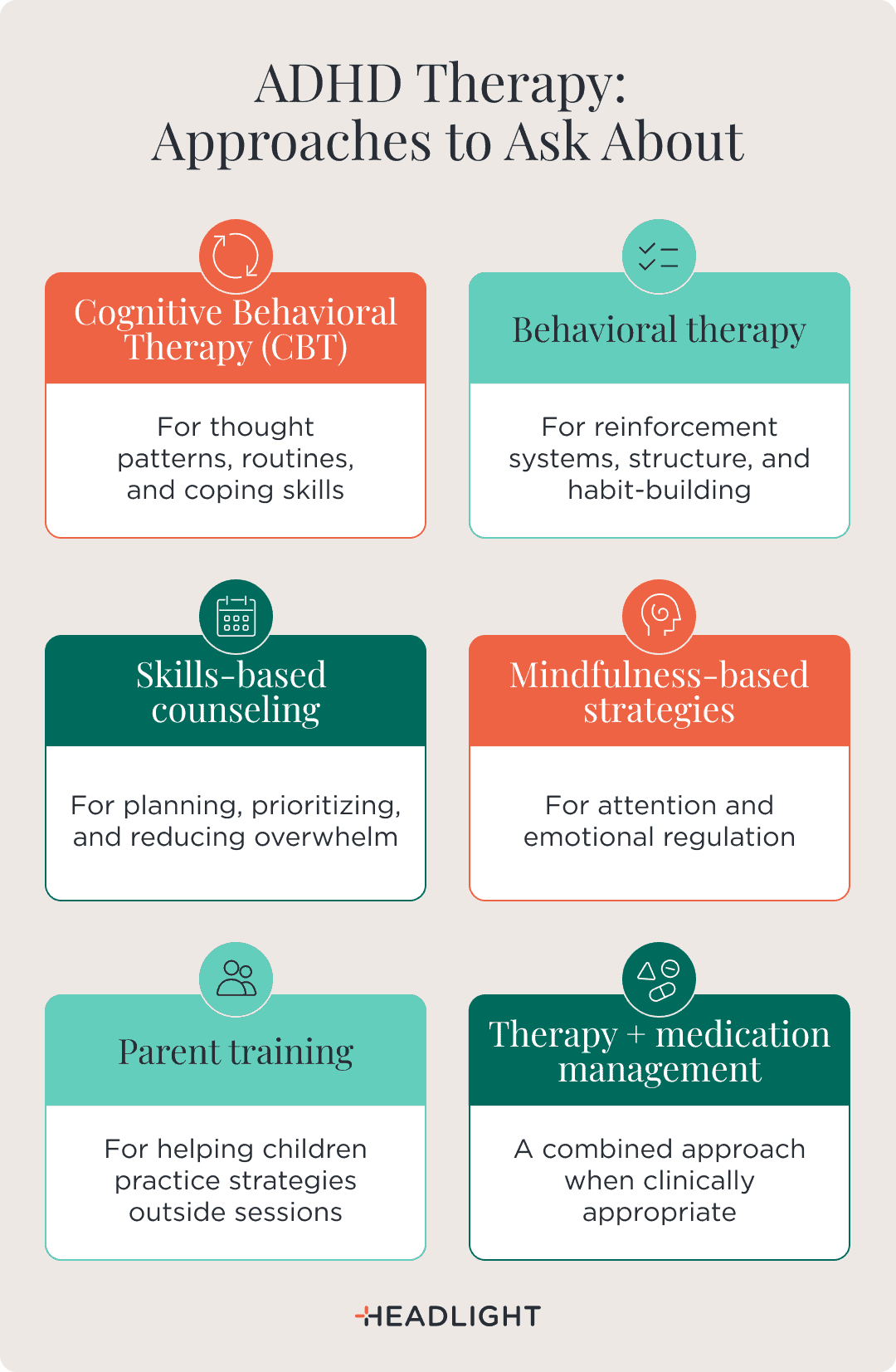
- Cognitive Behavioral Therapy (CBT) for thought patterns, routines, and coping skills
- Behavioral therapy for reinforcement systems, structure, and habit-building
- Skills-based counseling for planning, prioritizing, and reducing overwhelm
- Mindfulness-based strategies for attention and emotional regulation
- Parent training for helping children practice strategies outside sessions
- Combined therapy and medication management when clinically appropriate
Some of the most effective treatment modalities for ADHD include ADHD-adapted CBT, Acceptance and Commitment Therapy (ACT), and Somatic/Nervous system regulation approaches, says Pearman.
How to check credentials, experience, and fit
John J. Ringhisen, PMHNP-BC, NPP, Director of the Adult Attention Deficit Hyperactivity Disorder Clinic at SUNY Upstate Medical University, says most state licensing boards allow the public to verify online if a therapist is licensed in the state and if their license is active and in good standing.
“From there, I would look beyond the letters after someone’s name and ask about their actual experience treating ADHD,” he says.
A good ADHD therapist should be able to explain what percentage of their practice involves ADHD, whether they work with adults, children, couples, or families, and what kinds of ADHD-related problems they commonly treat. “For adults, I would ask specifically about therapy for executive functioning, organization, procrastination, emotional regulation, time management, rejection sensitivity, and co-occurring anxiety or depression,” Ringhisen says.
For children, he suggests asking about parent training, school collaboration, behavior plans, and family-based strategies. And be sure to find out what kind of therapy they use. “For ADHD, therapy should not be only open-ended talking about stress,” says Ringhisen. “Supportive therapy can be helpful, but ADHD treatment usually needs to include practical skills, structure, goal-setting, behavior change, and strategies the person can apply between sessions.”
Before booking a session, check if they take your insurance, what their availability is, where they are located, and if they offer virtual care options.
Once you meet with the clinician, take notice if they explain care clearly and respectfully and trust your early impressions of comfort, safety, and collaboration. Studies show that the relationship you build with your therapist is one of the strongest predictors of whether therapy will actually help you.
Questions to ask before choosing ADHD therapists
Good therapists should welcome questions from potential clients, says Ringhisen. “The first appointment, or even the first phone consultation, is not just the therapist evaluating the client. It is also the client evaluating whether the therapist is the right fit,” he says.
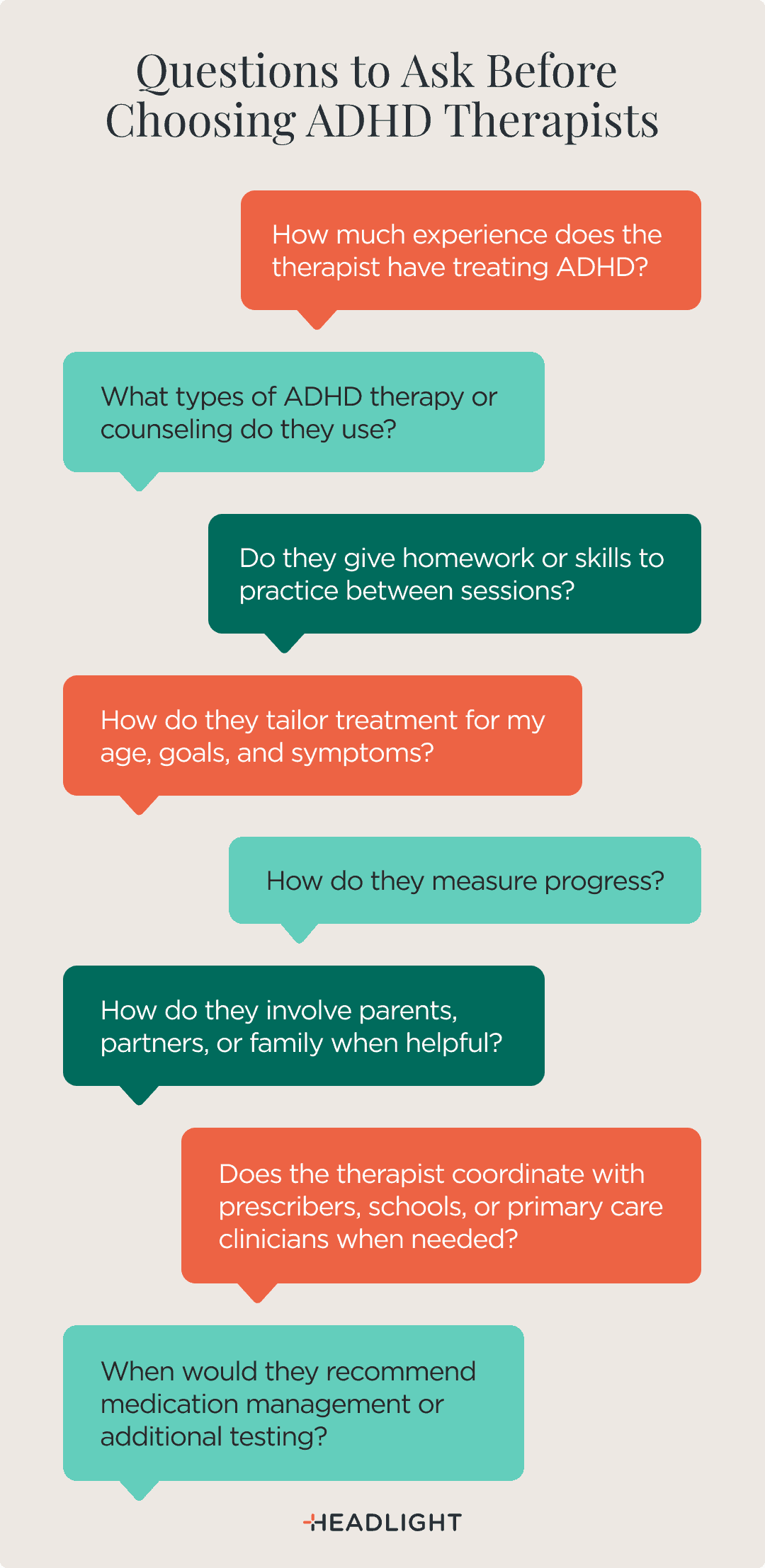
Reasonable questions include:
- How much experience do you have treating ADHD?
- What types of ADHD therapy or counseling do you use?
- Do you give homework or skills to practice between sessions?
- How do you tailor treatment for my age, goals, and symptoms?
- How do you measure progress?
- How do you involve parents, partners, or family when helpful?
- Do you coordinate with prescribers, schools, or primary care clinicians when needed?
- When would you recommend medication management or additional testing?
“A therapist who becomes defensive about those questions may not be the right fit,” Ringhisen says.
What to watch for when choosing a therapist for ADHD
A therapist who doesn’t have clear ADHD experience or a defined treatment approach may be a bad fit. Ringhisen says other concerning factors include a therapist who:
- Guarantees a specific outcome, such as promising to “cure” ADHD, minimizing ADHD as laziness or lack of discipline, relies only on generic advice like “try harder” or “use a planner”
- Gives a one-size-fits-all advice without understanding your symptoms or applies one rigid method to every client
- Lacks moving toward specific goals, strategies, or measurable change
- Ignores co-occurring conditions that commonly overlap with ADHD such as anxiety, depression, trauma histories, substance use, sleep problems, learning disorders, and relationship difficulties. “A therapist does not need to treat everything alone, but they should be able to recognize when additional assessment or collaboration is needed,” says Ringhisen.
- Consistently judges or shames you, doesn’t listen, or makes you feel unsafe
- Doesn’t clearly communicate goals, homework, or progress. “Therapy does take time, but after several sessions, the person should at least understand the goals, the plan, and what they are practicing between visits,” Ringhisen says.
What to expect from ADHD counseling
ADHD counseling may include several components, such as:
- Initial discussion of symptoms, history, goals, and daily challenges
- Review of school, work, home, relationships, and emotional patterns
- Written assessments and self-screenings
- Skill-building between sessions through homework or practice
- Adjustments when strategies do not fit real life
- Collaboration with parents, partners, or other providers when appropriate
- Ongoing check-ins to see what is improving and what still feels difficult
When to seek ADHD care or testing
It’s time to seek help when ADHD symptoms are causing significant impairment, not just occasional inconvenience. Ringhisen says that might look like chronic lateness, missed deadlines, disorganization, unfinished work, relationship conflict, emotional outbursts, impulsive decisions, academic or work problems, difficulty managing money, or feeling constantly overwhelmed by ordinary life tasks.
“A good rule of thumb is this: if the same problems keep repeating despite sincere effort, it is worth getting help,” he says.
Other indicators include:
- A child’s behavior causes frequent conflict at home or school
- Anxiety, depression, sleep problems, or substance use are also present
- Safety concerns, self-harm, or crisis symptoms require urgent support
“People often wait until they are in crisis, but therapy can be most useful before things fall apart,” Ringhisen says. “ADHD treatment is not just about reducing symptoms, it is about improving functioning, confidence, relationships, and quality of life.”
How Headlight can help you find ADHD support
If you’re searching for a clinician who specializes in ADHD and you live in the western states, Headlight can help connect you to an ADHD clinician who can provide an ADHD assessment and help with therapy and support with medication management, including medications for ADHD when clinically indicated. Search our provider page to connect with therapists and psychiatrists and book online appointments today.
With Headlight clinicians, you can access in-person or virtual sessions. Plus, over 90% of Headlight clients use insurance to pay for services. To get help now and find a fitting therapist or clinician, contact Headlight to begin the personalized matching process.
Diagnosis and treatment will ultimately depend on your symptoms, medical history, co-occurring conditions, and personal goals.
Frequently asked questions (FAQs)
Can I work with an ADHD therapist even without a formal diagnosis?
Yes. Many therapy targets like organization, time management, emotional regulation, procrastination, communication, and follow-through, are useful whether or not you ultimately meet full diagnostic criteria for ADHD.
That said, a formal evaluation can be important if you’re considering medication, seeking workplace or school accommodations, or trying to understand whether symptoms are truly ADHD versus anxiety, depression, sleep deprivation, trauma, substance use, or another medical or psychiatric condition.
How often should ADHD therapy sessions happen?
Early in treatment, weekly sessions tend to be most beneficial. ADHD therapy often works best when there is enough frequency to build momentum, practice skills, troubleshoot what did not work, and adjust strategies in real time. Once you have a working system and symptoms are more stable, sessions may move to every other week or monthly maintenance. The right frequency depends on severity, goals, cost, availability, and whether there are co-occurring issues.
What should I bring to a first ADHD therapy appointment?
Bring a short list of the problems you want help with and examples of how the problems affect work, school, home, relationships, finances, or daily routines. Also, if you have them, bring prior evaluations, medication history, therapy history, school records, accommodation letters, or diagnostic testing. Most importantly, bring goals. Instead of only saying, “I want to focus better,” it helps to say, “I want to stop missing deadlines,” “I want to manage my mornings,” “I want to stop fighting with my partner about chores,” or “I want a system for bills and appointments.” The more specific the goal, the easier it is for you and your clinician to build a practical plan.
Deep dive recommendations
https://www.nimh.nih.gov/health/topics/attention-deficit-hyperactivity-disorder-adhd
https://www.apa.org/ptsd-guideline/patients-and-families/finding-good-therapist