Adult ADHD Evaluation: What to Expect and How to Prepare
- Category: ADHD
- July 6, 2026
Key takeaways
- About half of adults living with ADHD were diagnosed in adulthood.
- An adult ADHD evaluation involves a comprehensive assessment of your symptoms, medical history, and more.
- There are three types of ADHD: inattentive, hyperactive-impulsive, and combined. A qualified mental health clinician can determine which type you have.
- Headlight can help you find a therapist to conduct an adult ADHD evaluation and provide a diagnosis and care plan.
Maybe you can’t shake your friend’s nudge to get tested for ADHD — or perhaps it’s been on your mind for a while. Either way, understanding why your brain may function differently than others can bring immense clarity. If you’ve lived your life running late, falling behind on tasks and responsibilities, or feeling emotionally overwhelmed, an adult ADHD evaluation can help give you answers and a path forward to the best treatment.
If you’ve spent years wondering why you struggle to focus, keep track of tasks, or arrive on time (no matter how hard you try), an adult ADHD evaluation might finally give you some answers. Getting help as an adult is more common than you might think. Of the estimated 15.5 million U.S. adults who currently live with an ADHD diagnosis, about half received their diagnosis in adulthood.
However, many adults who seek out an adult ADHD evaluation have been living with symptoms since childhood. In fact, because ADHD is a developmental disorder, an official diagnosis means symptoms were present before the age of 12.
A friend of mine recently shared with me that she got tested for ADHD in her mid-40s after noticing signs in her son that brought her back to how she functioned as a kid. After seeing therapists, both her and her son received ADHD diagnoses. Her situation isn’t unusual — some parents recall their own struggles as a child when they witness their kid showing the same patterns they once lived out.
While ADHD can be missed in childhood for a variety of reasons, Michael Dawson, PMHNP, Lead Psychiatric Nurse Practitioner at Headlight, says ADHD usually gets diagnosed when there are clear symptoms of hyperactivity or disruptive behaviors that impact a child’s teachers or caregivers. “Primarily inattentive ADHD, especially in young women, can be missed or misunderstood,” he says.
People often learn compensatory strategies to help mask their symptoms until a form of crisis causes the strategies to become less effective. “This might be additional stressors like a sick parent or the birth of a child,” Dawson says. “They may also become evident when someone moves from an individual contributor or highly stimulating role into something less immediately engaging, like management or administration.”
Common reasons adults seek answers and an ADHD evaluation, include:
- Focus struggles
- Distractibility
- Impulsivity
- Hyperactivity
- Disorganization
- Procrastination
- Restlessness
- Emotional overwhelm
During an evaluation, your clinician will ask about your symptoms, medical history, and how you function. They will also consider any overlapping conditions you live with.
Adult ADHD evaluation: what it includes
There isn’t one single ADHD test that can determine whether you have the condition. Instead, diagnosis is based on an evaluation that includes a multi-step clinical assessment to ensure an accurate diagnosis and appropriate care planning. Clinicians follow a standardized set of criteria from the American Psychiatric Association’s Diagnostic and Statistical Manual (DSM-5-TR).
The evaluation will include the following:
Review of current symptoms and past patterns
Through a clinical interview, your clinician will ask about your symptoms and how they affect your daily life. They will refer to the DSM-5-TR to help determine if you’re displaying symptoms of ADHD. For people older than 17 years of age, they must show at least 5 symptoms that fall in one category (inattention or hyperactivity/impulsivity) of the manual for six months or longer.
“Here you will discuss what led you to seek out testing, provide your symptom history, family history and other relevant information that the clinician will ask about,” says Anna Plotkina, PsyD, a psychologist who specializes in ADHD.
Understanding of impairment across daily life
While understanding the number of symptoms you experience is important, an essential requirement for receiving an ADHD diagnosis is if the symptoms are persistent and debilitating to the point that they disrupt major aspects of your life such as work, responsibilities, finances, and relationships.
The clinician will ask questions to get a better understanding of how the symptoms impact your life. “[It’s] important to share the coping strategies you employ now, as these may help illuminate the ways ADHD may potentially be impacting your life,” says Dawson.
Written assessments and self-screenings
Your clinician may ask you to fill out screener forms. Common ones that Headlight uses include the WURS (Wender Utah Rating Scale), ASRS’s mentioned, and Vanderbilt for youth ADHD symptoms. Clinicians trained also use the BRIEFF/BRIEFF2 (ages 5-18), Conners-3 (Youth), CAARS-2 (Adults), and CPT-3 (ages 8+). Adult ADHD Self-Report Scale (ASRS), Diagnostic Interview for ADHD in Adults (DIVA), and Conners’ Adult ADHD Rating Scales (CAARS).
“This portion usually lasts around 3 to 4 hours and can be broken up into shorter testing sessions, as needed,” Dr. Plotkina says. Your clinician may also ask you if it’s ok to have people close to you such as your partner or a trusted friend or colleague, answer the screeners for more objective input.
Elimination of other diagnoses
To make sure your symptoms aren’t due to another condition such as anxiety, depression, or sleep-related issues, your clinician will rule out these first.
“The presence of a physiological condition doesn’t rule out ADHD, but treating these conditions can help determine if they are the root cause of inattention or hyperactivity, or if there is also co-occurring ADHD,” says Dawson.
How do I know if I have ADHD?
Identifying which of the below signs of ADHD you experience is a good place to start.
- Trouble starting tasks
- Difficulty finishing tasks
- Forgetfulness
- Disorganization
- Time blindness
- Restlessness
- Impulsive decisions
While ADHD is often connected to hyperactivity, it’s important to note that visible hyperactivity is less noticeable in adults with ADHD than it is with children. “There are more social rules as an adult, and it’s often frowned upon to get up and pace during an office meeting,” says Dawson. In adults, he says hyperactivity may look like feelings of restlessness or a need to be constantly busy.
“Some people will mask their need for movement with smoke breaks or frequent trips to the restroom. Impulsive behaviors and low tolerance for frustration may also be signs of hyperactive tendencies in adults,” he says. Additionally, noticing how symptoms of ADHD create real-life problems can help. Here’s how the condition may look different in each area of life.
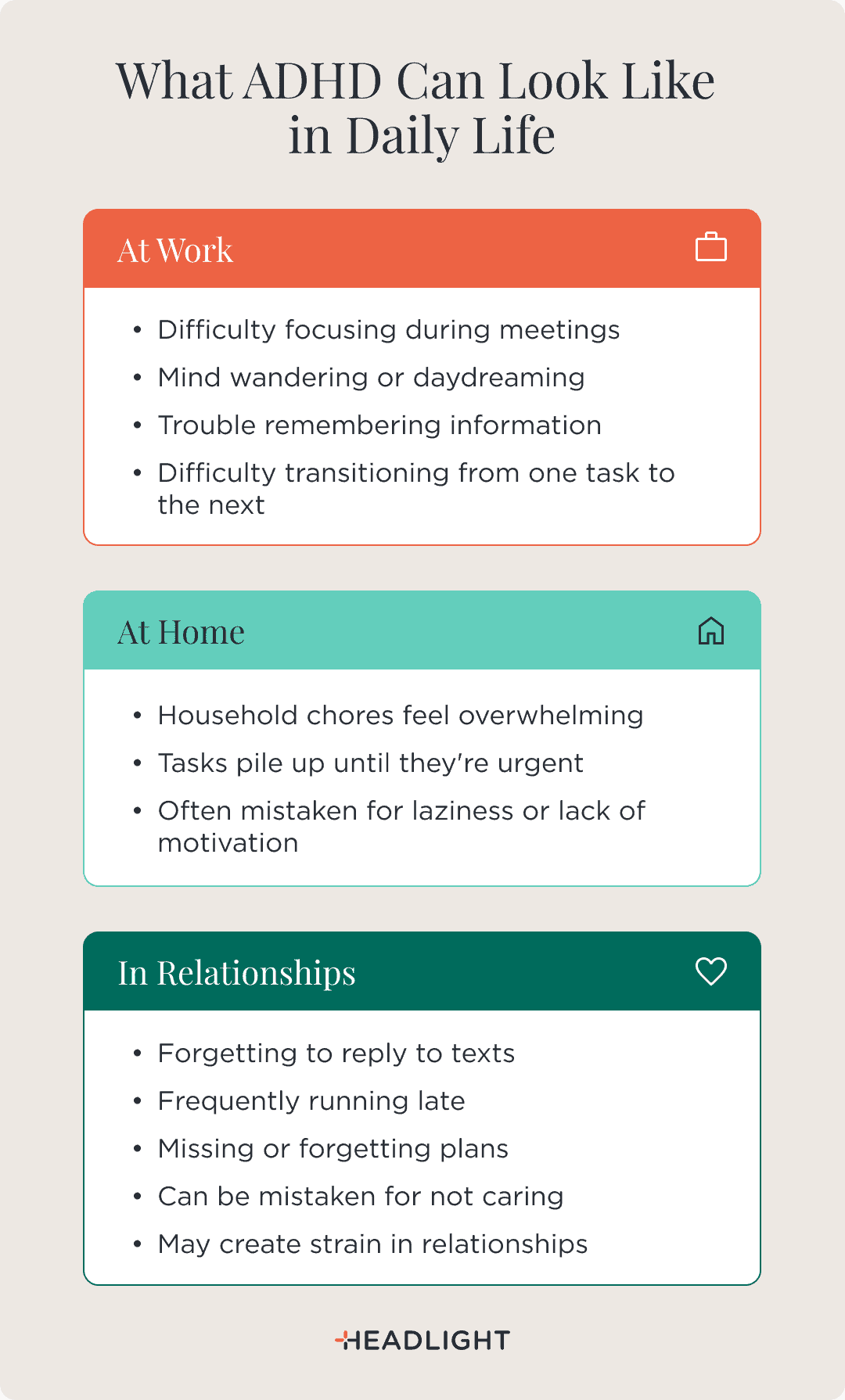
Work
ADHD can look like someone quietly struggling to focus and remember information during a work meeting while daydreaming instead, says Dr. Plotkina. “Feeling stuck or unable to easily transition from one task to the next is another manifestation,” she says.
Home
A person living with ADHD may feel overwhelmed at the thought of managing basic household chores or leave them to accumulate until they can’t be ignored. “[This often] gets mistaken for laziness or low motivation,” says Dr. Plotkina.
Relationships
In relationships, ADHD may cause a person to routinely neglect responding to text messages, chronically show up late, or forget plans with friends. “This can be misattributed to a lack of care or to thoughtlessness and inevitably places strain on interpersonal relationships,” Dr. Plotkina says.
While they do pose unique challenges, ADHD symptoms can also afford individuals certain “superpowers” she adds. “[Superpowers may present] as the ability to hyperfocus, ability to think in creative and non-linear ways, and the capacity for a deep understanding of other people’s emotional worlds,” she says.
ADHD test vs. ADHD screening vs. diagnosis
Screenings for ADHD offer a quick way to self-assess symptoms through questionnaires and can provide a basis for following up with a clinician. While these can help identify concerning patterns and support an evaluation, they don’t replace clinical judgment.
Testing or assessments are conducted by trained professionals and might include rating scales and cognitive testing that assesses your attention, memory, processing speed, and executive function. Some of the tests used include:
- Trail Making Test, which assesses processing speed, attention, and cognitive flexibility
- Stroop Color and Word Test to assess the ability to inhibit automatic responses, a core executive function challenge in ADHD
- Wisconsin Card Sorting Test to evaluate cognitive flexibility and problem-solving
- Digit Span (from the WAIS), which tests working memory by asking you to recall sequences of numbers forward and backward
An ADHD test for adults isn’t enough on its own and requires evaluation from a clinician.
Diagnosis is determined by a qualified clinician after a full evaluation that might include a review of your symptoms and medical history, clinical interview, and screenings and testing.
While rating scale scores don’t rule in or out an ADHD diagnosis, Dawson says they assist clinicians in having a dialog to make the assessment.
An example of a positive score and a negative assessment might be a patient with ADHD symptoms whose lab work reveals underlying medical problems while a negative screener might indicate well-compensated ADHD that still meets diagnostic criteria. “Many clinicians will use a variety of screeners to obtain a full picture of a patient’s issues and will also help guide treatment decisions,” Dawson explains.
What clinicians ask during an ADHD assessment for adults
Below are some examples of potential questions you might get asked during an ADHD assessment for adults.
Current attention, organization, and impulsivity
- Do you have difficulty sustaining attention on tasks or does your mind wander during conversations?
- Do you frequently lose things you need for daily activities, like your phone, keys, or important documents?
- Do you often say things without thinking or interrupt others before they’ve finished speaking?
- How often do you start things and not finish them?
Childhood symptoms and school history
- Did your teachers ever raise concerns about your attention, behavior, or ability to complete work?
- Did you struggle to finish assignments or follow through on instructions in school?
- Were you ever held back, put in special classes, or referred for any kind of evaluation as a child?
- Would you say you had more trouble sitting still or staying focused than other kids your age?
Work or academic performance
- Do you have difficulty meeting deadlines or keeping up with the demands of your job?
- Have you ever been put on a performance plan, let go from a job, or left a job because it felt unmanageable?
- Do you find it hard to prioritize tasks because you get stuck on small things and let bigger ones go undone?
- How many jobs have you had in the last five years, and why did you leave them?
Home responsibilities
- Do you struggle to pay bills on time, even when you have the money?
- Do you start cleaning or organizing and then get sidetracked before finishing?
- Do you miss appointments or find yourself frequently running late?
- Do you lose track of important paperwork like mail and bills, even when they are in order?
Relationship and family impact
- Have partners, family members, or close friends expressed frustration with your forgetfulness, lateness, or follow-through?
- Do you feel like you carry less of the mental load at home than you intend to?
- Do you find yourself saying things impulsively in arguments that you later regret?
- Have symptoms you recognize as ADHD played a role in any relationship difficulties or breakups?
Sleep, substance use, medical, and mental health history
- Do you have trouble winding down at night because your mind races when you’re trying to fall asleep?
- Have you ever felt like substances helped you manage restlessness or anxiety?
- Have you ever had a head injury, thyroid issues, or sleep disorders like sleep apnea?
- Have you ever been prescribed medication for mood, anxiety, or attention before?
Answering all questions honestly is essential, says Dawson. “Withholding things from clinicians may result in misdiagnosis, which could potentially result in an incorrect and unhelpful treatment,” he says. “Pride can also result in masking the true impacts of a mental health condition which could result in missing a diagnosis and not receiving care.”
Why childhood history and outside input matter
Although ADHD can be missed in childhood, when diagnosing adults, clinicians look for signs that occurred before age 12.
“Some people have difficulty remembering their childhood, especially in the context of trauma. Others may downplay their own past struggles based on preset achievements,” says Dawson.
In these cases, a clinician may ask for old report cards or school records or may ask to talk with a parent, partner, sibling, or close friend who could provide useful context and fill in memory gaps.
The friend I mentioned earlier, shared that she asked her parents to dig up report cards from elementary school. She found insightful notes from teachers that included comments like “distracted easily in class.”
Why clinicians screen for other conditions
ADHD symptoms can overlap with symptoms of other conditions. In fact, up to 80% of adults with ADHD have at least one co-existing psychiatric disorder. Dr. Plotkina says anxiety and depressive disorders often co-exist with ADHD.
The conditions below can share similar symptoms as ADHD.
- Anxiety
- Depression
- Trauma
- Bipolar disorder
- Sleep disorders
- Substance use
- Thyroid issues
- Learning differences
To determine what is causing your symptoms, a mental health clinician will ask if you’ve been diagnosed with any of the above and if the conditions are being managed effectively. “Accurate diagnosis can be particularly challenging due to the fact that there is high symptom overlap between various mood disorders and ADHD,” says Dr. Plotkina.
However, thorough neuropsychological testing can help provide an overall understanding of how one’s brain works. “[Testing is] also a great tool for differential diagnosis, a.k.a. helping distinguish the root of someone’s symptoms, whether it be anxiety, depression, a disorder of attention deficits, or some combination of those,” Dr. Plotkina says.
How to prepare for an adult ADHD evaluation
Before you head to your evaluation, consider the following to make the visit go smoothly.
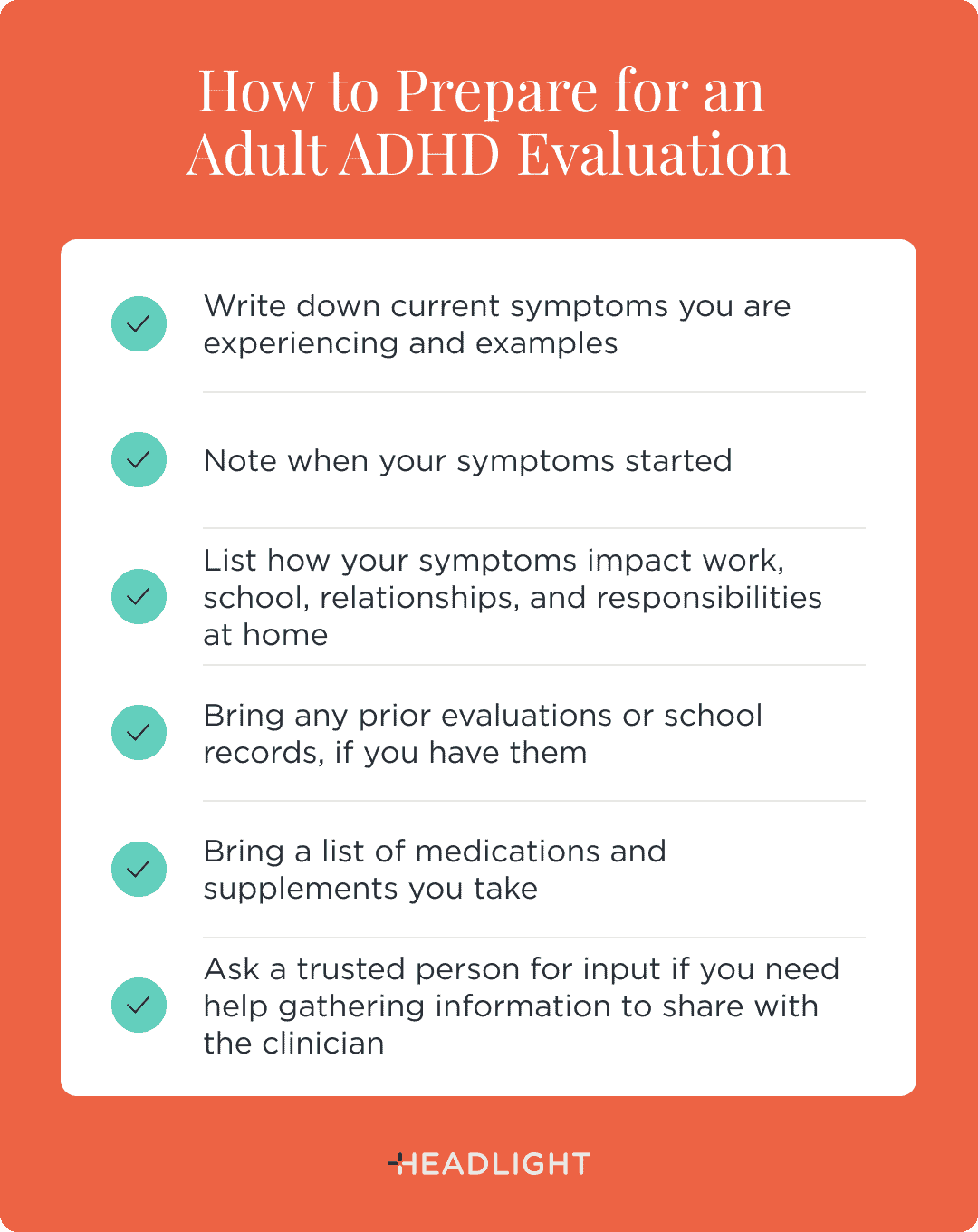
- Write down current symptoms you’re experiencing and examples
- Note when your symptoms started
- List how your symptoms impact work, school, relationships, and responsibilities at home
- Bring any prior evaluations or school records, if you have them
- Bring a list of medications and supplements you take
- Ask a trusted person for input if you need help gathering information to share with the clinician
“Try to come well rested and hydrated, bring snacks, don’t be afraid to ask questions, and to ask for breaks,” says Dr. Plotkina. “[Just] do your best!”
It’s normal to feel nervous, but remind yourself that the overarching goal is to gather helpful data for yourself. “No matter what the results, you’ll walk away with a better understanding of yourself than before,” Dr. Plotkina says.
What happens after an ADHD diagnosis
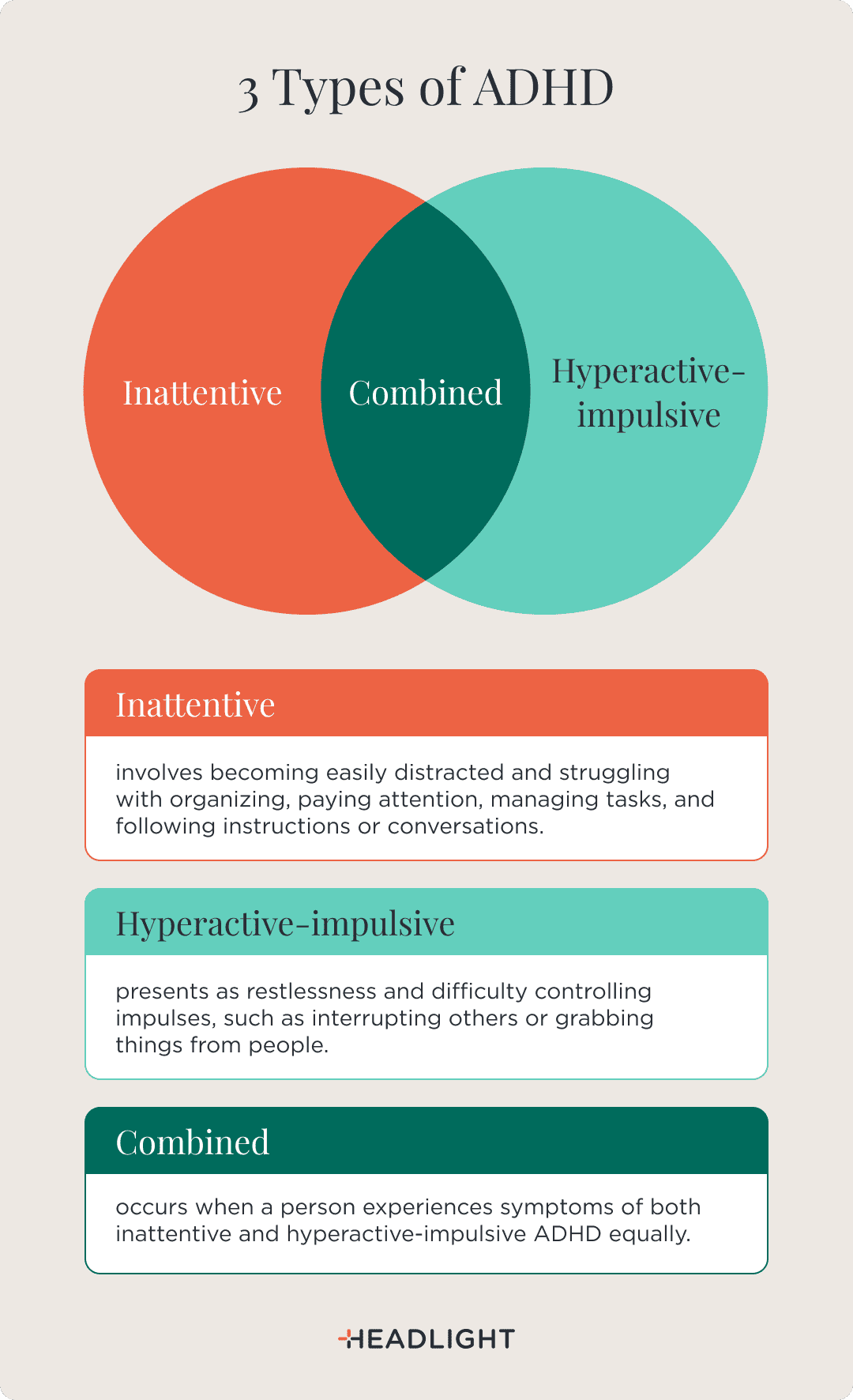
Once you complete an adult ADHD evaluation, the clinician will review the findings with you and tell you the type of ADHD you have. ADHD presents in the following ways:
- Inattentive involves becoming easily distracted and struggling with organizing, paying attention, managing tasks, and following instructions or conversations.
- Hyperactive-impulsive presents as restlessness and difficulty controlling impulses, such as interrupting others or grabbing things from people.
- Combined occurs when a person experiences symptoms of both inattentive and hyperactive-impulsive ADHD equally.
Knowing which type of ADHD you have helps the clinician determine your care plan. “Your provider will determine your care and develop your treatment plan based on your individual needs, your diagnosis, and your personal symptom presentation and symptom profile,” says Dr. Plotkina.
Treatment options aim at reducing symptoms of ADHD and may include:
- Therapy, such as cognitive behavioral therapy (CBT), dialectical behavior therapy (DBT), and mindfulness-based cognitive therapy (MBCT)
- Skills-based strategies to help manage time and improve organization
- Medication management includes stimulants, such as Adderall and Vyvanse, and non-stimulants, such as Strattera
- Lifestyle routines around improving sleeping, time management, and organization
- School and workplace accommodations, such as using noise-canceling headphones and asking for a flexible schedule
Once you have a plan in place, following up with your clinician is important so they can monitor what is working and not working and adjust accordingly.
If you’re not diagnosed with ADHD, your evaluation will still give a detailed report about the different ways in which your brain operates in regards to perceptual reasoning abilities, working memory, visual processing skills, and more.
“You will have a deeper and more nuanced understanding of personal cognitive strengths and weaknesses [and] areas of growth,” says Dr. Plotkina. “Your ADHD evaluation report will also include specific recommendations about steps you can take to address the very challenges that led you to seek out testing in the first place.”
How Headlight can help
If you are uncertain that an Adult ADHD diagnosis fits for you, and live in the western states, Headlight can connect you to a qualified clinician who can conduct an ADHD assessment and help you find appropriate therapy and support with medication management.
Headlight offers you the opportunity to choose in-person or virtual sessions. Plus, over 90% of Headlight clients use insurance to pay for services. To get help now and find a fitting therapist or clinician, contact Headlight to begin the personalized matching process.
Diagnosis and treatment will ultimately depend on your symptoms, medical history, co-occurring conditions, and personal goals.
Frequently asked questions (FAQs)
What should I bring to an ADHD evaluation?
Bring notes on how symptoms impact your life from school to work to relationships, as well as a medication list and medical records indicating any health or mental health conditions. If you have records of report cards from childhood or performance reviews from work, these could be helpful to the clinician. You can also bring a trusted friend or loved one who can share patterns or observations about you. Also, bring water and snacks in case the session goes long.
Can ADHD be diagnosed in one appointment?
While it’s not impossible to receive a diagnosis for ADHD in one appointment, accurate diagnosis should require a thorough assessment of several steps including a diagnostic interview in one session and in a separate session objective (neurocognitive assessment tools) and subjective (symptom questionnaires) testing measures.
What happens if I don’t meet the criteria for ADHD?
Irrespective of any diagnosis, you should walk away from an ADHD evaluation with a detailed report about the different ways in which your brain operates, including your perceptual reasoning abilities, working memory, visual processing skills, and more. You will have a clearer understanding of your cognitive strengths and weaknesses. You will also receive recommendations for how to address the challenges that caused you to get an evaluation.
Deep dive recommendations
Here is a list of helpful resources for further reading.
- https://www.nimh.nih.gov/health/publications/adhd-what-you-need-to-know
- https://www.cdc.gov/adhd/diagnosis/index.html
- https://pmc.ncbi.nlm.nih.gov/articles/PMC7067282/