
Is Therapy Covered by Insurance? How to Check Your Benefits
- Category: General
- October 5, 2026
Key takeaways
- Federal regulations require insurance companies to cover therapy, but that doesn’t necessarily make therapy free; in most cases, you’ll still need to pay out-of-pocket copays, coinsurance, or deductibles until you meet your annual policy limits.
- To get the lowest out-of-pocket rate, you’ll want to find a therapist who is in-network for your exact plan tier.
- The most reliable way to avoid unexpected bills is to call your insurer before booking your first therapy appointment and asking them to verify your mental health benefits, deductible status, copays, and prior authorization requirements.
- Insurance plans typically require a therapist to conduct an intake evaluation and assign an appropriate DSM-5 diagnostic code for billing.
Most people who have considered seeking mental health support have found themselves asking, “wait — is therapy covered by insurance?” If you’ve ever debated starting therapy but stopped shy of making an appointment for fear of going broke, you’re far from alone. According to the American Psychological Association (APA), over a third of Americans cite cost as one of the main reasons they avoid or delay mental health treatment.
While there are federal regulations that require health insurance plans to treat mental and behavioral health as essential benefits, the distinction between a service being “covered” and being fully paid for creates a ton of understandable confusion. Read on to learn why therapy coverage depends on your specific insurance plan and benefits, how to check your network status, deductibles, copays, and coinsurance, and where to get help checking coverage.
Is therapy covered by insurance?
While many health insurance plans do cover therapy, the exact type of therapy coverage varies significantly depending on the insurance provider, the specific plan, and individual policy details. According to the Health Insurance Marketplace, the U.S. government considers mental and behavioral health services to be “essential health benefits,” and all marketplace plans (health coverage purchased through an official government website or exchange) must cover the following:
- Behavioral health treatment (like psychotherapy and counseling)
- Mental and behavioral health inpatient services
- Substance use disorder treatment
That said, while insurance plans are required to cover these mental and behavioral health services, the definition of “cover” can vary. While the Mental Health Parity and Addiction Equity Act (MHPAEA) of 2008 prohibited insurers from “imposing less favorable benefit limitations” on mental health and substance use disorder services, according to the Centers for Medicare & Medicaid Services, that simply meant insurers couldn’t charge higher copays for therapy than for other services. However, there’s no law requiring insurance companies to “cover” therapy fully, i.e. make it completely free.
“Even when a provider is in-network and the service is covered by the client’s plan, the client may still be responsible for a copay, coinsurance, or deductible,” says Headlight Intake Manager Miguel Godinez. “In other words, insurance coverage means the service is eligible for benefits under the plan, but the client may still have a financial responsibility for part of the visit.”
While some therapy providers, like Headlight, do accept insurance, and work directly with insurance companies to offer mental health services for the cost of a co-pay, a 2024 report from the APA found that roughly one-third of psychologists don’t accept any form of health insurance, with nearly half of them saying they had accepted it in the past. The vast majority of respondents (82%) said the primary reason they didn’t take insurance was insufficient reimbursement rates, while 62% cited administrative challenges, and more than half of the group expressed concerns about payment reliability.
Marriage and Family Therapist Alyssa Mass, MFT, relates to these issues, and points to these concerns as the primary reasons she doesn’t accept insurance in her private practice. “I don’t take insurance because the reimbursement rates are low,” she says. “And I don’t want to spend the time that I can spend working with clients haggling with an insurance company. Or having them dictate how I can work, how long I can work, or the style in which I can work.”
How health insurance coverage for therapy works
Mental health benefits are usually considered one part of an overall health insurance plan. Under the MHPAEA, insurance companies are required to financially treat mental and behavioral health and substance use disorder the same way they treat medical and surgical coverage. According to the American Psychological Association (APA), this law also covers non-financial treatment limits, meaning it has mostly eliminated any restrictions on the number of annual mental health visits a person can have. That said, insurance companies can still put limits on services related to “medical necessity.”
Employer-sponsored health coverage, marketplace plans, children’s health insurance, and most Medicaid programs are all subject to the rules of the MHPAEA, but there are exceptions (like Medicaid and some state government employee plans). In general, while the MHPAEA is meant to give mental health coverage the same protections as other types of medical care coverage, it’s always best to check your specific plan description for all the details on how insurance coverage for therapy works.
“Some insurance companies might cover a certain number of sessions,” Mass says. “Other insurance companies might cover a percentage of cost. In those scenarios, if you’re not going to go through somebody on the list of your insurance company’s providers, then you’re going to be paying out of pocket. So obviously, that’s a fee up front, which is a financial commitment that not everyone can make or wants to make.”
The important thing to know is that while federal parity requires equal management terms for mental health as it compares to medical and surgical health, it doesn’t mean that every health plan is required to cover every specific therapy modality, treatment type, or individual clinician. Insurers are still able to maintain selective provider networks, exclude certain types of modalities, and to evaluate whether a specific treatment is “medically necessary.”
How to check whether your insurance covers therapy
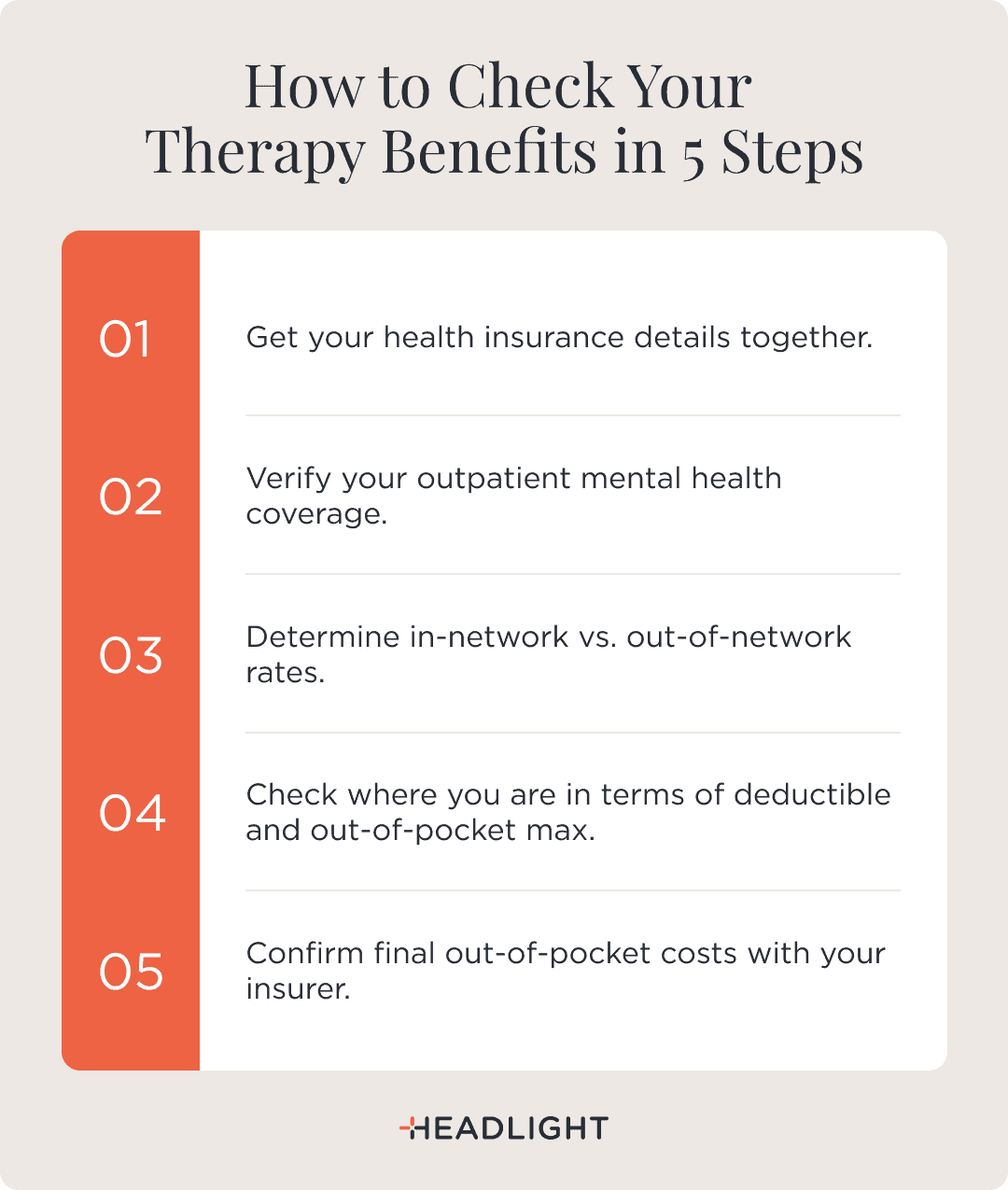
While it may seem like checking whether your insurance company covers therapy should be as simple as calling a clinician and asking, “do you take my insurance?” things can be a bit more complicated than that. There are nuances to every scenario and specific network details or plan tiers you should verify with your insurer to ensure you don’t receive unexpected bills.
“If somebody wants to go through their insurance, they need to call the number on the back of their insurance card and ask them what they qualify for,” Mass says.
According to Godinez, not only is it important to confirm with your insurer that mental health/behavioral health benefits are covered under your specific plan, but you should also check the following:
- The specific provider/clinician is in-network for your exact plan, not simply that the provider’s company or group accepts your insurance.
- Your exact plan, product, or network name, since an insurance company may offer multiple plans and networks with different benefits and provider networks.
- Whether your behavioral health benefits are administered through a separate company or network (sometimes referred to as a carve-out), as these benefits may have different coverage requirements or billing processes than their medical benefits.
Insurance terms that can affect what you pay for therapy
To understand whether therapy is covered by insurance (and how much you may actually need to set aside for mental health care), it’s helpful to understand the following definitions:
- Deductible: The amount of money you’ll need to pay before your insurer starts contributing
- Copay: The fixed amount of money you owe for a covered visit (can be applied before or after you hit your deductible)
- Coinsurance: The percentage of the covered cost you’ll owe once you’ve hit your deductible
- In-network: A clinician or facility that’s contracted with your health plan to provide a discounted rate
- Out-of-network: A clinician or facility that hasn’t contracted with your insurer and typically requires you to pay the cost (and, depending on your insurance plan, you may be able to receive partial or full reimbursement for)
In-network vs. out-of-network therapy
Again, while it may seem like simply asking a clinician whether or not they take insurance should be enough to know if your care with them will be covered, you’ll need more detailed information to know for sure. For example, a clinician who is in network with your insurance company (i.e. a “preferred provider,” according to HealthCare.gov) may be bound by your plan’s pre-negotiated fee agreements, while an out-of-network clinician may be willing to bill your insurer directly or provide paperwork for you to submit for reimbursement.
In-network providers are required to follow your insurance plan’s specific standardized fee schedule and can’t bill you for more than your insurer’s contracted rate. Some insurance plans only pay for services from in-network providers, according to HealthInsurance.org.
Out-of-network providers, on the other hand, do not have fee agreements with your insurance company and, depending on your specific plan, may require upfront, out-of-pocket payments. If your insurer does provide partial or full reimbursement for out-of-network visits, you may be able to obtain an itemized receipt known as a superbill to submit to your insurance company. Some plans, however, don’t offer reimbursements for non-emergency, out-of-network care, so it’s important to know the specifics of your plan before choosing a provider.
Does health insurance cover online therapy?
While in-person therapy is still the most common type of mental health care, according to a 2026 study in JAMA Psychiatry, 27.8% of Americans use telehealth services to receive care, and 21.5% use hybrid services (combined in-person and telehealth) to care. Like all types of mental health services, coverage for online therapy heavily depends on your specific insurance policy and provider network.
“Most insurance plans cover telehealth, including virtual mental health appointments, but the amount you pay and the rules for coverage can vary by plan,” Godinez says. “We recommend calling the number on the back of your insurance card and asking whether your specific plan covers outpatient behavioral health services by telehealth, whether the cost is the same as an in-person visit, and whether there are any restrictions or authorization requirements.”
When a diagnosis or medical necessity may affect coverage
In many cases, insurance coverage or reimbursement for therapy sessions can depend on whether the treatment you’re receiving meets your plan’s definition of “medical necessity.” According to HealthCare.gov, services or supplies are “medically necessary” when they’re deemed necessary to “diagnose or treat an illness, injury, condition, disease or its symptoms and that meet accepted standards of medicine.” In most cases, a clinician will have to evaluate your needs to determine an appropriate clinical diagnosis when relevant.
“A clinical diagnosis and medical necessity can play an important role in whether an insurance company pays for therapy,” Godinez says. “Insurance coverage for therapy generally requires that the service meets the plan’s coverage and medical-necessity requirements. When you use insurance for therapy, your insurance company may require information demonstrating that the service is being provided to evaluate or treat a mental health condition and meets the plan’s coverage requirements. Your therapist determines the appropriate clinical diagnosis based on your symptoms, assessment, and clinical judgment.”
Godinez adds that using insurance may involve sharing certain diagnoses and treatment information with the insurer for billing and claims purposes. “However, this does not mean that the insurer automatically receives your therapist’s private psychotherapy notes,” he says. “HIPAA provides additional protections for psychotherapy notes, while insurers generally receive the information necessary to process and review a claim or determine coverage.”
If you’re going to use insurance to cover therapy, you’ll most likely need to provide a billing code based on your clinical diagnosis. All diagnoses are derived from the Diagnostic and Statistical Manual of Mental Disorders (DSM-5), the standard reference book used by mental health professionals to diagnose and classify mental health conditions, according to the Cleveland Clinic. “That diagnosis will go to your insurance company, which will qualify you for a treatment code,” Mass says. “Sometimes that will impact the amount of sessions that they will agree to. For example, for grief or adjustment disorder, those codes usually have a time limit. Your provider could then change the code if you max out, but then you’re going to be going through insurance again to see if your insurer will still provide coverage.”
Questions to ask your insurance company before starting therapy
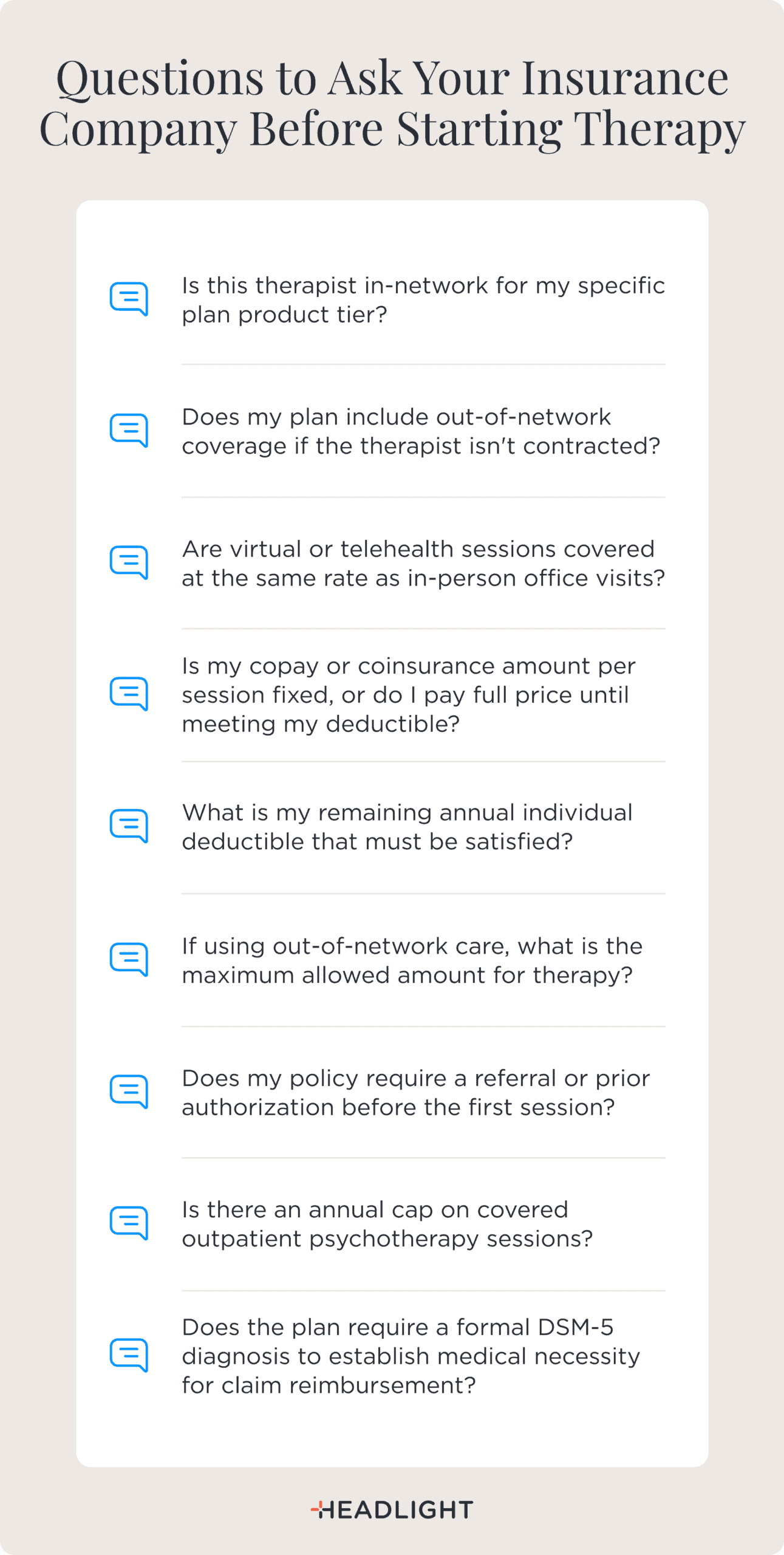
The best way to understand whether your specific insurance plan covers therapy is to call your insurer to clarify your benefits before booking a consultation or appointment. Knowing all the info up front can help prevent unexpected out-of-pocket bills down the line. When speaking with an insurance representative, consider asking these specific questions to get the details you need:
- Is outpatient therapy included in my mental health benefits?
- Is this specific clinician in-network under my exact plan?
- What deductible, copay, or coinsurance applies?
- Do I need a referral, prior authorization, or other approval before starting?
- Are there plan-specific limits or requirements I should know about?
How to find a therapist covered by insurance
While there are a lot of nuances and specific plan differences to consider when seeking therapy covered by insurance, there are a few ways to find the right provider. The best way to start is to check your insurance carrier’s online directory or member portal. There, you’ll be able to find a list of potential in-network providers. However, it’s always important to directly contact the clinicians on the list to confirm their in-network status before booking an appointment.
Another way to find a therapist covered by insurance is to ask a therapy group or organization whether they can verify your eligibility and insurance benefits. Many practices have dedicated billing services and can run an electronic eligibility and benefits check before your first visit to confirm your deductible, copay, or coinsurance responsibilities.
Always be sure to confirm your exact insurance plan when considering a therapist. Because insurers manage a huge variety of plan types (including PPOs, HMOs, Marketplace plans, etc.), you’ll want to verify that the therapist you’re considering is covered under your specific plan name, group number, and network prefix.
While insurance coverage is important, it may not be the only factor you want to consider when seeking out a therapist. Cost can be a concern for many, but personal preferences — like therapeutic approach, specialization, availability, and more — are also worth thinking about.
If, at any point during your treatment, you switch jobs, transition to a new policy year, or experience plan changes, you’ll definitely want to recheck your benefits. Any time you experience an insurance change, be sure to give your updated card details to your provider before your next session to avoid any billing surprises.
What if insurance does not fully cover therapy?
If your insurance plan doesn’t fully cover therapy and you can’t afford the out-of-pocket costs, you have a few options. First, call your insurer and ask whether your plan includes out-of-network benefits or a reimbursement option. Certain plans (like PPOs) allow you to pay the therapist directly and then submit superbills for partial reimbursement. In that case, be sure to ask the clinician or organization you’re seeking treatment from whether self-pay or payment options are in fact offered. If you do submit a claim and it’s denied, request that your insurer provide the reason and ask about applicable review or appeal options.
If reimbursement isn’t an option, check to see if you have access to an employer-sponsored employee assistance program (EAP) that offers relevant mental health support. “EAPs may provide access to a limited number of mental health sessions at little or no cost,” Godinez says.
It’s also worth reviewing whether your plan allows you to pay for therapy through a health savings account (HSA) or a flexible spending account (FSA). “If you have a high deductible or significant coinsurance, you may want to ask about the self-pay rate,” Godinez adds. “In some cases, paying the self-pay rate may be less expensive than using your insurance and being responsible for a large deductible or coinsurance amount.”
Godinez also adds a few clarifying takeaways: first, it’s important to remember that any amounts paid outside of insurance generally do not count toward a deductible or out-of-pocket maximum. “So clients should consider both the immediate cost and how paying out of pocket may affect their overall healthcare expenses,” he says. “Federal employees and individuals with government-sponsored insurance may have additional plans and requirements. They should check with their plan or benefits administrator to understand more.”
While trying to figure out whether therapy is covered by insurance can sound overwhelming or daunting, there are mental health clinicians and practices that help minimize or eliminate the hassle. “At Headlight Health, we want to make the process of getting started as easy and transparent as possible,” Godinez says. “Once your appointment is scheduled, our billing team will verify your insurance benefits to check/determine that your plan is active and that we’re able to bill your insurance. If we find that your plan is no longer active or includes a carve-out that we’re unable to accept, we’ll reach out as soon as possible to talk through alternative options and provide helpful resources.”
While verification doesn’t necessarily guarantee final out-of-pocket costs, speaking directly with your insurance carrier while Headlight’s billing team calculates estimates can help make the process much smoother “For the most accurate information about what you may owe, we encourage you to contact your insurance carrier directly using the number on the back of your insurance card,” Godinez says. “Our goal is to help you feel informed and supported throughout the process, so don’t hesitate to reach out if you have questions.”
Frequently asked questions (FAQs)
Does insurance cover therapy?
Yes, most insurance plans do cover mental and behavioral health services as essential health benefits under the the Mental Health Parity and Addiction Equity Act (MHPAEA), but the definition of “coverage” can vary. Therapy providers who are in network with an insurance plan tend to be covered at a higher rate than those out of network, and just because therapy is “covered” does not mean it will be free of charge. Clients are typically expected to share the cost of therapy sessions by paying a certain amount out of pocket first (deductible), and paying either a copay (a flat fee per session) or coinsurance (a percentage of the session cost).
How do I know if therapy is covered by insurance before my first session?
In addition to verifying your insurance with the clinician and checking your summary of benefits and coverage, the best way to receive accurate information about whether therapy is covered by your insurance plan is to call the member customer service number on the back of your insurance card and ask the representative specific questions, including:
- Is outpatient mental health therapy covered under my plan?
- Is [therapist’s name or NPI Number] in-network for my exact plan?
- What is my copay or coinsurance per session?
- Do I need to meet a deductible before insurance pays, and how much is remaining?
- Do I need a referral or prior authorization before my first visit?
How do I find a therapist covered by insurance?
Start by checking your insurer’s directly on their website or mobile app. You can usually filter clinicians by specialty, location and format, and specific concerns. You can also cross-reference the results with online therapist directories like Psychology Today. Next, you’ll want to verify your insurance plan details directly with the clinician, confirming whether they’re actively in-network for your exact plan and whether they are currently accepting new patients. Selecting a clinician who works with a larger mental health organization that accepts major insurance plans, like Headlight, can also help increase the chances that your therapy will be covered.