
Anxious-Avoidant Attachment: What It Is and Why the Cycle Repeats
- Category: General
- August 6, 2026
Key takeaways
- Anxious-avoidant attachment (fearful-avoidant) is a “push-pull” pattern where you intensely crave intimacy but panic and pull away once you get it.
- Attachment style isn’t a fixed identity or a flaw; it’s a blueprint developed in childhood to survive unpredictable or unsafe caregiving.
- Working with a therapist can help you identify and track anxious-avoidant triggers and start to change ingrained patterns of behavior.
Anxious-avoidant attachment (often called “fearful-avoidant” attachment) is characterized by a push-pull pattern of craving closeness with another person but simultaneously fear the moment closeness arrives. That can initiate a need to pull away, seek reassurance, or even end a relationship. While anxious-avoidant attachment typically traces back to inconsistent or unsafe early caregiving, it’s not a fixed state or permanent feature. Instead, it’s considered a set of survival strategies that can be unlearned and changed. By noticing triggers without judgment, practicing small moments of safe closeness, and, ideally, working with a therapist, the anxious-avoidant pattern can be broken, and safe, secure relationships can be on the other side.
Anxious-avoidant attachment in particular is a type of attachment many people can relate to. If you’ve ever felt the roller coaster of emotions associated with wanting someone close but then feeling terrified when that fantasy becomes a reality, you may be familiar with the experience. Understanding why you (or your partner) may crave connection one minute and then run from it the next (only to seek reassurance shortly after) may help break the cycle. Read on to understand the basics of anxious-avoidant attachment, the signs to watch for, and the ways to start changing it through awareness, therapy, and dedicated effort.
What is anxious-avoidant attachment?
Before diving into the definition of anxious-avoidant attachment, it’s important to understand what “attachment” really means in the realm of psychology and relationships. Dating back to the 1960s, attachment theory was developed by British psychoanalyst John Bowlby in collaboration with developmental psychologist Mary Ainsworth, according to EBSCO. They proposed that babies require secure attachment with at least one caregiver, and those who lack a stable caregiver relationship may later have difficulties forming trusting adult relationships.
“Attachment research originated from infants and their caregivers and examined how those early bonds shaped emotional and social connections in relationships,” says Headlight marriage and family therapist Gloria Saldana, MFT. “What led to avoidant attachment was the result of neglectful caregivers, where children learned they could not depend on their caregivers and therefore had hyperindependence and were emotionally distant.”
The original theory identified three categories of attachment—secure, avoidant, and anxious (or resistant)—with a fourth, fearful/disorganized category added later, according to the journal Personal Relationships:
- Secure attachment is just what it sounds like: a securely attached person is optimistic, values closeness and intimacy, and deals with conflict in a constructive way, according to Adult Attachment.
- Avoidant attachment is characterized by emotional distancing, low trust in others, discomfort with closeness, and intense independence.
- Anxious attachment is characterized by constant worries about abandonment, excessive dependence, negative self-view, and strategizing to maintain connections.
- The defining feature of disorganized or fearful attachment, according to the journal Personality Disorders is “the absence of a coherent strategy for interacting with and responding to a caregiver in times of stress.”
Ainsworth used the term “anxious-resistant” to describe children who had a difficult time being soothed and who exhibited contradictory behaviors: They wanted to be comforted, but also wanted to “punish” their caregiver for leaving in the first place, according to the University of Illinois at Urbana-Champaign Department of Psychology.
Researchers later applied the term “fearful” as an analog to avoidant patterns combined with elements of disorganized/high-anxiety attachment. This style of attachment combined high anxiety and high avoidance and involved a negative view of the self and of others that led to a behavior style including both approach and avoidance, according to Psychoneuroendocrinology. Over time, “anxious-avoidant” became a common alternative term to describe the same pattern.
In general, anxious-avoidant attachment is characterized by:
- A push-pull pattern around closeness
- A strong desire for connection
- Fear of vulnerability, rejection, or being trapped
- An alternating presentation of anxious pursuit and avoidant withdrawal
Anxious-avoidant attachment can often develop in response to trauma, abuse, or highly inconsistent caregiving. It’s important to understand that anxious-avoidant attachment—and any form of attachment for that matter—is not a personal flaw or fixed identity.
“Attachment styles develop in childhood, and as children, we don’t have any power or control over that,” says Tessa Gordon, LMFT . “However, as adults, we do. We have the ability to notice these patterns and to slowly, intentionally, build something different…What once kept you safe as a child doesn’t have to keep running the show now.”
Rather than thinking of anxious-avoidant attachment as something a person is or has, Gordon says she finds it more useful and accurate to look at it as a behavioral pattern that emerged at a young age, one shaped by experiences with trust and safety. “It’s a set of relational strategies someone developed to survive a specific set of circumstances, not a fixed identity or a life sentence,” she says.
Anxious-avoidant attachment style isn’t exclusively reserved for romantic relationships—it can show up in different kinds of dynamics. “Clients may frequently ask if I’m mad at them,” Gordon says, “seek reassurance that they’re doing therapy ‘right,’ that how they answered a question was ‘right,’ or ask repeatedly if they’re being ‘annoying.’” she says. ”
Anxious-avoidant vs. avoidant attachment meaning
Understanding anxious-avoidant attachment can be a bit of a challenge in the absence of scientific literature explicitly using that term. Complicating the matter is the fact that the American Psychological Association (APA) formally defines anxious-avoidance as “an adult interpersonal style characterized by discomfort in being with others and a tendency to avoid intimate relationships with them,” essentially classifying it as synonymous with avoidant attachment.
While Ainsworth’s original use of “anxious avoidant” was used interchangeably with “avoidant,” more modern interpretations of “anxious-avoidant” attachment refer to the hybrid concept more commonly called “fearful” or “fearful-avoidant”: feeling the push and pull of wanting closeness but simultaneously rejecting or fearing it.
Both anxious-avoidant attachment and avoidant attachment pattern are forms of insecure attachment, but the main distinction between the two is that the anxious-avoidant attachment pattern both craves and fears intimacy. “It’s this duality, wanting closeness and fearing it simultaneously, that creates the unpredictable push-pull pattern of behaviors,” Gordon says.
For those with avoidant attachment, there is less of an internal tug-of-war, according to Gordon. “People with this attachment pattern may have experiences with relationships being unreliable and untrustworthy, and relationships are often characterized by miscommunication and confusion,” she says. “But unlike the anxious-avoidant attachment pattern, the desire for closeness itself has largely been deactivated.”
What causes avoidant attachment and anxious-avoidant patterns?
While there’s no single cause of avoidant or anxious-avoidant patterns, attachment style is a theory rooted in the early bonds between children and their caregivers. “Anxious-avoidant attachment stems from having a traumatic experience with a caregiver, or one where the caregiver is both a source of comfort and fear,” Saldana says. “For this reason, they experience that push and pull in their desire for closeness, sometimes it felt good and was reciprocated and sometimes it led them feeling hurt.”
Both anxious-avoidant and avoidant attachment patterns usually develop in childhood as a result of a primary caregiver consistently being unreliable, rejecting, or being unable to meet the needs of a child. As a result, the child learns to rely solely on themselves. Some of the potential contributors to avoidant or anxious-avoidant patterns include:
- Dismissal or minimization of early emotional needs
- Caregivers who felt unavailable, unpredictable, critical, or frightening
- Pressure to be independent too soon
- Past relationships that reinforced mistrust
- Trauma, loss, rejection, or emotional inconsistency
- Patterns can develop or intensify later in life
While all of these may be contributing factors, Gordon points out that a caregiver’s capacity to meet those needs rarely exists in a vacuum. “It’s shaped by their own unaddressed trauma, by poverty and resource scarcity, by ableism, by chronic illness or medical burden, by lack of community and systemic support,” she says. “Locating the ‘cause’ solely in an individual caregiver’s failure misses the larger conditions that often made consistent caregiving genuinely difficult to access.”
Signs of anxious avoidant attachment style in relationships
Saldana says that one of the most common signs of anxious-avoidant attachment style that she routinely sees in her practice is a simultaneous desire for intimacy and a drive toward self-sabotage. “It’s common to see the fear of being hurt as a reason they will pull away from relationships even if they are generally healthy without red flags,” she says. “They may also have a tough time being able to discern what are healthy vs. unhealthy relational dynamics.”
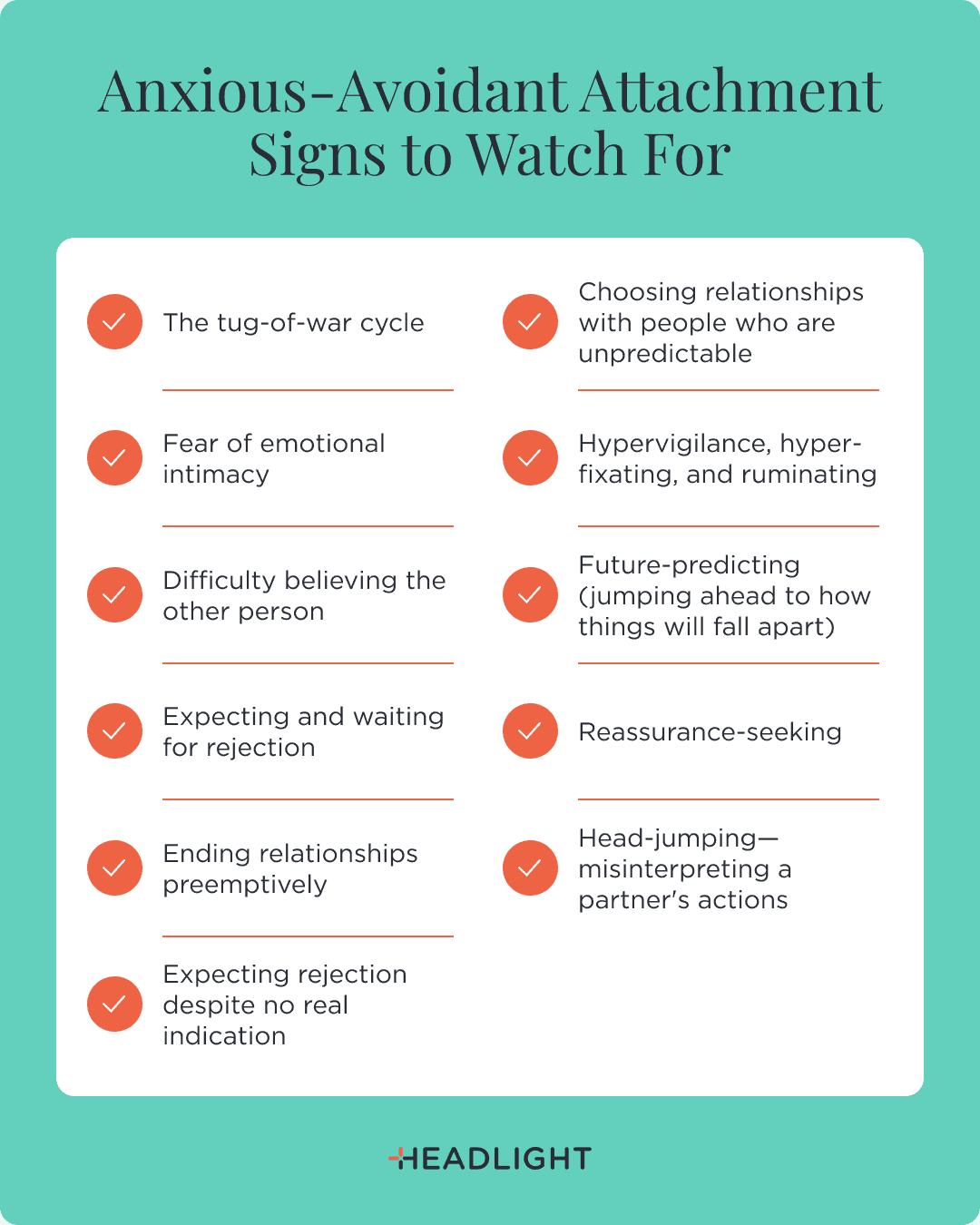
Gordon notes several signs of anxious-avoidant attachment styles in relationships that she typically sees in her practice:
- The tug-of-war cycle (or pursue-withdraw)
- Fear of emotional intimacy
- Viewing their partner as unpredictable
- Difficulty believing the other person in the relationship will love, support, care for, or like them
- Expecting and waiting for rejection, hurt, and disappointment in relationships
- Ending relationships (including the therapeutic one) preemptively, as a way of protecting against anticipated rejection
- Expecting rejection despite no real indication of this, and then acting in ways that lead to the ending of the relationship, thus fulfilling the prophecy
- Choosing relationships with people who are unpredictable, fear-inducing, and untrustworthy
- Hypervigilance, hyper-fixating, and ruminating on the relationship
- Future-predicting (jumping ahead to how things will fall apart)
- Reassurance-seeking
- Head-jumping—misinterpreting a partner’s actions without evidence
In her practice, Gordon sees these signs show up in several arenas, including in the realm of texting and DMs. “I see this most with clients navigating dating and relationships—obsessing over the amount of time between texts back from a partner, or checking a partner’s status and activity across various social media platforms,” she says. “Other times a client reaches out multiple times by email, text, or phone call to book an intake appointment or consultation, and then disappears entirely after that first session, not responding to any future communication.”
Gordon says she also routinely sees signs of anxious-avoidant patterns in her work with neurodivergent couples and families, as well as those impacted by chronic illness and medical trauma. “For clients with chronic illness, healthcare systems that have been unreliable, dismissive, or outright harmful—shaped by ableism and medical trauma—can create that same unpredictable, unsafe relational experience a caregiver might,” she says.
In some cases, the anxious-avoidant pattern often gets tangled up with things that have nothing to do with attachment fears at all. “What looks like ‘pulling away’ might actually be sensory overwhelm,” she says. “A client isn’t avoiding closeness; their nervous system needs a break from sustained social contact.”
How the repetitive anxious-avoidant cycle affects relationships
According to Saldana, the reason the anxious-avoidant cycle continues to repeat is that it’s familiar to those experiencing it. “We do as we are taught or modeled,” she says. “And if we haven’t seen an example of a healthy relationship or question the ‘why,’ then we will keep repeating these patterns..”
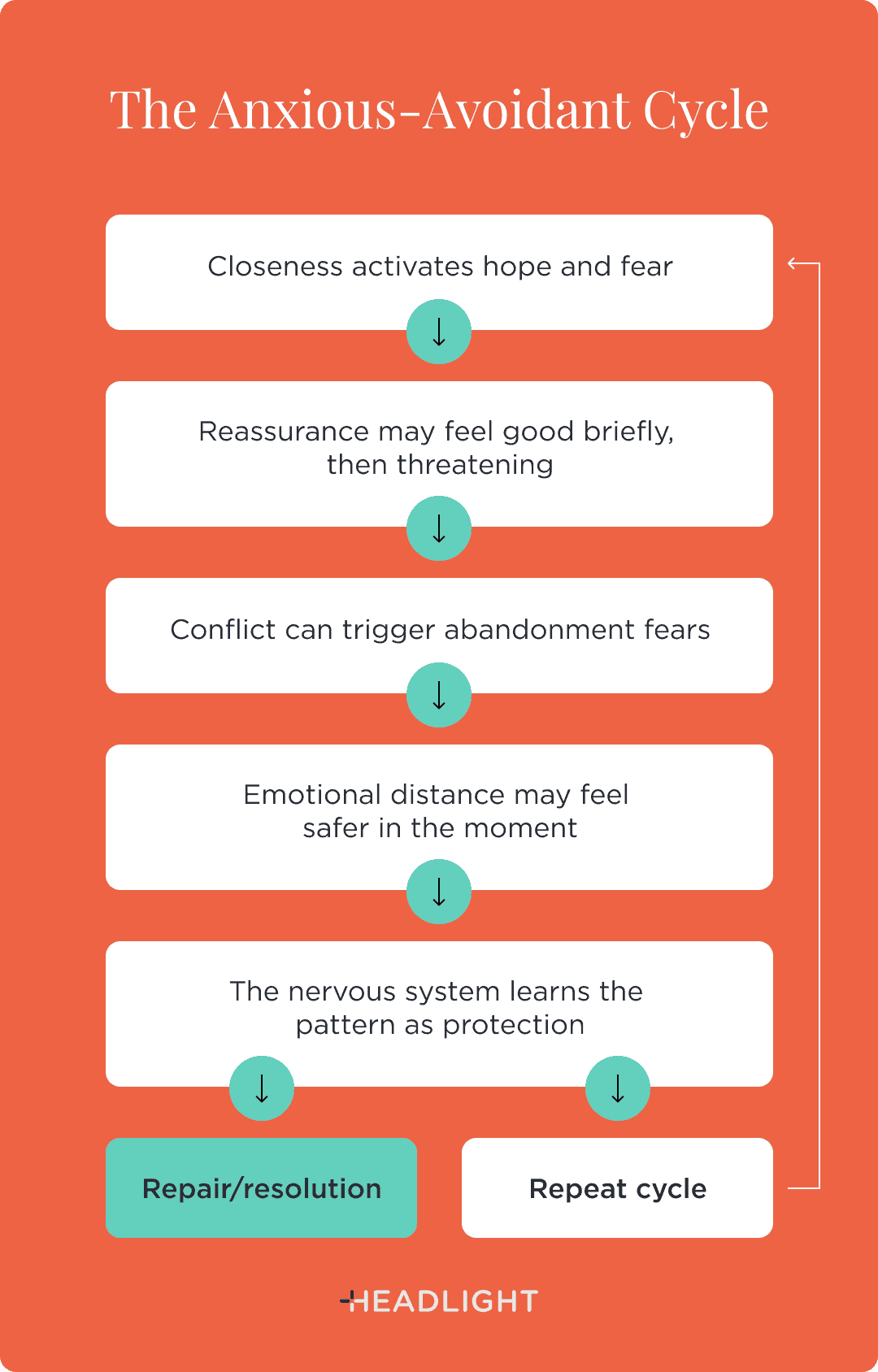
In many cases, the repetitive cycle of anxious-avoidance can look like the following:
- Closeness activates hope and fear
- Reassurance may feel good briefly, then threatening
- Conflict can trigger abandonment fears
- Emotional distance may feel safer in the moment
- The nervous system learns the pattern as protection
- Relief after withdrawal reinforces the cycle
Because of the roller-coaster nature of anxious-avoidant attachment, partners on the receiving end of this attachment style often have to navigate unpredictable behavior patterns and conflicting messages. Over time, it can lead to confusion, eroded trust, and feelings of rejection on both sides.
“Anxious-avoidant attachment presents as very mixed signals,” Saldana says. “This attachment type desperately craves deep emotional connection and vulnerability but at the same time is frightened by it, which leads to a push-pull dynamic with partners.”
How to recognize your triggers without blaming yourself
In order to start recognizing triggers, Saldana says that internal investigation is an important aspect of identifying the patterns of anxious-avoidant attachment. “Like many things, we do as we’re taught, and it’s not our fault we were taught unhelpful skills,” she says. “We would want to get curious about our experiences and ask ourselves why: ‘Why am I feeling unfulfilled? Why am I unhappy? What can I see as patterns or times when I feel activated?’ All these questions help us get to a place where we can better understand ourselves in order to create change.”
A few ways to begin recognizing triggers of anxious-avoidant attachment:
- Notice moments that activate panic or shutdown. “A trigger is information,” says Gordon. “It’s your nervous system doing exactly what it learned to do a long time ago, in an environment where that response actually kept you safe. So step one is separating the trigger from the shame story that gets attached to it.”
Gordon says that she typically invites clients to get curious rather than critical. “For example, instead of saying, ‘Why am I like this?’ or ‘What’s wrong with me?’ we shift the question to ‘What is this response trying to protect me from?’ That reframe alone takes a lot of the self-blame out of the room.”
- Track common trigger points. For some people, serious conversations, increased commitment, or perceived criticism can set off anxious-avoidant behaviors. For others, delayed replies, emotional requests, or other triggers can cause a spiral. Taking note of what causes episodes of anxiety or avoidance can start to reveal patterns.
From there, track your patterns. Notice: hat happened right before I felt the urge to pull away, or the urge to reach out? What did I feel in my body? “Over time, patterns start to surface, and clients can catch the trigger earlier and earlier—before it hijacks the whole interaction,” says Gordon.
- Separate feelings from facts. Before jumping to conclusions, try to distinguish whether an overwhelming reaction is truly based on factual evidence or if it’s a feeling based on how information has been perceived.
- Name the protective impulse. Does a specific trigger cause the need to pursue, withdraw, freeze, people-please, or some other type of impulse?
How to start building more secure relationship patterns
One way to start building more secure relationship patterns is through education on attachment styles. “Knowledge is power, but be discerning about where you get and source that knowledge,” Gordon says. With so much information available on social media and elsewhere on the internet, seek out vetted information from trusted sources that feels empowering rather than pathologizing.
Another tangible practice that Gordon often recommends to clients is to come up with a shared word or hand gesture with their partner that signals the need for a pause. “It’s a way of saying, without a whole conversation, ‘I’m upset, hurt, overstimulated, overwhelmed, anxious, angry, etc. and I recognize I’ve been triggered, and I’m trying not to fall into my usual pattern right now,’” Gordon says. “That signal buys you the ability to step away, regulate your nervous system, reflect, and then come back to the conversation later, so you can actually communicate what you’re feeling to your partner instead of reacting from the trigger.”
A few more ways to start building more secure relationship patterns include:
- Practicing slower responses during conflict
- Asking for space with a clear return time
- Using direct reassurance requests
- Setting boundaries without disappearing
- Repairing after withdrawal or escalation
- Building tolerance for healthy closeness gradually
When therapy can help with anxious-avoidant attachment
While learning to recognize and track unhelpful relationship patterns may help in beginning to undo learned patterns of anxious-avoidant attachment, working with a mental health clinician like those at Headlight can escalate healing in a number of ways. For one thing, establishing a relationship with a therapist can illuminate some of the ingrained habits and behaviors that perpetuate the anxious-avoidant cycle.
“Therapy is a new relationship, and a place where clients can experience a healthier dynamic than what they are used to,” Saldana says. “The relationship itself can be healing because they can be modeled on new ways of communicating or being. Helpful things that clients can do are to work on isolating their current relationship vs. comparing it and creating fear from negative past experiences.”
While attachment style is not a diagnosis, therapy can help identify patterns by exploring topics like:
- Relationship history
- Trauma history
- Anxiety or depression symptoms
- Communication habits
- Emotional regulation skills
While every case is unique, therapeutic treatment options for those dealing with anxious-avoidant attachment may include:
- Individual therapy
- Couples therapy
- Trauma-focused therapy
- Cognitive behavioral therapy (CBT), dialectical behavior therapy (DBT), acceptance and commitment therapy (ACT), eye movement desensitization and reprocessing (EMDR), or psychodynamic approaches when appropriate
Additionally, working with a healthcare provider can help personalize care and initiate conversations around adjunct tools like medication if anxiety, depression, or other symptoms are present.
“I recommend a therapist, someone who creates that nonjudgmental space, and who you can practice these relational skills with directly,” Gordon says. “The therapeutic relationship becomes a live, low-stakes place to practice trust, rupture, and repair.”
When to seek care or urgent support
“When it’s really getting in the way of your relationships or you recognize that there is a problem but you aren’t able to get yourself to stop those patterns,” Saldana says.
Of course, “if a client is experiencing thoughts of suicide or self-harm, that’s always an urgent conversation,” Gordon adds. “And I make sure they have crisis resources and a safety plan immediately, not at their next scheduled session.”
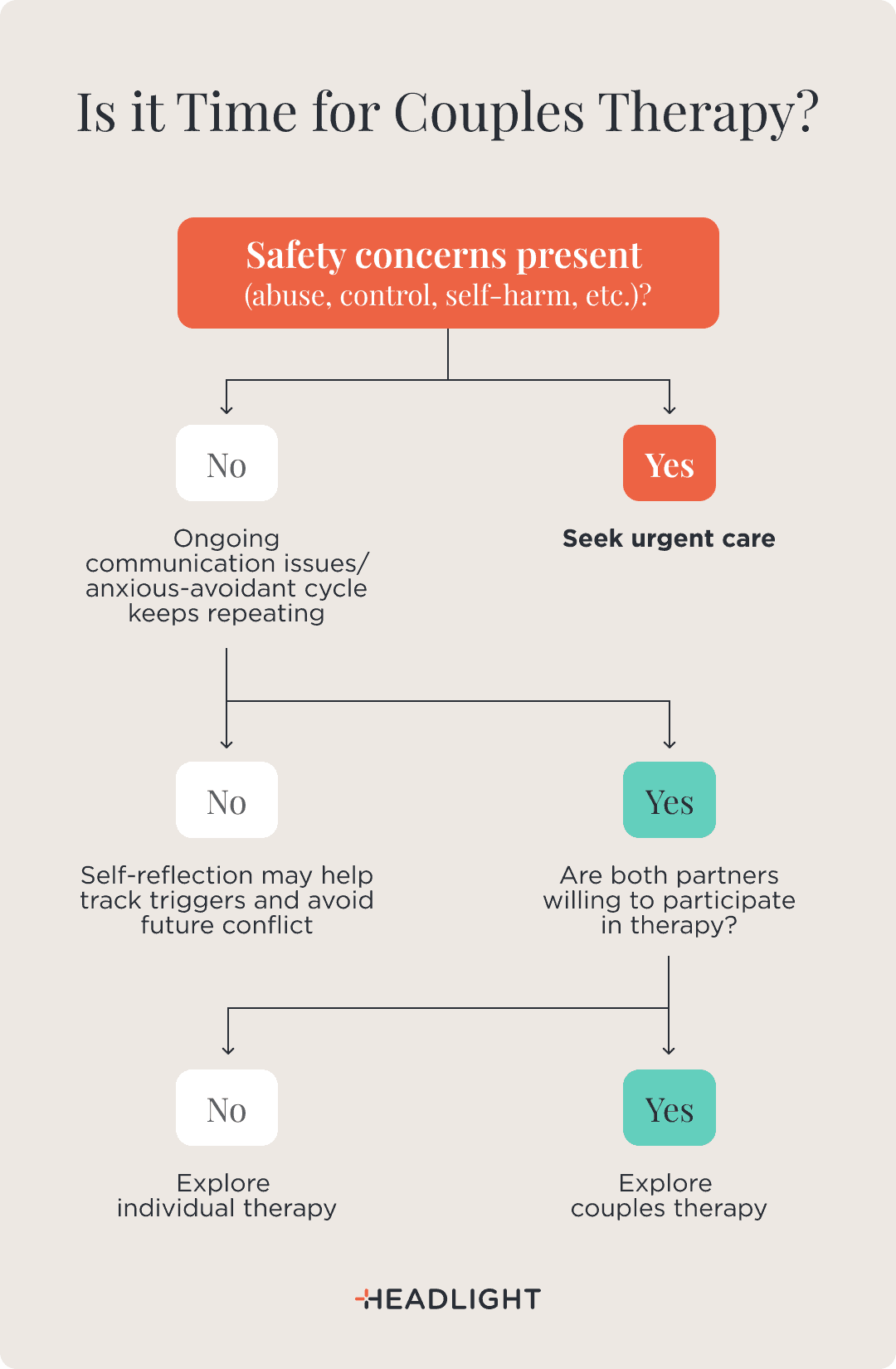
Some signs that urgent care is necessary include:
- The pattern causes repeated relationship distress
- Fear, jealousy, panic, or shutdown feel hard to manage
- Past trauma is interfering with current relationships
- Depression, anxiety, or sleep problems are worsening
- Relationship conflict includes emotional abuse, threats, or control
- Thoughts of self-harm, harm to others, or causing immediate danger all merit immediate, urgent help
If the relationship dynamic has moved beyond the back-and-forth pattern that’s characteristic of the anxious-avoidant attachment style and has taken on elements of control, intimidation, or fear for physical safety, that’s a major red flag. “That’s no longer ‘just’ an attachment pattern,” Gordon says. “That’s a safety issue and it needs to be addressed immediately. If this is the case, reach out for additional support, like a domestic violence advocate.”
And finally, if someone feels that they are unable to function on a day-to-day basis and having trouble sleeping, eating or working due to relationship distress, it’s time to seek out more frequent support or a higher level of care.
Regardless of where you are in your journey with anxious-avoidant attachment style, seeking out professional help can go a long way in your healing and growth. To start prioritizing your best interests in relationships and beyond, talk to a clinician like those at Headlight to find accessible expert guidance.
Frequently asked questions (FAQs)
Can someone have anxious-avoidant attachment without trauma?
“Trauma” is a subjective term and exists on a spectrum. One person’s “trauma” can look vastly different from someone else’s, and it may not be one single event that defines a traumatic experience. Anxious-avoidant attachment typically develops in environments where a child’s caregiver (who is supposed to be a “secure” base) is also the source of the child’s fear or confusion. This can happen in ways that aren’t always thought of as “classic” trauma. It’s also important to remember that there are a lot of factors that can contribute to a caregiver’s inability to provide a secure base, and a variety of factors that contribute to the development of anxious-avoidant attachment, including later adult experiences. So anxious-avoidant attachment can develop for a number of reasons that may not resemble textbook trauma.
Why do anxious and avoidant people attract each other?
The anxious-avoidant attachment style is a cycle, and it can be reflected in relationships as well as individuals. When one person is anxious and their partner is avoidant, the dynamic can resemble the cycle apparent in individual anxious-avoidant attachment style, including initial closeness activating hope and/or fear in one partner, reassurance that initially feels good but then feels threatening, conflict that can trigger abandonment fears, emotional distance that may feel momentarily safer, and relief from that withdrawal that reinforces the cycle.
Should I date while working on anxious-avoidant attachment?
With the help of a therapist, it’s possible to continue dating while working on anxious-avoidant attachment, and to start breaking harmful patterns. Learning to identify triggers, track patterns, and actively work on more productive, healthy communication strategies can all help improve a current relationship or set you up for a more successful next relationship.