
Dismissive Avoidant Attachment: Signs and How to Heal
- Category: Relationships
- June 30, 2026
Key takeaways
- Dismissive avoidant attachment is a relationship attachment pattern rooted in a strong belief in self-reliance, avoidance of vulnerability, and emotional shut down.
- With self-work, particularly in therapy, dismissive avoidant attachment patterns can be improved so that you can develop deeper, more meaningful connections with people in your life.
- If you have difficulty maintaining relationships, collaborating in team environments, and practicing vulnerability, you may benefit from therapy.
Have you ever reacted to a partner, family member, or friend expressing their needs by telling them they’re being too sensitive or dramatic? You may be someone with a dismissive avoidant attachment style. This style is often hallmarked by avoiding closeness and vulnerability. But with awareness, self-work, and therapy, you can develop more secure attachment and build fulfilling relationships. Learn how to recognize this attachment style in yourself, in partners, and strategies that support healing.
Thinking to yourself, “It’s just better if I do it” doesn’t mean you doubt others or don’t want help—it might stem from a deeply ingrained belief that the only person you can rely on is you. Or maybe you’re in a relationship but shut down when your partner initiates an emotional conversation. Vulnerability does not feel like your strong suit.
If these things ring true, you might be someone with dismissive avoidant attachment.
Dismissive avoidant attachment is a pattern of behavior and self-protection where you learn to rely on yourself and avoid closeness with others. This can impact your relationships across your life, including with romantic partners, friends, and colleagues.
If you’re interested in learning to build closer, stronger bonds and feel safe in relying on trustworthy people in your life, you can work on strategies that help build more secure connection patterns.
Even diving into this article is a huge step, as it can be overwhelming to feel the push-pull of opposite emotions. You want closeness, but it feels overwhelming. Or, maybe you are on the other side and you love someone who repeatedly pulls away and doesn’t trust.
With awareness, willingness to do self-work, and the right support, you can help change your own attachment pattern. Here’s how to gather emotional awareness, practice strong communication, develop safe boundaries, and bring in therapy at the right time so you can move forward.
What is dismissive avoidant attachment?
Dismissive avoidant attachment is a type of attachment style that develops as a learned coping strategy from our relationship with our caregivers, says Michael Falcone, Psy.D, LMFT, Executive Therapist at Headlight. As you grow up, you learn about how much you can rely on your caregivers to meet your needs and provide an emotionally safe space for you.
Ideally, caregivers respond to asks for help and connection with consistency and sensitivity. However, if they are unresponsive, you develop an expectation that people won’t be there for you when you need them—and it’s better just to rely on yourself, adds licensed clinical psychologist Vanessa Gomes, PhD. If that sounds like you, you may have dismissive avoidant attachment.
Dismissive avoidant is considered one of the insecure attachment styles. That doesn’t mean you want to avoid others. People with this pattern often still want love and connection. And, it doesn’t mean that you are inherently flawed or have a mental health diagnosis. This is an attachment style, and knowing where you stand can help you grow as a person and help you overcome challenges in a relationship.
Dismissive avoidant traits to look for
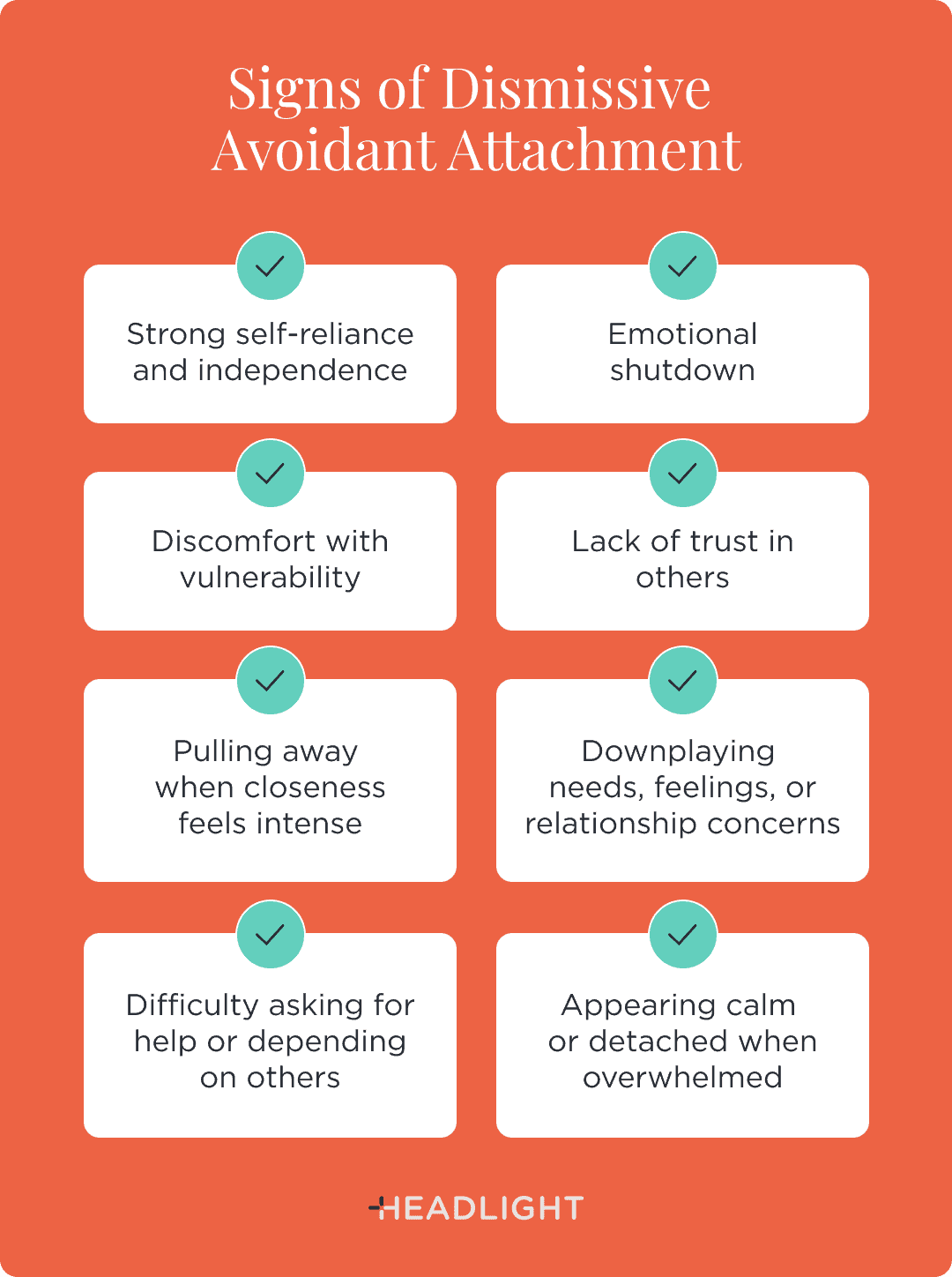
We’re not all the same, but there are certain dismissive avoidant traits that stand out. According to Dr. Falcone, those include:
- Strong self-reliance and independence
- Emotional shutdown
- Discomfort with vulnerability
- Lack of trust in others
- Pulling away when closeness feels intense
- Downplaying needs, feelings, or relationship concerns
- Difficulty asking for help or depending on others
- Appearing calm or detached when overwhelmed
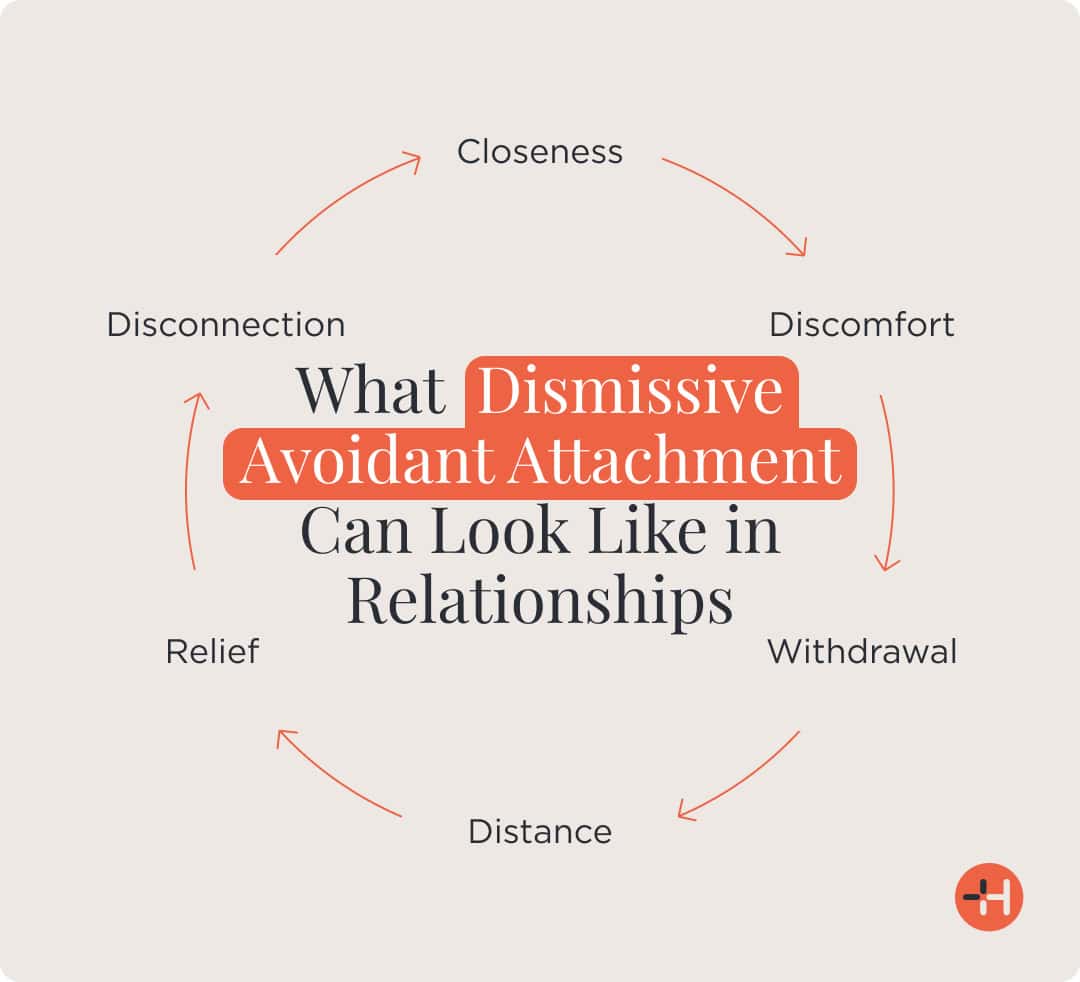
What dismissive avoidant attachment can look like in relationships
People who have attachment styles where they are uncomfortable with closeness are more likely to be single and not build stable romantic relationships, according to one study in the European Journal of Investigation in Health, Psychology and Education.
Partnerships can have a large element of loneliness to them. You can be with someone as a friend or romantic partner, but lack closeness or intimacy. “Because vulnerability feels dangerous, people with dismissive avoidant attachment often operate under a single core belief, which is…trust in oneself is the safest,” says Falcone.
A person who has a dismissive avoidant attachment style may then struggle with closeness and intimacy or avoid asking for help so that they don’t have to depend on someone else, adds Gomes. “They keep their walls up,” she says.
In relationships, that might look like having surface-level conversations, needing space, avoiding long-term commitment, shutting down during emotional times, and prioritizing autonomy over everything else—even when a relationship suffers for it.
Why dismissive avoidant attachment develops
Dismissive avoidant attachment may be traced back to your younger years. “Dismissive avoidant attachment often stems from childhood emotional neglect, rejection, or shaming from primary caregiver/s,” says Falcone. “These painful caregiver dynamics teach a child that relationships are inherently unsafe.” Premature adultification—whereby adults perceive a child as older and more mature than their age or developmental stage and therefore do not protect the child adequately, per the journal Cognition and Emotion—can also fuel dismissive avoidant attachment, he adds.
As you age into an adult, traits associated with dismissive avoidant attachment appear as you fiercely work to protect and guard yourself. You may then carry the old coping strategies that you developed as a young person into adult relationships where they can become a detriment to your relationships.
Dismissive avoidant vs. fearful avoidant attachment
Dismissive avoidant often can be confused with fearful avoidant. While both are attachment styles, “the difference lies in how individuals perceive and respond to those needs,” says Gomes.
In dismissive avoidant, she says, you suppress your need for attachment and take care of things on your own. With fearful avoidant, you desire but also fear connection.
Common triggers for dismissive avoidant patterns
You may recognize certain patterns in your own relationships, and triggers that kick dismissive avoidant into high gear. We all have triggers that hit harder than others, but it can help to understand what resonates most with you. It’s in this awareness that you can start to make changes:
- You feel pressured to open up or commit in a romantic relationship
- You experience conflict that feels intense
- Your partner is asking for reassurance
- You feel controlled or criticized
- You need to ask for help
- You feel as if you’re in a vulnerable position
How to deal with dismissive avoidant attachment in yourself
Although it might feel like a tall hill to climb, all attachment styles can be shifted to more secure patterns. Here are several strategies to try:
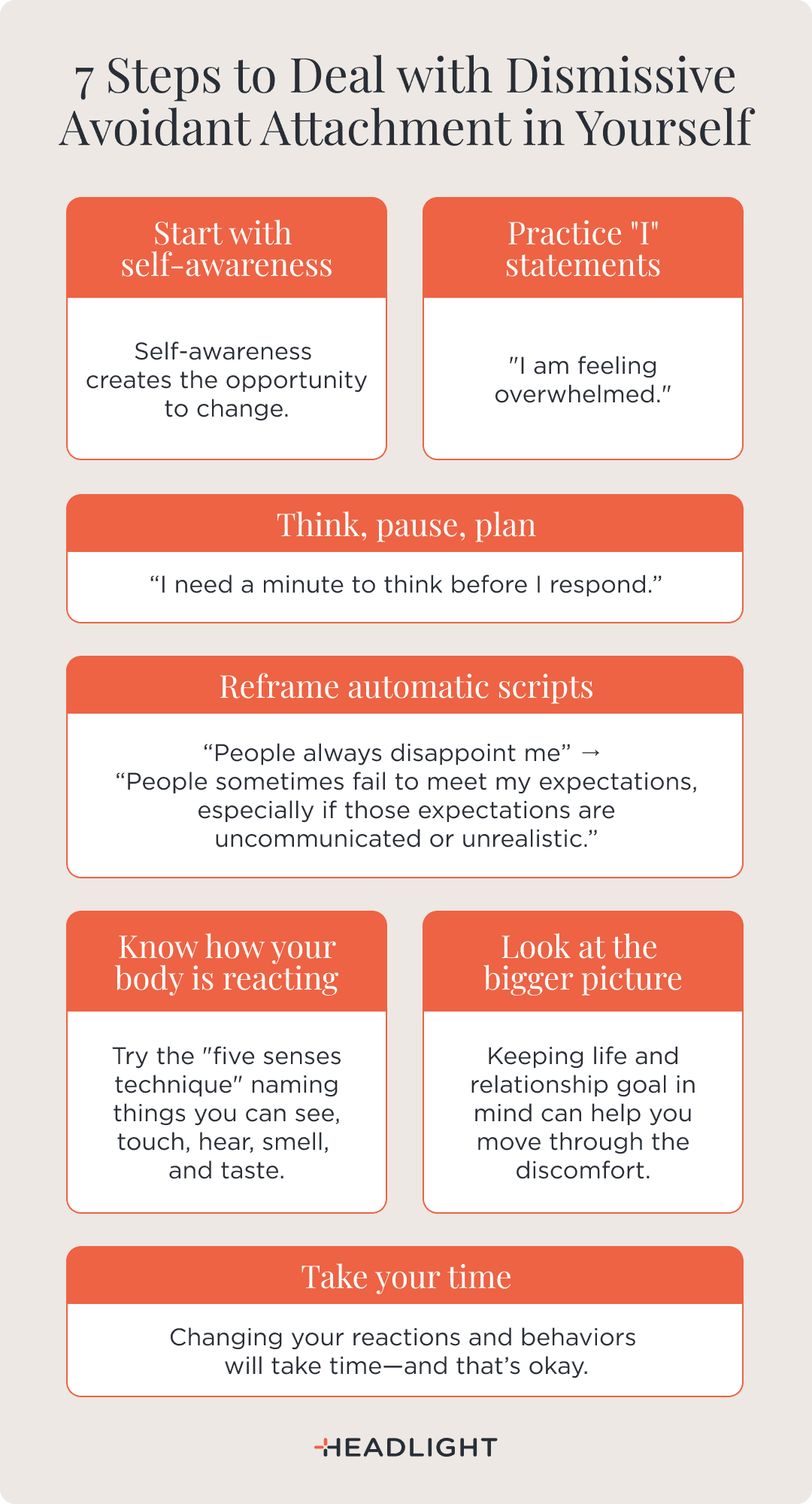
Start with self-awareness: This is Gomes’ favorite skill she teaches. “Once you learn to notice what is happening to you as it happens, it allows you to pause and choose a different course of action. Self-awareness creates the opportunity to change.”
Practice “I” statements: Falcone works with clients on changing language from “you are overwhelming me” to “I am feeling overwhelmed.” This can help you own your emotions and communicate well rather than shutting down, he says.
Remember these three steps: When a trigger happens, think, pause and plan, advises Gomes. These three steps create distance between the trigger and your emotions, allowing you to respond more constructively.
Reframe automatic scripts: Another skill is reframing negative automatic thoughts into more balanced ones, says Falcone. This is a strategy from cognitive behavioral therapy (CBT). One example, he says: Instead of “people always disappoint me,” you can reframe it to “people sometimes fail to meet my expectations, especially if those expectations are uncommunicated or unrealistic.”
Know how your body is reacting: Your body may display early signs of withdrawal, including chest tightness, numbness, or the urge to flee, says Falcone. Connecting to your body and recognizing these signs will help you work with your therapist to develop grounding strategies. One popular grounding strategy is the “five senses technique” where you name things you can see, touch, hear, smell, and taste.
Look at the bigger picture: What are your life and relationship goals, asks Gomes. If they involve closeness with others in some way (stronger friendships, a long-term partner), keeping those goals in mind can help you move through some of the discomfort.
Take your time: You spent decades in this attachment pattern, so changing your reactions and behaviors will take time—and that’s okay. “Give yourself the chance to learn that old expectations may no longer be accurate and that it is possible to learn to trust, be close, and rely on others for comfort and support,” says Gomes.
How to support a dismissive avoidant partner
If you have a dismissive avoidant partner, take comfort in knowing that your partner can learn to trust and rely on other people, says Gomes. (Yourself included.) While it’s not your job to heal your partner, having positive, trusting experiences with you can help rewire their old beliefs so they can feel more safe in the relationship.
Gomes points out that the main goal is to help your partner learn that it’s safe to ask for help and that you will respect and meet their needs. How you respond to your partner in times of need matters. “Attachment patterns are not changed by a single interaction. Rather, they change through repeated experiences of reliability, consistency, and responsiveness over time,” explains Gomes.
This sense of safety can be built in several ways, Gomes says:
- Use clear, direct, and respectful communication.
- Be proactive in discussing potential problems and plan on how you will respond to them.
- Always respect your partner’s needs.
- Avoid pressuring your partner to open up, but maintain a safe, welcoming environment when they want to share.
- Be supportive when they ask for help.
- Validate—don’t fix—their experiences or problems.
- If your partner needs or asks for distance, be understanding.
- Celebrate small steps forward, such as a small way they asked for help.
How therapy can help heal avoidant attachment patterns
There are two parts to healing avoidant attachment patterns, says Falcone: 1) therapy and 2) focused self-work. These two need to be done together for success.
For someone who has dismissive avoidant attachment, they may be hesitant to enter therapy. The working-by-yourself part is less scary. However, doing all of the work by yourself can backfire, says Falcone, leading to a deeper belief in hyper-independence and self-reliance.
Developing a firm, trusting relationship with a therapist is a nice counter to this, as it helps build a safe, nonjudgemental relationship with another person (your therapist). “Ultimately, integrating clinical therapy with strategic self-work can serve as a powerful catalyst for building closer, stronger relationships,” says Falcone.
In therapy, you will learn to:
- Identify relationship patterns and behavior triggers
- Build emotional awareness and regulation
- Practice safer communication
- Work though fears related to vulnerability
Finally, insecure attachment patterns may increase the likelihood of developing anxiety or depression, points out research in Frontiers in Behavioral Neuroscience. Therapy can also address co-occurring anxiety, depression, or chronic stressors.
If you’re partnered up and deciding between individual therapy or couples therapy, both can be helpful, says Falcone. “Engagning in both individual and couples therapy simultaneously can be incredibly powerful if time and resources permit,” he says. You can arrange a therapy schedule that incorporates both in a way that works for you—therapy should not be a source of stress.
When to seek professional support
If you’re considering professional support and it already feels overwhelming, that’s to be expected when you have dismissive avoidant attachment patterns. A core part of how you relate to other people is not trusting them, which makes reaching out for help challenging. “Therapy can help if you struggle with this attachment style or experience related life stressors,” says Falcone, who recommends professional support if you:
- Have difficulty maintaining relationships
- Collaborating in team environments
- Expressing emotions
- Practicing vulnerability
- Have a romantic partner, colleague, or manager who says it’s challenging to connect or collaborate with you
“Therapists at Headlight that are trained in attachment theory first identify the behavioral and emotional traits of dismissive-avoidant attachment,” says Falcone. Most important is finding a therapist that creates a safe, nonjudgmental, and trusting environment where you can explore how your past experiences and/or traumas inform how you behave and relate to others. “This foundation slowly dismantles [your] core belief that ‘others are unsafe’ or ‘I can only rely on myself’,” he explains.
And it’s at that point where dismissive avoidant attachment begins to heal.
Frequently asked questions (FAQs)
Can a dismissive avoidant attachment style change?
Yes, with individual work and therapy, dismissive avoidant attachment style can change so that you build closer, more trusting relationships.
How do I know if I have dismissive avoidant attachment?
The top four signs of dismissive avoidant attachment are strong self-reliance and independence, emotional shutdown, discomfort with vulnerability, and lack of trust in others.
What should I avoid doing with a dismissive avoidant partner?
If you recognize dismissive avoidant behaviors in your partner, don’t speak to your partner disrespectfully, don’t ignore their boundaries, and don’t pressure your partner to open up. Instead, working on being clear in your communication and providing a safe environment for connection will go a long way in supporting your partner.