
Body Dysmorphia Treatment: Evidence-Based Options
- Category: Eating disorders
- July 6, 2026
Key takeaways
- Body dysmorphia, or the correct clinical term which is body dysmorphic disorder (BDD), is most effectively treated with a combination of medication and cognitive behavioral therapy (CBT).
- CBT treats body dysmorphia by identifying and reframing maladaptive thoughts about your body and self-worth, and changing unhealthy behaviors.
- Antidepressant medication can treat body dysmorphia by lowering obsessive thoughts and behaviors and reducing symptoms of anxiety and depression.
- Unfortunately, many people with BDD delay treatment because they view their problem as physical, rather than mental.
- Seeking support and treatment from mental health professionals, like those who work with Headlight, can help you feel better with BDD.
Body dysmorphic disorder (BDD) isn’t just a beauty obsession or self-esteem problem. It’s a diagnosable mental health condition that, when left untreated, can have devastating impacts on a person’s life. Body dysmorphia treatment often involves a combination of therapy and medication.
Seeking treatment for body dysmorphic disorder (BDD) can feel scary, and that’s an understatement. Many people with BDD are tempted to address their body dysmorphia with cosmetic treatments—on the spectrum of hair dye to nose jobs and beyond—but that isn’t the answer. Neither is hiding away, shaming yourself, or downplaying how your obsessive body-related thoughts are restricting your life.
Body dysmorphia treatment addresses the root cause of the condition, which lies in your mental health and not your physical appearance. Effective treatment usually involves a combination of medication and therapy, where you’ll be taught to recognize your harmful thought patterns, how to reframe them, and coping mechanisms for your triggers.
Here’s everything you need to know about body dysmorphia treatment and what it looks like in the real world.
What body dysmorphia treatment is meant to address
“Body dysmorphic disorder (BDD) is a mental health condition where someone becomes preoccupied with perceived flaws in their appearance,” says Julia Scherting, LPC, LMHC, a therapist with Headlight who is personally in recovery for BDD.
Importantly, these flaws are often minor or completely non-existent to other people.
Body dysmorphia treatment addresses these obsessive body image-related thoughts, which often feel intrusive, hard to control, and consume an hour or more of the person’s day.
Treatment also tackles compulsive or life-limiting behaviors, like:
- Mirror checking
- Body checking
- Excessive grooming
- Seeking reassurance from others
- Comparing yourself to others
- Avoiding social events, photos, intimacy, or mirrors
Ultimately, the goal of body dysmorphia treatment is to reduce your appearance-related thoughts and behaviors, ease your distress, and help you live a full and free life once again.
How to treat body dysmorphia: Step #1 is recognizing the symptoms
For many people, the journey to body dysmorphia treatment isn’t as straightforward as just signing up with a therapist. The first challenge is realizing that you (or your loved one) have a problem, and that the problem is psychological rather than physical.
“BDD is generally considered treatable, but it can be a challenging condition to address,” says Scherting. A huge part of that challenge is that many people with BDD don’t recognize the problem as psychological.
Many people with BDD genuinely believe their problem lies in their appearance, so they avoid public settings or undergo cosmetic treatment, rather than seeking mental health treatment.
There’s also the misconception that body dysmorphia symptoms are simply an extreme form of vanity. “Most people with BDD are just trying to fit in and not have any special attention paid to them,” says Scott Granet, LCSW, a therapist on the scientific and clinical advisory board for the International OCD Foundation and expert in BDD.
“Being perceived as vain is often cited as a reason why people with the disorder resist seeking psychiatric help,” he says.
This mismatch between recognizing body dysmorphia for what it is (a mental health condition, not a physical flaw), and aligning with the right solution (mental health treatment, not cosmetic treatment), can delay recovery for years.
There’s some good news, though: “Once someone engages with the right treatment, though, the evidence base is solid, and meaningful improvement, including full remission, is absolutely possible,” says Scherting.
Body dysmorphic disorder symptoms to watch for
If you’re worried that you, or someone you love, might have BDD, then it can be helpful to learn red flags to look out for.
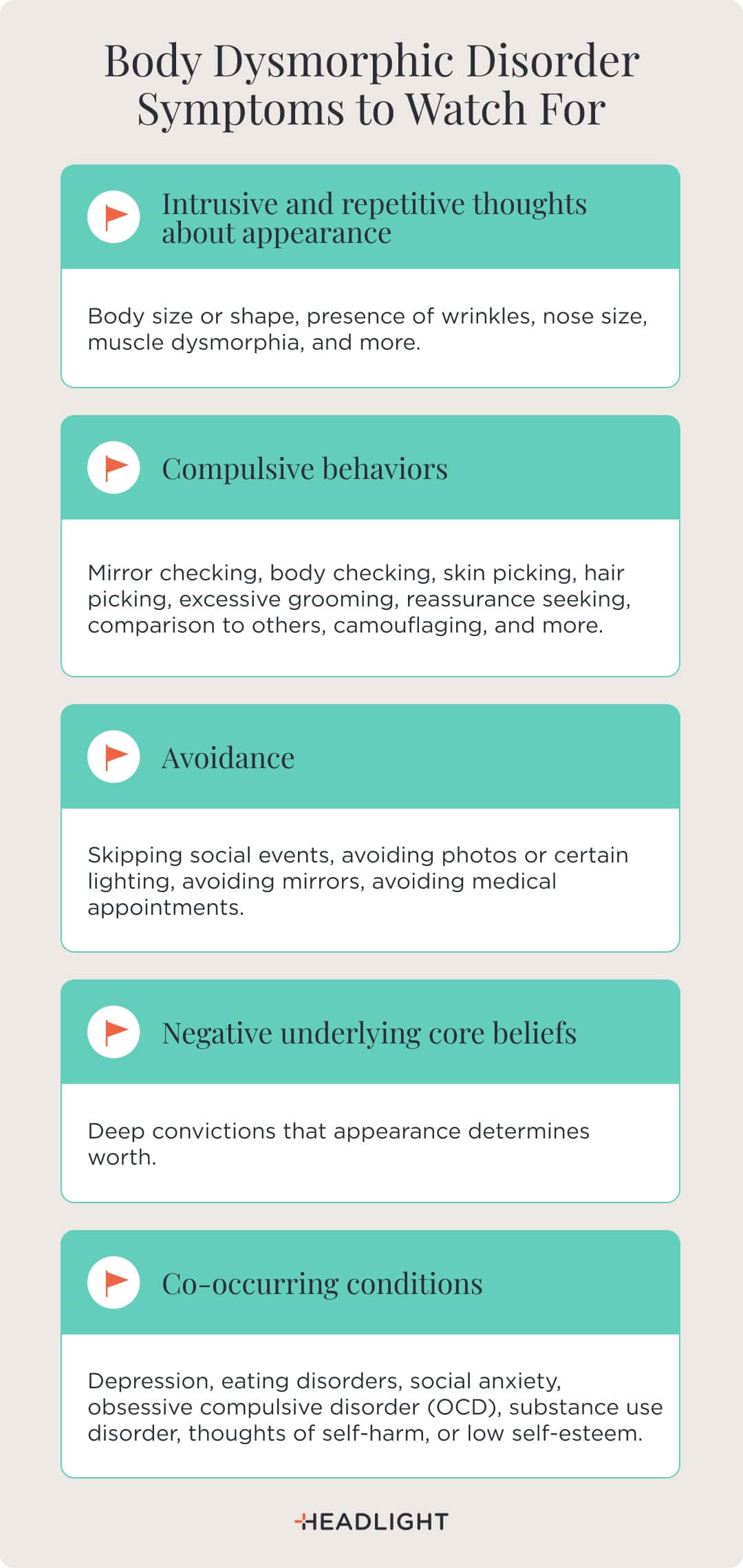
Body dysmorphic disorder symptoms can include:
- Intrusive and repetitive thoughts about appearance: Body size or shape, presence of wrinkles, nose size, muscle dysmorphia, and more.
- Compulsive behaviors: Mirror checking, body checking, skin picking, hair picking, excessive grooming, reassurance seeking, comparison to others, camouflaging (hiding the perceived “flaw,” for instance with makeup or clothing), and more.
- Avoidance: Skipping social events, avoiding photos or certain lighting, avoiding mirrors, avoiding medical appointments.
- Negative underlying core beliefs: Deep convictions that appearance determines worth, such as “my nose is big so people hate me” or “my skin is saggy so I’m unlovable” or “I am unworthy until my appearance improves.”
- Co-occurring conditions: Depression, eating disorders, social anxiety, obsessive compulsive disorder (OCD), substance use disorder, thoughts of self-harm, or low self-esteem.
Body dysmorphia treatment targets those symptoms and screens for co-occurring conditions, in a way that’s personalized to what the individual is dealing with.
Therapy for body dysmorphia: Cognitive behavioral therapy
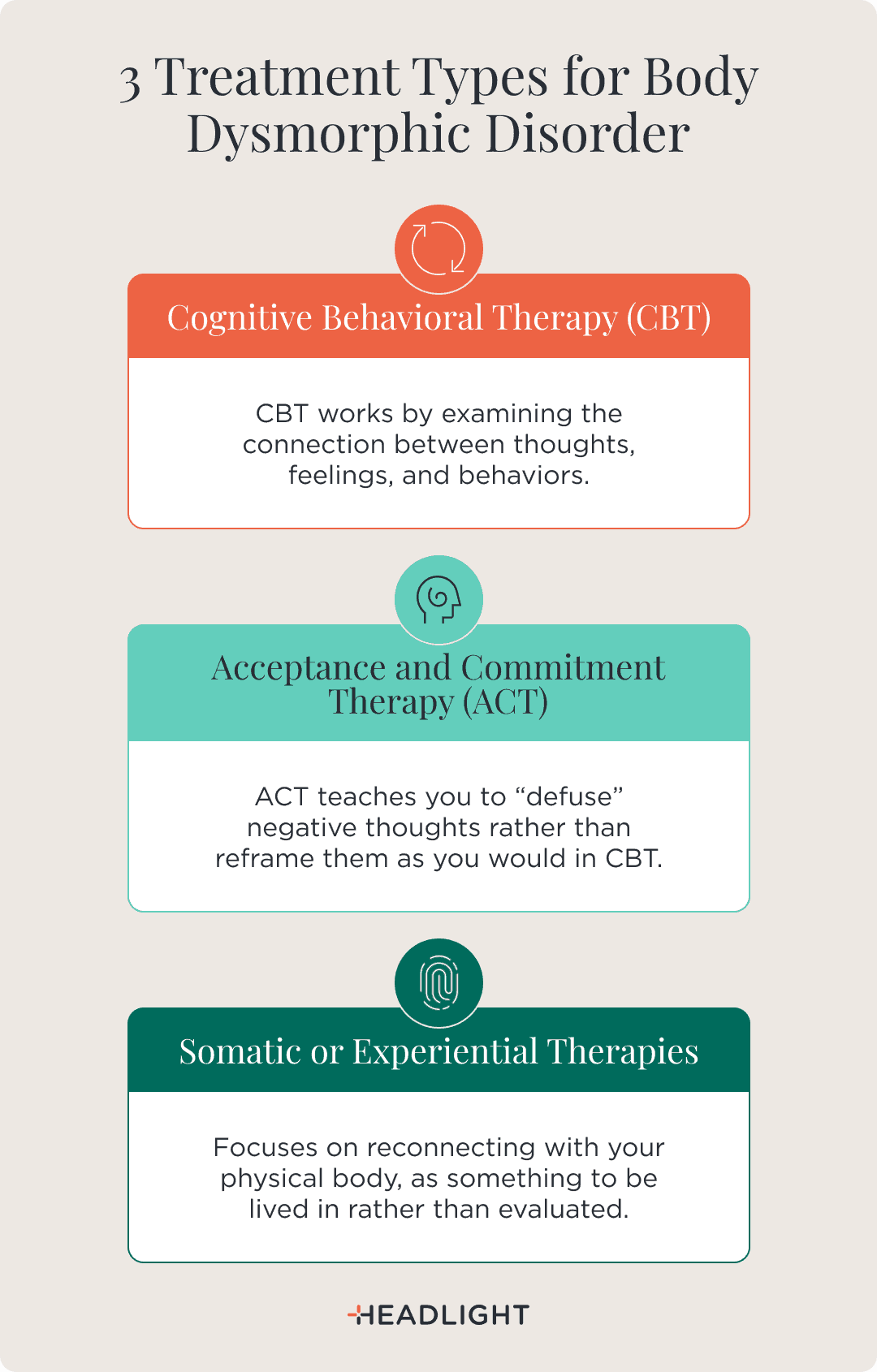
Cognitive behavioral therapy (CBT) is the primary therapy for body dysmorphia. But, what is CBT and how does it work? “At its core, [CBT] works by examining the connection between thoughts, feelings, and behaviors,” says Scherting.
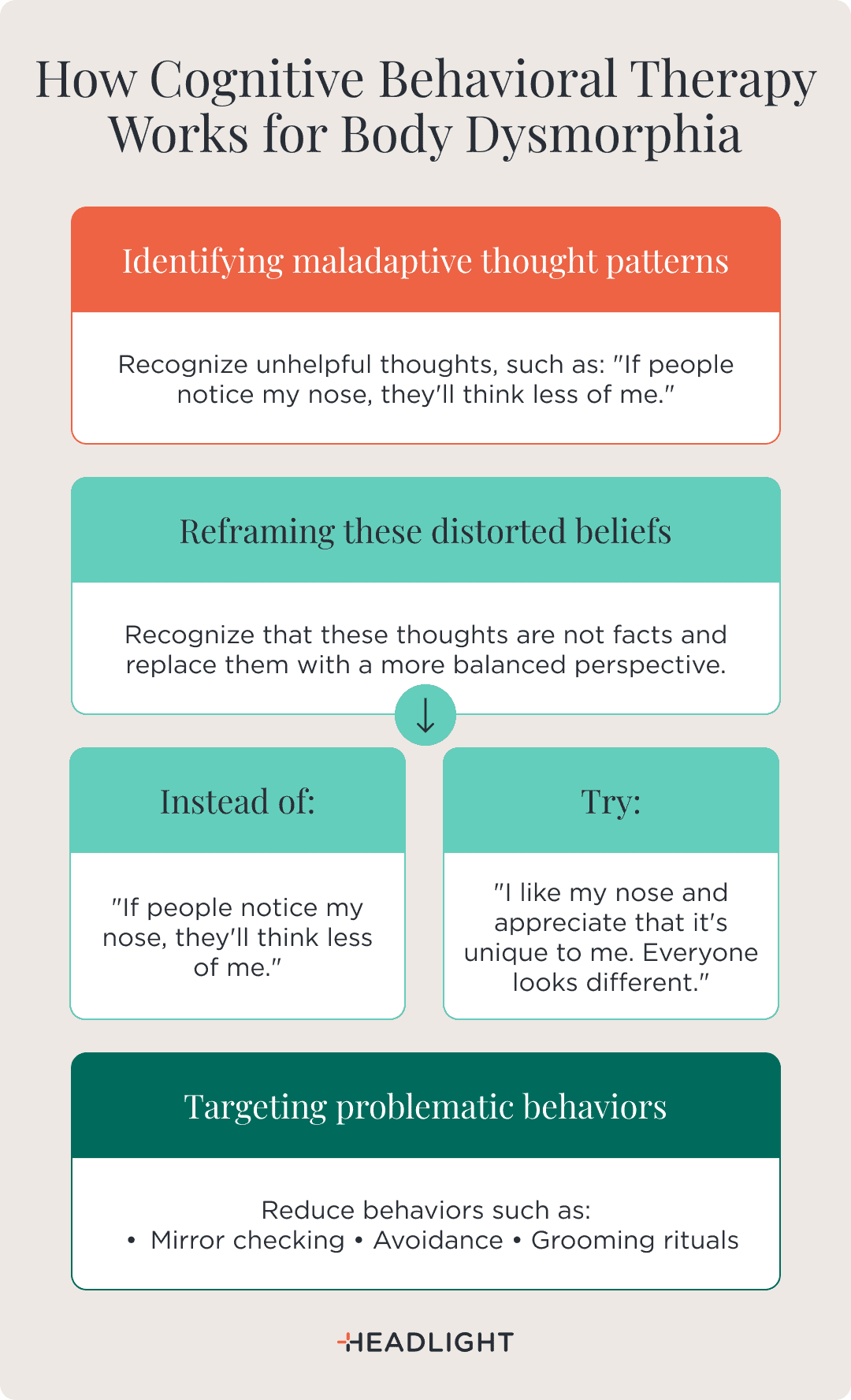
CBT for body dysmorphia focuses on:
- Identifying maladaptive thought patterns, such as “if people notice my nose, they’ll think less of me.”
- Reframing these distorted beliefs, and recognizing that they are not fact. Reframing can help a person shift how they feel, moving away from shame toward a more neutral or positive self-belief. For instance, “I like my nose and appreciate that it’s unique to me; everyone looks different.”
- Targeting problematic behaviors, such as mirror checking, avoidance, and grooming rituals. These behaviors may naturally change as the person learns to recognize their maladaptive thoughts. Or, they may be targeted more overtly through CBT techniques such as exposure and response prevention (ERP).
“As feelings shift, behavior tends to follow,” says Scherting. This might look like showing up to work meetings with more confidence, going on a first date without apologizing for how you look, or reducing the amount of time you spend combing your hair in the mirror.
Exposure and response prevention (ERP) for body dysmorphia
Exposure and response prevention (ERP) is especially useful for people with BDD, when the shift in feelings and awareness isn’t enough to nudge behaviors along. ERP exists under the broader umbrella of CBT, but it’s a specific technique your clinician will likely use to target compulsion and avoidance behaviors.
“The ‘exposure’ part means intentionally facing situations that activate distress, such as being in bright lighting or going out into public without camouflaging clothing,” explains Scherting.
Next up, ‘response prevention’ means abstaining from the urge to perform a compulsive behavior, such as checking yourself in a mirror or seeking reassurance, that would normally follow.
“Doing both together is what makes this approach effective,” says Scherting.
Exposure without response prevention will be far less effective. That’s because performing the compulsion (for instance, asking if you look okay or ducking into the nearest bathroom to check your skin) gives your brain some temporary relief, and prevents it from learning that the anxiety can naturally decrease on its own.
If this sounds overwhelming, take a deep breath (literally!). A big part of your therapist’s role here is to teach you mindfulness exercises and other healthy coping tools to support you in managing anxiety during the response prevention stage.
What CBT for BDD may include in practice
Understanding CBT’s definition and goals is one thing, but what does it actually look like in real life?
According to Scherting, CBT for body dysmorphia can look like:
- Going out in public without checking your reflection for a set period of time
- Standing in front of a mirror without scanning for flaws
- Looking into a mirror and naming areas of your body that you appreciate or like
- Attending a social event that you’d normally avoid, without seeking reassurance from anyone
- Posting an unedited photo online
- Sitting through a video call with the camera on
- Practicing non-engagement or mindfulness regarding intrusive thoughts
- Mentally reframing intrusive thoughts
Your therapist will also help you build a hierarchy of exposures, so that you can start out with situations that feel less scary, and work your way up from there.
“The part of treatment that feels hardest at the start, sitting with discomfort instead of checking or avoiding, is the heart of the work,” says Scherting. In her experience, most people find that anxiety peaks early on in treatment, and then comes down faster than expected (think weeks, not years).
“You don’t have to feel brave before you start,” she says. “You just have to be willing to take one small step and let the evidence build from there.”
Headlight can help you take the next step to feeling better, by matching you with a personalized therapist to support you on your BDD journey.
Body dysmorphic disorder medication options
Body dysmorphia can also be treated with medications, which may help reduce obsessive thoughts and behaviors as well as accompanying feelings of depression or anxiety.
According to Granet, some warning signs that medication may be needed to treat BDD include:
- Anxiety
- Depression
- Obsessive thinking about a body part(s)
- Related compulsive behaviors
- Social isolation
- Suicidal ideation
Selective serotonin reuptake inhibitors (SSRIs) are the first-line medication that’s usually prescribed for BDD. These include:
- Escitalopram
- Fluoxetine
- Sertraline
There are also some body dysmorphic disorder medications and treatments under investigation for cases of BDD that are more treatment-resistant, per experts in Current Neuropharmacology. These may be added to your existing regimen, or tried on their own, and include:
- Clomipramine, a tricyclic antidepressant
- Atypical antipsychotics
- Intranasal oxytocin
- Transcranial magnetic stimulation (TMS)
With medications, it may take four to 16 weeks to see symptom reduction, and side effects should be monitored. Typically, medication is a long-term treatment for BDD. Ultimately, the best medication and therapy combo will be individualized. In addition to therapy, Headlight can also help you with prescription mental health support.
Other treatments for body dysmorphic disorder
CBT and medications are effective at treating BDD, but they’re not the only treatments available.
Other evidence-based body dysmorphic disorder treatments include:
- Acceptance and Commitment Therapy (ACT): A type of value-driven therapy where you’re taught to “defuse” negative thoughts rather than reframe them, as you would in CBT.
- Somatic or experiential therapies: These types of therapy focus on reconnecting with your physical body, as something to be lived in rather than evaluated. This might involve a combination of psychoeducation (teaching you about your mind and body) and physical activities (such as hiking, dance, or sport).
For Scherting, who is in recovery from BDD herself, an experiential approach was especially helpful. Outdoor activities like running, hiking, and biking gave her small, repeated chances to shift her focus from evaluating her appearance to appreciating what her body was capable of and where it could take her.
Training to climb Mt. Baker in Washington State was a particularly formative part of this practice. “Trusting my body to carry me through long days asked something different of me than my appearance ever had,” she says. “My body wasn’t a project to be evaluated; it was a partner I depended on.”
By the time she reached the summit of Mt. Baker, she felt present in her body (rather than outside of it, watching and judging) in a way she hadn’t felt in years. “That feeling of empowerment didn’t erase the old thoughts overnight, but it gave me real, felt evidence that my body could be a source of strength and gratitude, rather than something to constantly manage,” she says.
What not to rely on as body dysmorphia treatment
Up to 40% of people with BDD seek cosmetic surgery to address their perceived “flaws,” per the International OCD Foundation. Sadly, these procedures rarely improve BDD and oftentimes actually worsen symptoms.
“One of the most tragic things I come across in my work is when someone has a procedure,” says Granet. “They typically don’t like the results and often wish the body part looked how it did previously, even though they hated it at the time.” This can start a cycle of corrective surgery, and worse: overwhelming shame and guilt.
Even in the rare instance where cosmetic procedures reduce the preoccupation, another body part tends to surface as the next BDD focus, explains Granet. “As I often say, a psychiatric problem can’t be fixed with surgery.”
There are also less invasive coping mechanisms that people with BDD tend to rely upon, such as:
- Seeking reassurance from loved ones
- Checking their body in mirrors
- Online researching spirals
- Excessively grooming themselves
- Avoiding social situations
Unsurprisingly, these also don’t fix the underlying problem. “At best [these] provide only temporary relief, though more often than not make someone feel even worse,” says Granet.
Supportive habits that can reinforce treatment
Treating BDD isn’t all about what not to do. There are plenty of new, healthy habits that you can replace your old, unhealthy coping mechanisms with.
Some supportive habits during BDD treatment include:
- Stay consistent with therapy sessions
- Engage with any homework given by your therapist
- Follow your medication plan
- Prioritize healthy habits like sleep, balanced meals, and stress reduction
- Reduce isolation by reaching out to family and friends
- Consider joining a BDD support group
- Journal to help track triggers, urges, and progress
- Pick up a new hobby or reengage with an old one
How loved ones can support someone with BDD
If your loved one is struggling with body dysmorphia, then it’s important that you don’t invalidate their concerns or feed into their reassurance cycles.
Instead of saying “you look great” or “nobody’s looking at you anyway,” you might ask them where these worries are coming from. Try to listen to their concerns, without dismissing or debating their perceived “flaw.”
When the moment is right, you can also encourage your loved one to seek therapy or support from a mental health professional. If the person is a teen or child, then involve their family if you’re worried for them.
Educating yourself on BDD, including its symptoms and treatment, is another key step. Just reading this article is a good starting point, but there are other useful resources like the International OCD Foundation’s dedicated BDD website.
Loving and supporting someone who’s living with BDD can also be challenging for your own mental health. “It can be frightening to watch a loved one suffer from this disorder, and there typically is a lot of confusion over how best to support the person,” says Granet.
You might consider enrolling in therapy for yourself, to help you cope. Headlight offers virtual and in-person therapy, and is here to help.
Frequently asked questions (FAQs)
Is body dysmorphia treatable?
Yes, body dysmorphia is treatable. Many people find relief from body dysmorphia symptoms with a combination of cognitive behavioral therapy (CBT) and medication.
What is the best therapy for body dysmorphia?
Cognitive behavioral therapy is the first-line therapy for body dysmorphia. A recent meta-analysis (the gold standard of research) in the Journal of Affective Disorders concluded that CBT can:
- Reduce the severity of BDD
- Reduce depression symptoms
- Reduce anxiety levels
- Contribute to remission of BDD
- Improve quality of life
Should cosmetic treatment be part of BDD treatment?
No, cosmetic treatment should not be part of BDD treatment because it acts as a band-aid rather than addressing the root problem. According to experts, most people with BDD who undergo cosmetic treatment experience regrets, shame, or guilt, or find another part of their body to obsess over. This simply delays treatment for the condition’s psychological causes, and can worsen symptoms in the meantime.
Is body dysmorphia or body dysmorphic disorder an eating disorder?
Body dysmorphic disorder (BDD) is not an eating disorder, but it can look similar to one, especially if the preoccupation focuses on body size or weight. If the person’s only concern is their size or weight, and they meet the criteria for an eating disorder, then an eating disorder would be diagnosed. If they don’t meet the full criteria (for example, obsessing over body appearance but not restricting or binging on food) then a BDD diagnosis would be more appropriate.
BDD and eating disorders can also co-occur, in which case the BDD symptoms would typically focus on a different aspect of appearance, for instance hair or skin rather than weight. This overlap and similarity is why a comprehensive mental health assessment, like you get with Headlight’s mental health services, is so important.